
钠-葡萄糖共转运蛋白抑制剂与钠-氢交换体 1 和 3 在心脏代谢疾病中的相互作用。
Crosstalk between Sodium-Glucose Cotransporter Inhibitors and Sodium-Hydrogen Exchanger 1 and 3 in Cardiometabolic Diseases.
机构信息
Department of Pharmaceutical Sciences, College of Pharmacy, QU Health, Qatar University, Doha P.O. Box 2713, Qatar.
Biomedical and Pharmaceutical Research Unit, QU Health, Qatar University, Doha P.O. Box 2713, Qatar.
出版信息
Int J Mol Sci. 2021 Nov 24;22(23):12677. doi: 10.3390/ijms222312677.
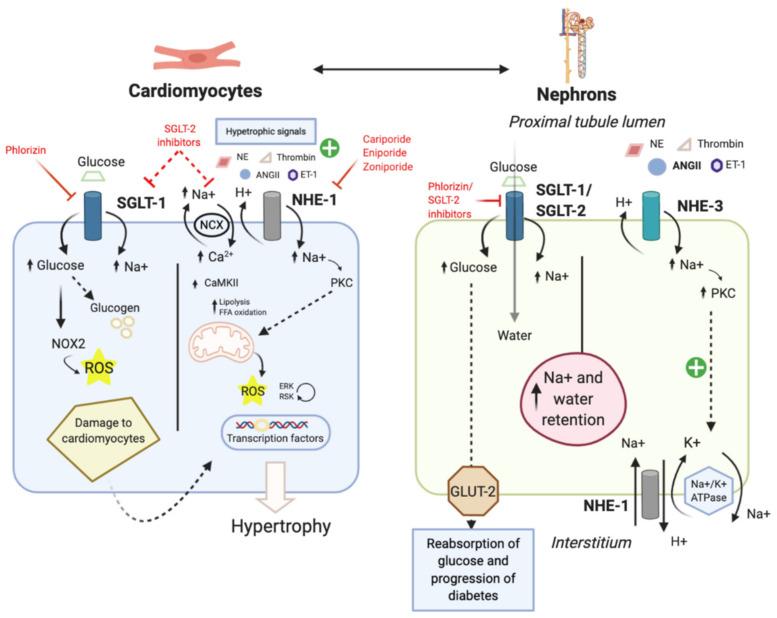
Abnormality in glucose homeostasis due to hyperglycemia or insulin resistance is the hallmark of type 2 diabetes mellitus (T2DM). These metabolic abnormalities in T2DM lead to cellular dysfunction and the development of diabetic cardiomyopathy leading to heart failure. New antihyperglycemic agents including glucagon-like peptide-1 receptor agonists and the sodium-glucose cotransporter-2 inhibitors (SGLT2i) have been shown to attenuate endothelial dysfunction at the cellular level. In addition, they improved cardiovascular safety by exhibiting cardioprotective effects. The mechanism by which these drugs exert their cardioprotective effects is unknown, although recent studies have shown that cardiovascular homeostasis occurs through the interplay of the sodium-hydrogen exchangers (NHE), specifically NHE1 and NHE3, with SGLT2i. Another theoretical explanation for the cardioprotective effects of SGLT2i is through natriuresis by the kidney. This theory highlights the possible involvement of renal NHE transporters in the management of heart failure. This review outlines the possible mechanisms responsible for causing diabetic cardiomyopathy and discusses the interaction between NHE and SGLT2i in cardiovascular diseases.
葡萄糖稳态异常导致的高血糖或胰岛素抵抗是 2 型糖尿病(T2DM)的标志。这些代谢异常导致细胞功能障碍和糖尿病心肌病的发展,进而导致心力衰竭。新型抗高血糖药物,包括胰高血糖素样肽-1 受体激动剂和钠-葡萄糖共转运蛋白-2 抑制剂(SGLT2i),已被证明可在细胞水平上减轻内皮功能障碍。此外,它们通过表现出心脏保护作用来改善心血管安全性。尽管最近的研究表明,心血管稳态是通过钠-氢交换器(NHE),特别是 NHE1 和 NHE3 与 SGLT2i 的相互作用来实现的,但这些药物发挥心脏保护作用的机制尚不清楚。SGLT2i 的心脏保护作用的另一个理论解释是通过肾脏排钠。这一理论强调了肾脏 NHE 转运体在心力衰竭管理中的可能作用。本文综述了导致糖尿病心肌病的可能机制,并讨论了 NHE 和 SGLT2i 在心血管疾病中的相互作用。


 Zotero 插件