
胸腺功能和 T 细胞受体库多样性:对患者对检查点阻断免疫治疗反应的影响。
Thymic Function and T-Cell Receptor Repertoire Diversity: Implications for Patient Response to Checkpoint Blockade Immunotherapy.
机构信息
Department of Pediatric Hematology and Oncology, Bambino Gesù Children's Hospital, Istituto di Ricovero e Cura a Carattere Scientifico (IRCCS), Rome, Italy.
Department of Maternal and Child Health, Sapienza University of Rome, Rome, Italy.
出版信息
Front Immunol. 2021 Nov 24;12:752042. doi: 10.3389/fimmu.2021.752042. eCollection 2021.
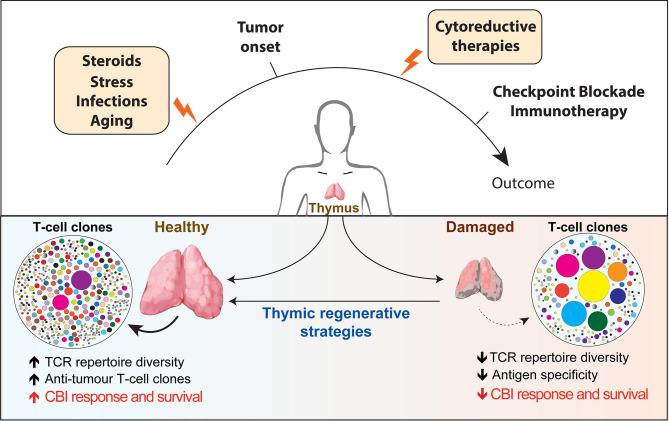
The capacity of T cells to recognize and mount an immune response against tumor antigens depends on the large diversity of the T-cell receptor (TCR) repertoire generated in the thymus during the process of T-cell development. However, this process is dramatically impaired by immunological insults, such as that caused by cytoreductive cancer therapies and infections, and by the physiological decline of thymic function with age. Defective thymic function and a skewed TCR repertoire can have significant clinical consequences. The presence of an adequate pool of T cells capable of recognizing specific tumor antigens is a prerequisite for the success of cancer immunotherapy using checkpoint blockade therapy. However, while this approach has improved the chances of survival of patients with different types of cancer, a large proportion of them do not respond. The limited response rate to checkpoint blockade therapy may be linked to a suboptimal TCR repertoire in cancer patients prior to therapy. Here, we focus on the role of the thymus in shaping the T-cell pool in health and disease, discuss how the TCR repertoire influences patients' response to checkpoint blockade therapy and highlight approaches able to manipulate thymic function to enhance anti-tumor immunity.
T 细胞识别和对肿瘤抗原产生免疫反应的能力取决于在 T 细胞发育过程中胸腺中产生的 T 细胞受体 (TCR) 库的巨大多样性。然而,这个过程会受到免疫损伤的显著影响,如细胞减少性癌症治疗和感染引起的损伤,以及随着年龄增长胸腺功能的生理性下降。胸腺功能缺陷和 TCR 库偏倚会产生重大的临床后果。存在能够识别特定肿瘤抗原的足够数量的 T 细胞是使用检查点阻断疗法进行癌症免疫治疗成功的前提。然而,尽管这种方法提高了不同类型癌症患者的生存机会,但其中很大一部分患者没有反应。检查点阻断疗法的反应率有限可能与治疗前癌症患者的 TCR 库不理想有关。在这里,我们专注于胸腺在塑造健康和疾病中的 T 细胞库中的作用,讨论 TCR 库如何影响患者对检查点阻断疗法的反应,并强调能够操纵胸腺功能以增强抗肿瘤免疫的方法。
 Zotero 插件