
OM-85 细菌裂解物通过下调 SARS-CoV-2 受体表达来抑制上皮细胞中的 SARS-CoV-2 感染。
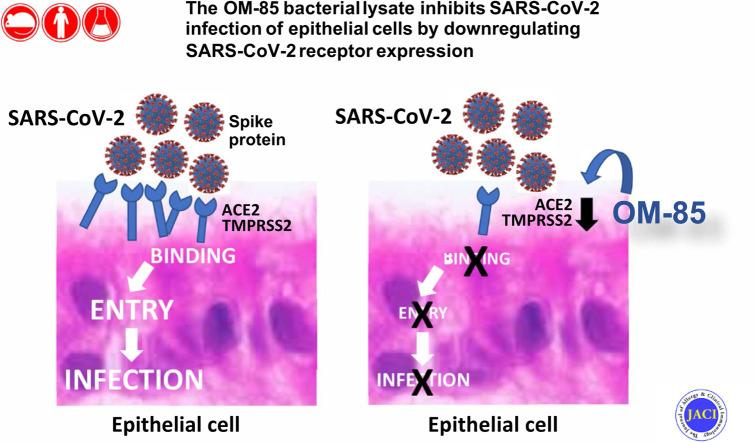
The OM-85 bacterial lysate inhibits SARS-CoV-2 infection of epithelial cells by downregulating SARS-CoV-2 receptor expression.
机构信息
Department of Cellular and Molecular Medicine, The University of Arizona, Tucson, Ariz; Asthma and Airway Disease Research Center, The University of Arizona, Tucson, Ariz; BIO5 Institute, The University of Arizona, Tucson, Ariz.
Asthma and Airway Disease Research Center, The University of Arizona, Tucson, Ariz.
出版信息
J Allergy Clin Immunol. 2022 Mar;149(3):923-933.e6. doi: 10.1016/j.jaci.2021.11.019. Epub 2021 Dec 10.
BACKGROUND
Treatments for coronavirus disease 2019, which is caused by severe acute respiratory syndrome coronavirus-2 (SARS-CoV-2), are urgently needed but remain limited. SARS-CoV-2 infects cells through interactions of its spike (S) protein with angiotensin-converting enzyme 2 (ACE2) and transmembrane protease serine 2 (TMPRSS2) on host cells. Multiple cells and organs are targeted, particularly airway epithelial cells. OM-85, a standardized lysate of human airway bacteria with strong immunomodulating properties and an impeccable safety profile, is widely used to prevent recurrent respiratory infections. We found that airway OM-85 administration inhibits Ace2 and Tmprss2 transcription in the mouse lung, suggesting that OM-85 might hinder SARS-CoV-2/host cell interactions.
OBJECTIVES
We sought to investigate whether and how OM-85 treatment protects nonhuman primate and human epithelial cells against SARS-CoV-2.
METHODS
ACE2 and TMPRSS2 mRNA and protein expression, cell binding of SARS-CoV-2 S1 protein, cell entry of SARS-CoV-2 S protein-pseudotyped lentiviral particles, and SARS-CoV-2 cell infection were measured in kidney, lung, and intestinal epithelial cell lines, primary human bronchial epithelial cells, and ACE2-transfected HEK293T cells treated with OM-85 in vitro.
RESULTS
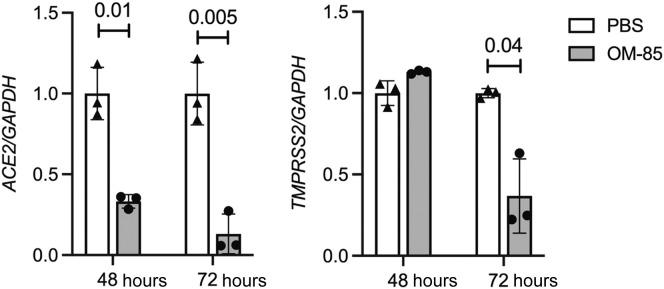
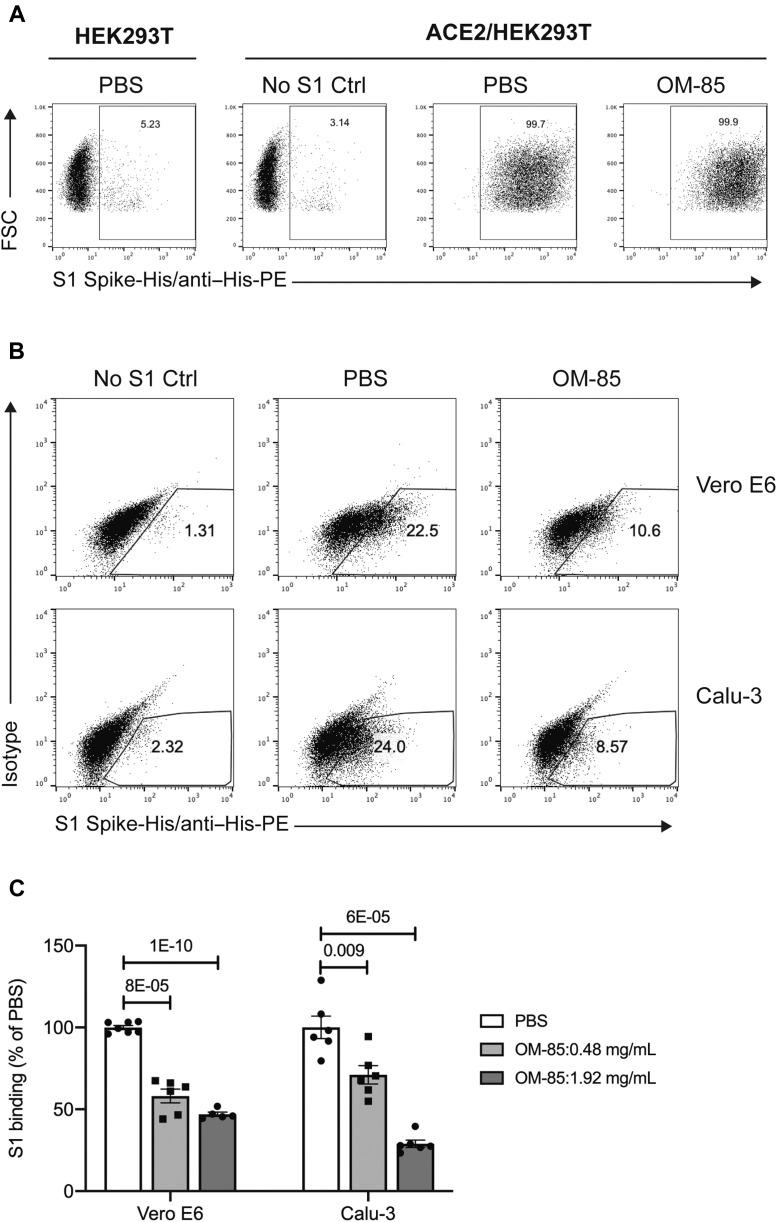
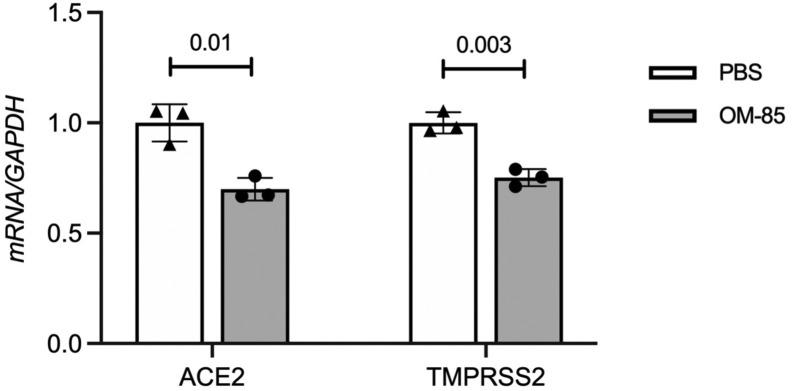
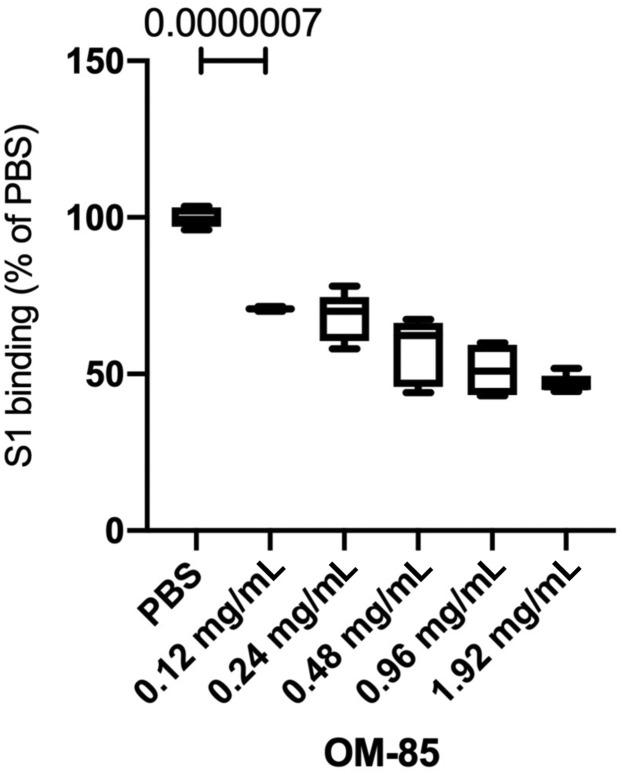
OM-85 significantly downregulated ACE2 and TMPRSS2 transcription and surface ACE2 protein expression in epithelial cell lines and primary bronchial epithelial cells. OM-85 also strongly inhibited SARS-CoV-2 S1 protein binding to, SARS-CoV-2 S protein-pseudotyped lentivirus entry into, and SARS-CoV-2 infection of epithelial cells. These effects of OM-85 appeared to depend on SARS-CoV-2 receptor downregulation.
CONCLUSIONS
OM-85 inhibits SARS-CoV-2 epithelial cell infection in vitro by downregulating SARS-CoV-2 receptor expression. Further studies are warranted to assess whether OM-85 may prevent and/or reduce the severity of coronavirus disease 2019.
背景
由严重急性呼吸系统综合征冠状病毒 2 型(SARS-CoV-2)引起的 2019 年冠状病毒病(COVID-19)的治疗方法急需,但仍然有限。SARS-CoV-2 通过其刺突(S)蛋白与宿主细胞上的血管紧张素转换酶 2(ACE2)和跨膜蛋白酶丝氨酸 2(TMPRSS2)的相互作用感染细胞。多种细胞和器官受到影响,特别是气道上皮细胞。OM-85 是一种具有强大免疫调节特性和无可挑剔的安全特性的人呼吸道细菌标准化裂解物,被广泛用于预防复发性呼吸道感染。我们发现气道 OM-85 给药可抑制小鼠肺中的 Ace2 和 Tmprss2 转录,这表明 OM-85 可能阻碍 SARS-CoV-2/宿主细胞相互作用。
目的
我们试图研究 OM-85 治疗是否以及如何保护非人类灵长类动物和人上皮细胞免受 SARS-CoV-2 感染。
方法
在体外,通过测量肾、肺和肠上皮细胞系、原代人支气管上皮细胞和转染 ACE2 的 HEK293T 细胞中 ACE2 和 TMPRSS2 mRNA 和蛋白表达、SARS-CoV-2 S1 蛋白的细胞结合、SARS-CoV-2 S 蛋白假型慢病毒颗粒的细胞进入以及 SARS-CoV-2 细胞感染,来评估 OM-85 处理对 ACE2 和 TMPRSS2 转录、上皮细胞表面 ACE2 蛋白表达的影响。
结果
OM-85 可显著下调上皮细胞系和原代支气管上皮细胞中的 ACE2 和 TMPRSS2 转录和表面 ACE2 蛋白表达。OM-85 还强烈抑制 SARS-CoV-2 S1 蛋白与、SARS-CoV-2 S 蛋白假型慢病毒进入和 SARS-CoV-2 感染上皮细胞。OM-85 的这些作用似乎取决于 SARS-CoV-2 受体下调。
结论
OM-85 通过下调 SARS-CoV-2 受体表达来抑制 SARS-CoV-2 在上皮细胞中的感染。进一步的研究需要评估 OM-85 是否可以预防和/或减轻 COVID-19 的严重程度。






 Zotero 插件