
高身体质量指数在多种慢性病中的因果作用:孟德尔随机化研究的系统评价和荟萃分析。
Causal role of high body mass index in multiple chronic diseases: a systematic review and meta-analysis of Mendelian randomization studies.
机构信息
Unit of Medical Epidemiology, Department of Surgical Sciences, Uppsala University, Uppsala, Sweden.
Unit of Cardiovascular and Nutritional Epidemiology, Institute of Environmental Medicine, Karolinska Institutet, Stockholm, Sweden.
出版信息
BMC Med. 2021 Dec 15;19(1):320. doi: 10.1186/s12916-021-02188-x.
BACKGROUND
Obesity is a worldwide epidemic that has been associated with a plurality of diseases in observational studies. The aim of this study was to summarize the evidence from Mendelian randomization (MR) studies of the association between body mass index (BMI) and chronic diseases.
METHODS
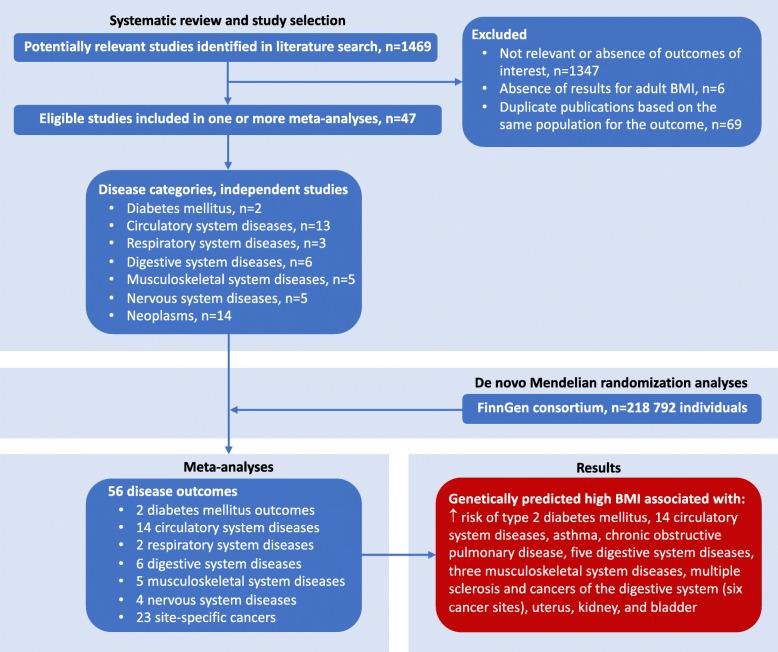
PubMed and Embase were searched for MR studies on adult BMI in relation to major chronic diseases, including diabetes mellitus; diseases of the circulatory, respiratory, digestive, musculoskeletal, and nervous systems; and neoplasms. A meta-analysis was performed for each disease by using results from published MR studies and corresponding de novo analyses based on summary-level genetic data from the FinnGen consortium (n = 218,792 individuals).
RESULTS
In a meta-analysis of results from published MR studies and de novo analyses of the FinnGen consortium, genetically predicted higher BMI was associated with increased risk of type 2 diabetes mellitus, 14 circulatory disease outcomes, asthma, chronic obstructive pulmonary disease, five digestive system diseases, three musculoskeletal system diseases, and multiple sclerosis as well as cancers of the digestive system (six cancer sites), uterus, kidney, and bladder. In contrast, genetically predicted higher adult BMI was associated with a decreased risk of Dupuytren's disease, osteoporosis, and breast, prostate, and non-melanoma cancer, and not associated with Alzheimer's disease, amyotrophic lateral sclerosis, or Parkinson's disease.
CONCLUSIONS
The totality of the evidence from MR studies supports a causal role of excess adiposity in a plurality of chronic diseases. Hence, continued efforts to reduce the prevalence of overweight and obesity are a major public health goal.
背景
肥胖是一种全球性的流行疾病,与多种疾病有关,这在观察性研究中已经得到了证实。本研究旨在总结孟德尔随机化(MR)研究中关于体重指数(BMI)与慢性疾病之间关联的证据。
方法
在 PubMed 和 Embase 中检索了关于成人 BMI 与主要慢性疾病(包括糖尿病;循环、呼吸、消化、肌肉骨骼和神经系统疾病;以及肿瘤)关系的 MR 研究。采用来自已发表的 MR 研究的结果以及基于 FinnGen 联盟汇总水平遗传数据的新分析(n=218792 人)对每种疾病进行荟萃分析。
结果
在对已发表的 MR 研究结果和 FinnGen 联盟的新分析进行的荟萃分析中,遗传预测的较高 BMI 与 2 型糖尿病、14 种循环系统疾病结局、哮喘、慢性阻塞性肺疾病、五种消化系统疾病、三种肌肉骨骼系统疾病以及多发性硬化症以及消化系统癌症(六个癌症部位)、子宫、肾脏和膀胱的风险增加有关。相比之下,遗传预测的较高成人 BMI 与 Dupuytren 病、骨质疏松症和乳腺癌、前列腺癌和非黑色素瘤癌症的风险降低有关,而与阿尔茨海默病、肌萎缩侧索硬化症或帕金森病无关。
结论
MR 研究的总体证据支持超重和肥胖与多种慢性疾病之间存在因果关系。因此,继续努力降低超重和肥胖的流行率是一个主要的公共卫生目标。



 Zotero 插件