
含呋喃嘧啶酮席夫碱的合成及其对锌的选择性识别研究及其在细胞成像和铜检测中的应用
Synthesis and Discovery of Schiff Base Bearing Furopyrimidinone for Selective Recognition of Zn and its Applications in Cell Imaging and Detection of Cu.
作者信息
Hu Yanggen, Luo Chao, Gui Lili, Lu Jing, Fu Juncai, Han Xinya, Ma Junkai, Luo Lun
机构信息
Hubei Key Laboratory of Wudang Local Chinese Medicine, School of Pharmaceutical Sciences, Hubei University of Medicine, Shiyan, China.
Institute of Biomedicine, Hubei University of Medicine, Shiyan, China.
出版信息
Front Chem. 2021 Nov 29;9:774090. doi: 10.3389/fchem.2021.774090. eCollection 2021.
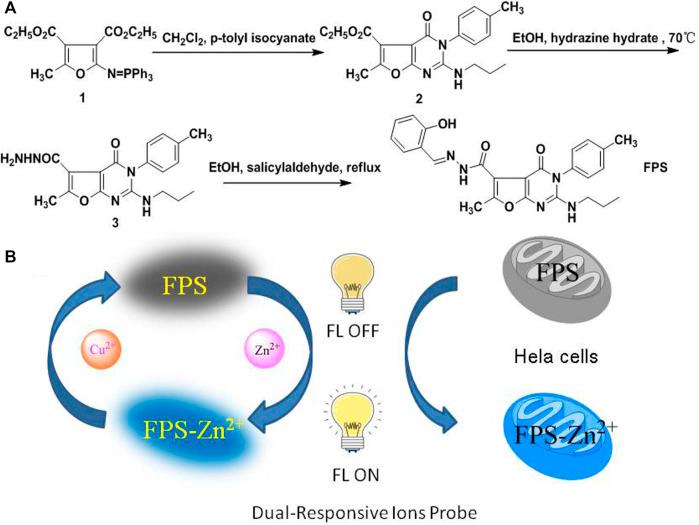
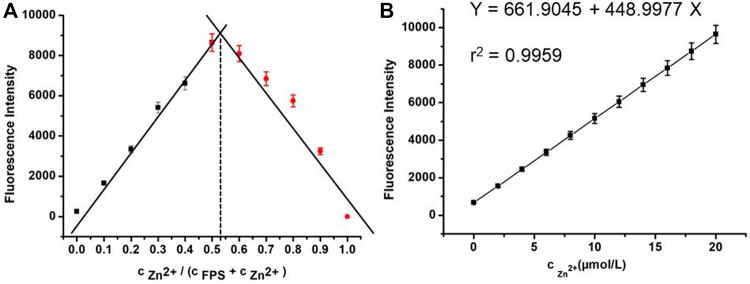
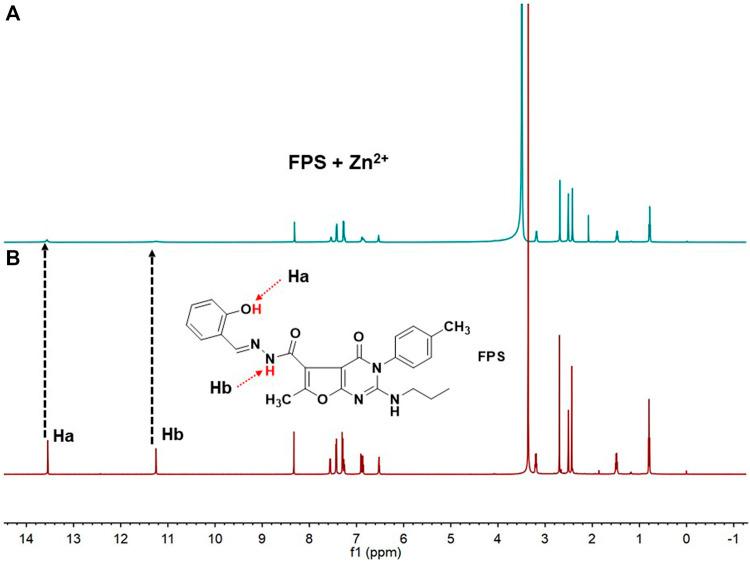
A simplefuro [2,3-d]pyrimidinone-based Schiff base FPS was synthesized via aza-Wittig reaction and structure elucidation was carried out by spectroscopic studies FT-IR, 1H NMR, and 13C NMR and mass spectrometry. FPS showed weak fluorescence emission in methanol and the selectivity of FPS to different metal ions (Mn, Ca, Fe, Fe, Mg, Al, Ba, Ag, Co, Na, K, Cu, Zn, Pb, Bi) were studied by absorption and fluorescence titration. The results show that FPS has selective fluorescence sensing behavior for Zn ions and the limit of detection (LOD) was calculated to be 1.19 × 10 mol/L. Moreover, FPS-Zn acts as a metal based highly selective and sensitive new chemosensor for Cu ions and the LOD was calculated to be 2.25 × 10 mol/L. In accordance with the results and theoretical calculations, we suspected that the binding mechanisms of FPS to Zn and Cu were assigned to be the cooperative interaction of Zn(Cu)-N.
通过氮杂维蒂希反应合成了一种基于呋喃并[2,3 - d]嘧啶酮的席夫碱FPS,并通过傅里叶变换红外光谱(FT - IR)、核磁共振氢谱(1H NMR)、核磁共振碳谱(13C NMR)和质谱等光谱研究进行了结构解析。FPS在甲醇中显示出微弱的荧光发射,并通过吸收和荧光滴定研究了FPS对不同金属离子(锰、钙、铁、铁、镁、铝、钡、银、钴、钠、钾、铜、锌、铅、铋)的选择性。结果表明,FPS对锌离子具有选择性荧光传感行为,计算得出检测限(LOD)为1.19×10⁻⁶ mol/L。此外,FPS - Zn对铜离子作为一种基于金属的高选择性和灵敏的新型化学传感器,计算得出LOD为2.25×10⁻⁶ mol/L。根据结果和理论计算,我们推测FPS与锌和铜的结合机制归因于Zn(Cu) - N的协同相互作用。







 Zotero 插件