
泽布替尼治疗初治和复发/难治性慢性淋巴细胞白血病:I/II 期 AU-003 研究的长期随访。
Zanubrutinib for treatment-naïve and relapsed/refractory chronic lymphocytic leukaemia: long-term follow-up of the phase I/II AU-003 study.
机构信息
Sir Charles Gairdner Hospital, Perth, WA, Australia.
University of Western Australia, Perth, WA, Australia.
出版信息
Br J Haematol. 2022 Mar;196(5):1209-1218. doi: 10.1111/bjh.17994. Epub 2021 Dec 16.
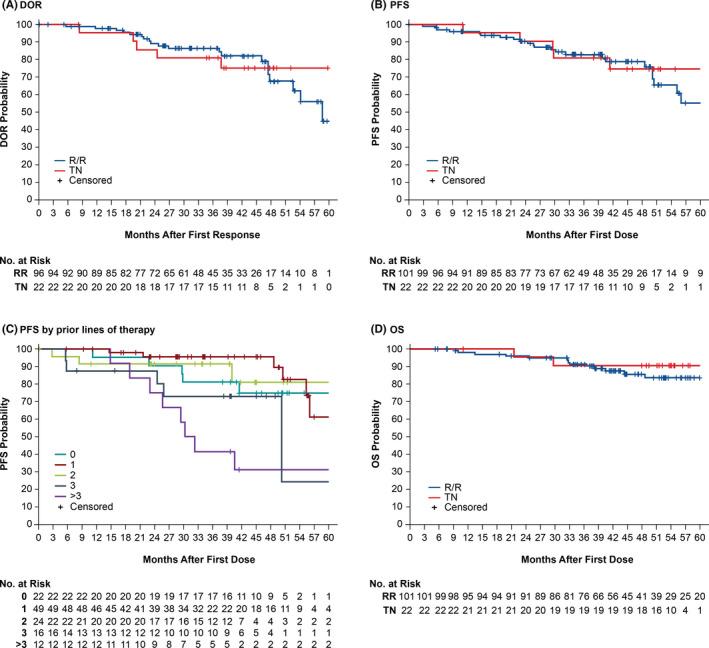
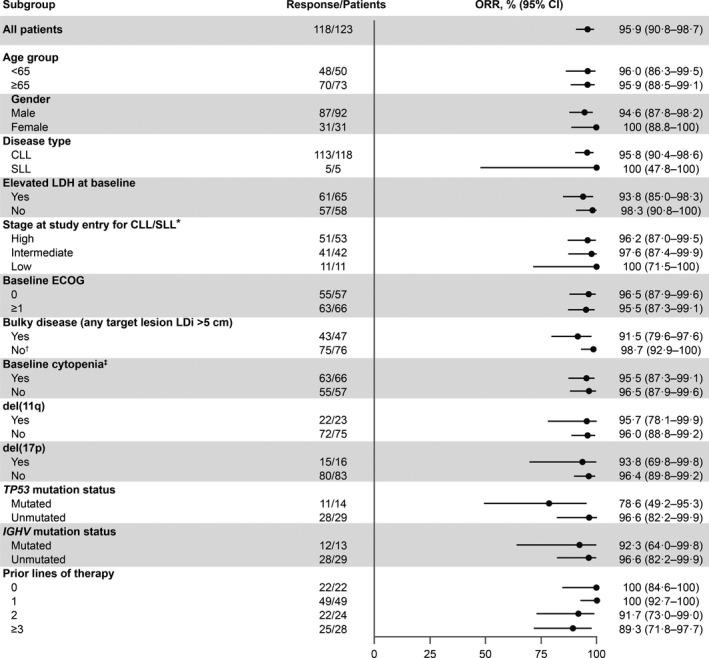
The phase I/II AU-003 study in patients with treatment-naïve (TN) or relapsed/refractory (R/R) chronic lymphocytic leukaemia/small lymphocytic lymphoma demonstrated that zanubrutinib therapy results in clinically meaningful and durable responses with acceptable safety and tolerability. We report updated safety and efficacy data for 123 patients with a median follow-up of 47·2 months. Patients received zanubrutinib 160 mg twice daily (81 patients), 320 mg once daily (40), or 160 mg once daily (two). Discontinuations due to adverse events or disease progression were uncommon. The overall response rate (ORR) was 95·9% (TN, 100%; R/R, 95%) with 18·7% achieving complete response (CR). Ongoing response at 3 years was reported in 85·7%. The ORR in patients with del(17p)/tumour protein p53 mutation was 87·5% (CR 16·7%). The 2- and 3-year progression-free survival estimates were 90% (TN, 90%; R/R, 91%) and 83% (TN, 81%; R/R, 83%) respectively. The most reported Grade ≥3 adverse events were neutropenia (15·4%), pneumonia (9·8%), hypertension (8·9%) and anaemia (6·5%). The annual incidence of atrial fibrillation, major haemorrhage, Grade ≥3 neutropenia and Grade ≥3 infection decreased over time. With a median follow-up of ~4 years, responses remain clinically meaningful and durable and long-term tolerability to zanubrutinib therapy continues.
AU-003 期 I/II 研究纳入了初治(TN)或复发/难治(R/R)慢性淋巴细胞白血病/小淋巴细胞淋巴瘤患者,结果表明,泽布替尼治疗可带来具有临床意义且持久的缓解,且安全性和耐受性可接受。我们报告了中位随访时间为 47.2 个月的 123 例患者的更新安全性和疗效数据。患者接受泽布替尼 160mg,每日 2 次(81 例)、320mg,每日 1 次(40 例)或 160mg,每日 1 次(2 例)。因不良事件或疾病进展而停药的情况并不常见。总缓解率(ORR)为 95.9%(TN 为 100%,R/R 为 95%),其中 18.7%达到完全缓解(CR)。3 年时持续缓解率为 85.7%。del(17p)/肿瘤蛋白 p53 突变患者的 ORR 为 87.5%(CR 为 16.7%)。2 年和 3 年无进展生存率估计值分别为 90%(TN 为 90%,R/R 为 91%)和 83%(TN 为 81%,R/R 为 83%)。最常见的≥3 级不良事件为中性粒细胞减少症(15.4%)、肺炎(9.8%)、高血压(8.9%)和贫血(6.5%)。心房颤动、大出血、≥3 级中性粒细胞减少症和≥3 级感染的年发生率随时间推移而降低。中位随访时间约为 4 年后,缓解仍具有临床意义且持久,泽布替尼治疗的长期耐受性持续。
 Zotero 插件