
用于阳性血培养的内部快速抗菌药敏试验方案的开发及其在常规微生物实验室中的实施
Development of an In-House Rapid Antimicrobial Susceptibility Testing Protocol for Positive Blood Culture and Its Implementation in Routine Microbiology Laboratories.
作者信息
Cao Min, Huang Lin, Hu Yanyan, Fang Yinfei, Zhang Rong, Chen Gongxiang
机构信息
Department of Clinical Microbiology, The Second Affiliated Hospital of Zhejiang University School of Medicine, Hangzhou, China.
Department of Clinical Microbiology, Affiliated Jinhua Hospital, Zhejiang University School of Medicine, Jinhua, China.
出版信息
Front Microbiol. 2021 Nov 30;12:765757. doi: 10.3389/fmicb.2021.765757. eCollection 2021.
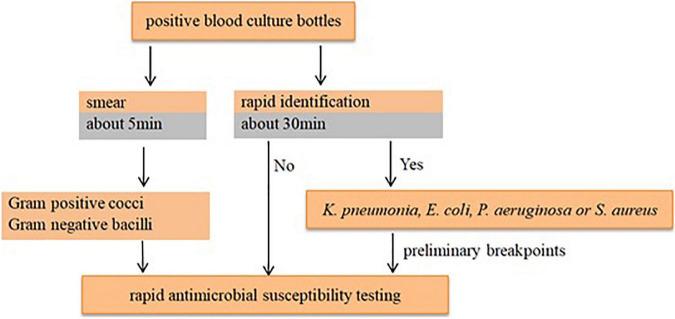
Bloodstream infections (BSI) are associated with high morbidity and mortality and remain a leading cause of death. Blood culture (BC) including the identification and the antimicrobial susceptibility testing of the causative microorganisms should be performed as soon as possible. In this study, we developed an in-house rapid antimicrobial susceptibility testing (rAST) protocol for positive BC. First, the rAST was performed in the simulated positive BC of standard strains ( ATCC 25922, ATCC 25923, and ATCC 27853) at three different times to assess the reproducibility and operability by dispensing four drops of BC broth onto a Mueller-Hinton agar plate after a positive signal. Furthermore, the rAST was performed in clinical positive BCs. The results of rAST at 4, 6, 8, and 18 h of incubation were compared with results of the standard 16- to 20-h disk diffusion method, and the preliminary breakpoints of the rAST method were established according to the inhibition diameter of sensitive strains and resistant strains. Finally, the rAST was performed in the simulated positive BC of clinical strains to evaluate the availability of the preliminary breakpoints. The rAST results of standard strains were distributed evenly at three different times. Among the 202 clinical strains used to establish the preliminary breakpoints, the number of zone diameters that could be read and interpreted (60, 87, 98, and 100%) increased with incubation time (4, 6, 8, and 18 h), and the categorical agreement was acceptable, with total error rates of 3.0, 2.3, 2.1, and 1.3% at 4, 6, 8, and 18 h of incubation, respectively. In conclusion, the in-house rAST protocol for positive BC can be implemented in routine laboratories. It provides reliable antimicrobial susceptibility testing results for BSI pathogens after 4-6 h of incubation.
血流感染(BSI)与高发病率和死亡率相关,仍然是主要的死亡原因。应尽快进行血培养(BC),包括对致病微生物进行鉴定和药敏试验。在本研究中,我们针对阳性血培养开发了一种内部快速药敏试验(rAST)方案。首先,在三个不同时间点对标准菌株(ATCC 25922、ATCC 25923和ATCC 27853)的模拟阳性血培养进行rAST,在出现阳性信号后,将四滴血培养肉汤滴加到穆勒-欣顿琼脂平板上,以评估其重现性和可操作性。此外,还对临床阳性血培养进行了rAST。将培养4、6、8和18小时的rAST结果与标准的16至20小时纸片扩散法结果进行比较,并根据敏感菌株和耐药菌株的抑菌直径确定rAST方法的初步断点。最后,在临床菌株的模拟阳性血培养中进行rAST,以评估初步断点的可用性。标准菌株的rAST结果在三个不同时间点分布均匀。在用于确定初步断点的202株临床菌株中,随着培养时间(4、6、8和18小时)的延长,可读取和解释的抑菌圈直径数量(分别为60%、87%、98%和100%)增加,分类一致性可接受,在培养4、6、8和18小时时的总错误率分别为3.0%、2.3%、2.1%和1.3%。总之,针对阳性血培养的内部rAST方案可在常规实验室中实施。它在培养4至6小时后可为血流感染病原体提供可靠的药敏试验结果。

 Zotero 插件