
抗血管内皮生长因子治疗年龄相关性黄斑变性:系统评价和网络荟萃分析。
Anti-vascular endothelial growth factor therapy for age-related macular degeneration: a systematic review and network meta-analysis.
机构信息
Knowledge Translation Program, Li Ka Shing Knowledge Institute, St. Michael's Hospital, Unity Health Toronto, 209 Victoria Street, East Building, Toronto, ON, M5B 1T8, Canada.
Epidemiology Division and Institute for Health Policy, Management, and Evaluation, Dalla Lana School of Public Health, University of Toronto, 155 College St Room 500, Toronto, Ontario, M5T 3M7, Canada.
出版信息
Syst Rev. 2021 Dec 20;10(1):315. doi: 10.1186/s13643-021-01864-6.
BACKGROUND
The comparative safety and efficacy between anti-vascular endothelial growth factor agents (anti-VEGFs) and between combined therapies for patients with neovascular age-related macular degeneration (nAMD) is unclear. We conducted a systematic review to examine the comparative safety and efficacy anti-VEGFs for adults with nAMD.
METHODS
Studies were identified through MEDLINE, EMBASE, and Cochrane CENTRAL (inception to June 3, 2019), grey literature, and scanning reference lists. Two reviewers independently screened citations and full-text articles to identify randomized controlled trials (RCTs), extracted data, and appraised risk of bias. Pairwise random-effects meta-analysis and Bayesian network meta-analysis (NMA) were conducted. The primary outcomes were the proportion of patients experiencing moderate vision gain (≥ 15 letters on the Early Treatment Diabetic Retinopathy Study chart) and the proportion of patients experiencing moderate vision loss (≤ 15 letters).
RESULTS
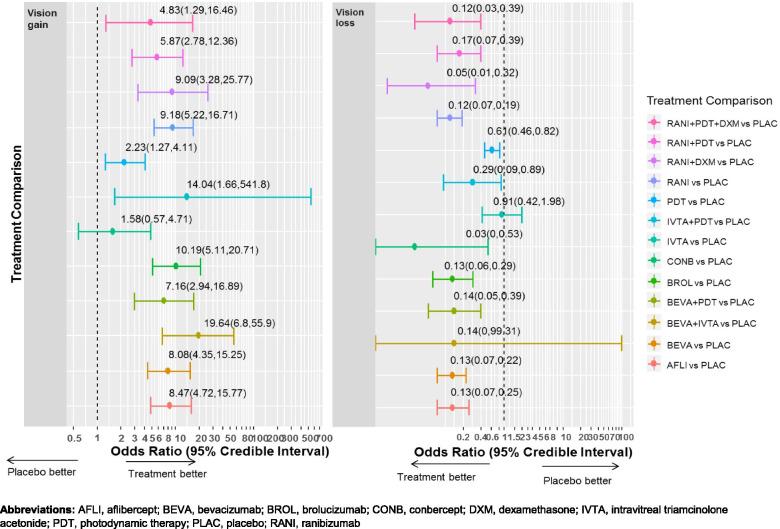
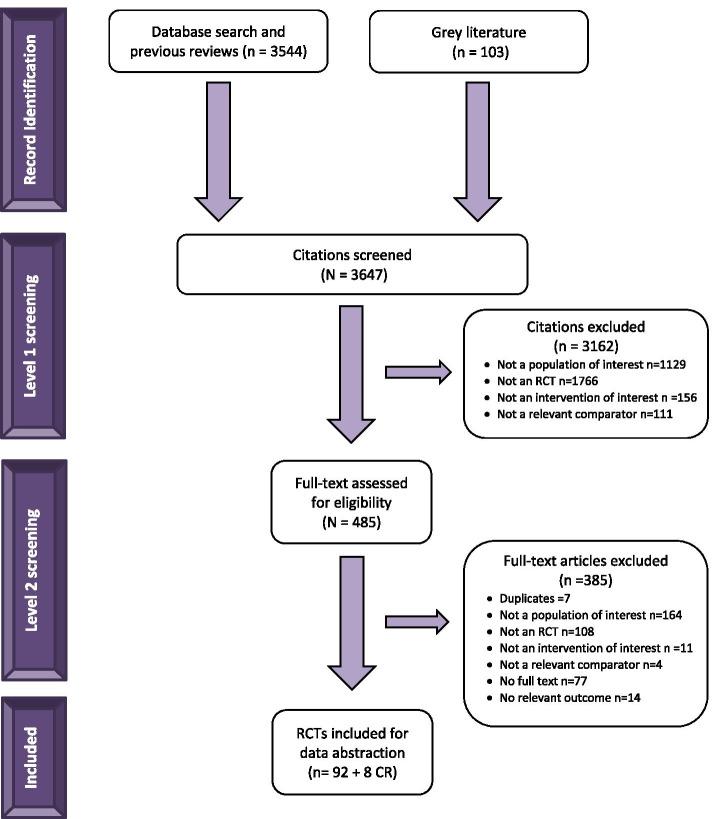
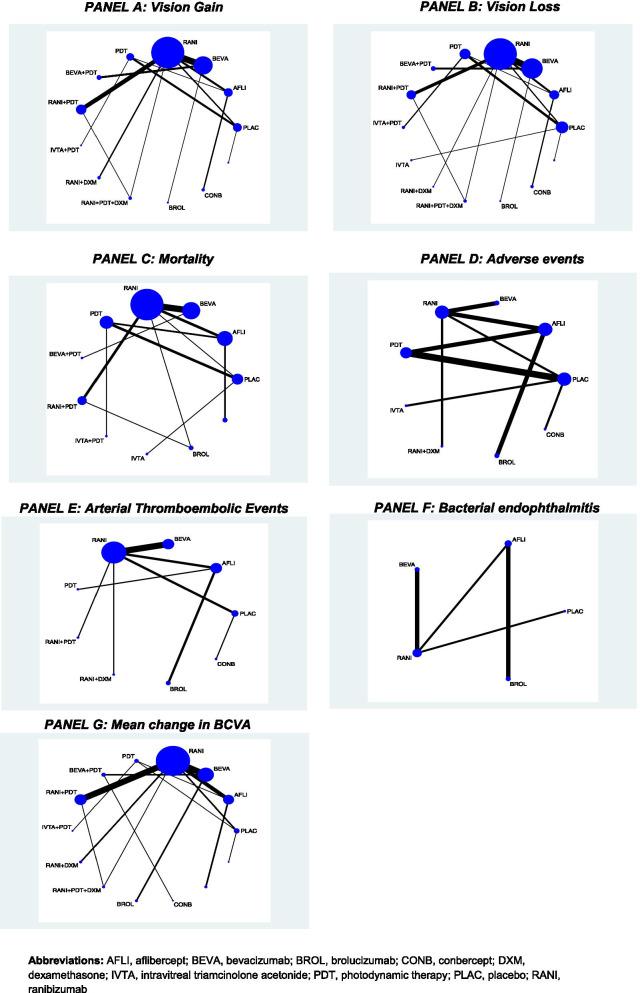
After screening 3647 citations and 485 potentially relevant full-text articles, 92 RCTs with 24,717 patients were included. NMA (34 RCTs, 8809 patients, 12 treatments) showed small differences among anti-VEGFs in improving the proportion of patients with moderate vision gain, with the largest for conbercept versus broluczumab (OR 0.15, 95% CrI: 0.05-0.56), conbercept versus ranibizumab (OR 0.17, 95% CrI: 0.05-0.59), conbercept versus aflibercept (OR 0.19, 95% CrI: 0.06-0.65), and conbercept versus bevacizumab (OR 0.2, 95% CrI: 0.06-0.69). In NMA (36 RCTs, 9081 patients, 13 treatments) for the proportion of patients with moderate vision loss, small differences were observed among anti-VEGFs, with the largest being for conbercept versus aflibercept (OR 0.24, 95% CrI: 0-4.29), conbercept versus brolucizumab (OR 0.24, 95% CrI: 0-4.71), conbercept versus bevacizumab (OR 0.26, 95% CrI: 0-4.65), and conbercept versus ranibizumab (OR 0.27, 95% CrI: 0-4.67).
CONCLUSION
The only observed differences were that ranibizumab, bevacizumab, aflibercept, and brolucizumab were statistically superior to conbercept in terms of the proportion of patients with nAMD who experienced moderate vision gain. However, this finding is based on indirect evidence through one small trial comparing conbercept with placebo. This does not account for drug-specific differences when assessing anatomic and functional treatment efficacy in variable dosing regimens.
SYSTEMATIC REVIEW REGISTRATION
PROSPERO registration number CRD42015022041.
背景
抗血管内皮生长因子药物(抗-VEGF)之间以及新生血管性年龄相关性黄斑变性(nAMD)联合治疗之间的相对安全性和疗效尚不清楚。我们进行了一项系统评价,以检查抗-VEGF 药物治疗 nAMD 成人患者的相对安全性和疗效。
方法
通过 MEDLINE、EMBASE 和 Cochrane 中心(从成立到 2019 年 6 月 3 日)、灰色文献和参考列表扫描来确定研究。两位审查员独立筛选引用和全文文章,以确定随机对照试验(RCT),提取数据并评估偏倚风险。进行了两两随机效应荟萃分析和贝叶斯网络荟萃分析(NMA)。主要结局是经历中度视力改善(早期治疗糖尿病性视网膜病变研究图表上≥15 个字母)的患者比例和经历中度视力下降(≤15 个字母)的患者比例。
结果
在筛选了 3647 条引用和 485 篇潜在相关的全文文章后,纳入了 92 项 RCT 和 24717 名患者。NMA(34 项 RCT,8809 名患者,12 种治疗方法)显示,抗-VEGF 药物在改善中度视力改善患者比例方面存在微小差异,其中康柏西普与比鲁单抗(OR 0.15,95%CI:0.05-0.56)、康柏西普与雷珠单抗(OR 0.17,95%CI:0.05-0.59)、康柏西普与阿柏西普(OR 0.19,95%CI:0.06-0.65)和康柏西普与贝伐单抗(OR 0.2,95%CI:0.06-0.69)之间的差异最大。在 NMA(36 项 RCT,9081 名患者,13 种治疗方法)中,中度视力下降患者比例的抗-VEGF 药物也存在微小差异,其中康柏西普与阿柏西普(OR 0.24,95%CI:0-4.29)、康柏西普与比鲁单抗(OR 0.24,95%CI:0-4.71)、康柏西普与贝伐单抗(OR 0.26,95%CI:0-4.65)和康柏西普与雷珠单抗(OR 0.27,95%CI:0-4.67)之间的差异最大。
结论
唯一观察到的差异是雷珠单抗、贝伐单抗、阿柏西普和比鲁单抗在 nAMD 患者中度视力改善比例方面统计学上优于康柏西普。然而,这一发现是基于一项比较康柏西普与安慰剂的小型试验的间接证据。在评估不同剂量方案的解剖学和功能治疗效果时,这并没有考虑到药物特异性差异。
系统评价注册号
PROSPERO 注册号 CRD42015022041。
 Zotero 插件