
弱视的外推延迟矫正。
Delayed Correction for Extrapolation in Amblyopia.
机构信息
Department of Ophthalmology, West China Hospital, Sichuan University, Chengdu, Sichuan, China.
Laboratory of Optometry and Vision Sciences, West China Hospital, Sichuan University, Chengdu, Sichuan, China.
出版信息
Invest Ophthalmol Vis Sci. 2021 Dec 1;62(15):20. doi: 10.1167/iovs.62.15.20.
PURPOSE
It has been suggested that amblyopes present impaired motion extrapolation mechanisms. In this study, we used the flash grab effect (FGE), the illusory mislocalization of a briefly flashed stimulus in the direction of a reversing moving background, to investigate whether the amblyopic visual system can correct overextrapolation.
METHODS
Thirteen amblyopes and 13 control subjects participated in the experiment. We measured the monocular FGE magnitude for each subject. Two spatial frequency (2 and 8 cycles), two texture configurations (square wave or sine wave), and two speed conditions (270 degrees/s and 67.5 degrees/s) were tested. In addition, control subjects were further tested in reduced luminance conditions.
RESULTS
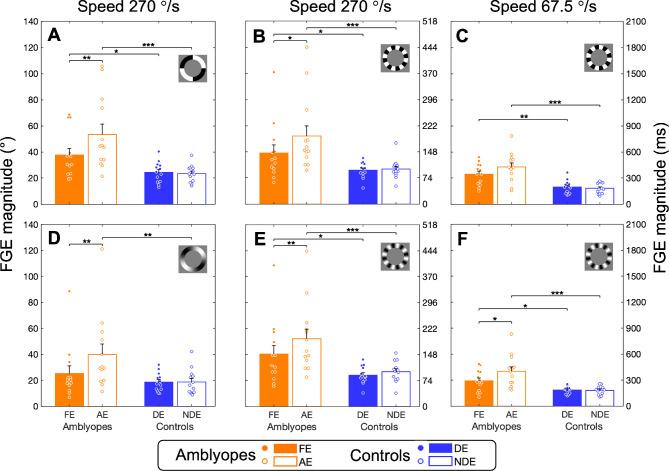
Compared with controls, amblyopes exhibited a larger FGE magnitude both in their fellow eye (FE) and amblyopic eye (AE). The FGE magnitude of their AE was significantly larger than that of the FE. In a control experiment, we observed that the FGE magnitude increases with the decreasing of the luminance. The FGE magnitude of amblyopes fall into the same range as that of controls under reduced luminance conditions.
CONCLUSIONS
We observed a lager FGE in patients with amblyopia, which indicates that the amblyopic visual system does not accurately correct the overextrapolation when a moving object abruptly reverses its direction. This spatiotemporal processing deficit could be ascribed to delayed visual processing in the amblyopic visual system.
目的
有人提出弱视者存在运动外推机制受损。本研究采用闪光抓取效应(FGE),即短暂闪光刺激在反向运动背景方向上的错觉定位错误,来研究弱视视觉系统是否可以纠正过度外推。
方法
13 名弱视者和 13 名对照组受试者参与了实验。我们测量了每位受试者的单眼 FGE 幅度。测试了两种空间频率(2 和 8 个周期)、两种纹理结构(方波或正弦波)和两种速度条件(270 度/秒和 67.5 度/秒)。此外,对照组还在降低亮度条件下进行了进一步测试。
结果
与对照组相比,弱视者在其健眼(FE)和弱视眼(AE)中均表现出更大的 FGE 幅度。AE 的 FGE 幅度明显大于 FE 的 FGE 幅度。在对照实验中,我们观察到 FGE 幅度随亮度的降低而增加。在降低亮度条件下,弱视者的 FGE 幅度落入与对照组相同的范围。
结论
我们观察到弱视患者的 FGE 较大,这表明当运动物体突然改变方向时,弱视视觉系统不能准确纠正过度外推。这种时空处理缺陷可能归因于弱视视觉系统中视觉处理的延迟。




 Zotero 插件