
ERK1/2 抑制通过激活 CaMKII 促进肌管的大量生长,从而导致成肌细胞融合为肌管。
ERK1/2 inhibition promotes robust myotube growth via CaMKII activation resulting in myoblast-to-myotube fusion.
机构信息
Department of Molecular Cell Biology, Weizmann Institute of Science, Rehovot, Israel.
Department of Biomolecular Sciences, Weizmann Institute of Science, Rehovot, Israel.
出版信息
Dev Cell. 2021 Dec 20;56(24):3349-3363.e6. doi: 10.1016/j.devcel.2021.11.022.
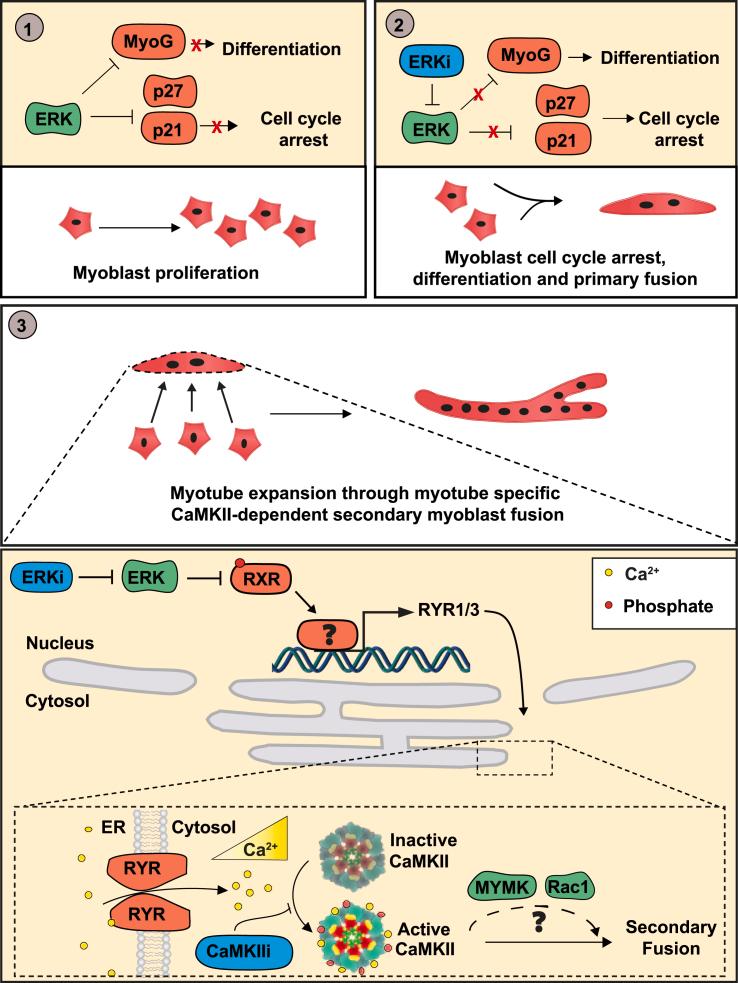
Myoblast fusion is essential for muscle development and regeneration. Yet, it remains poorly understood how mononucleated myoblasts fuse with preexisting fibers. We demonstrate that ERK1/2 inhibition (ERKi) induces robust differentiation and fusion of primary mouse myoblasts through a linear pathway involving RXR, ryanodine receptors, and calcium-dependent activation of CaMKII in nascent myotubes. CaMKII activation results in myotube growth via fusion with mononucleated myoblasts at a fusogenic synapse. Mechanistically, CaMKII interacts with and regulates MYMK and Rac1, and CaMKIIδ/γ knockout mice exhibit smaller regenerated myofibers following injury. In addition, the expression of a dominant negative CaMKII inhibits the formation of large multinucleated myotubes. Finally, we demonstrate the evolutionary conservation of the pathway in chicken myoblasts. We conclude that ERK1/2 represses a signaling cascade leading to CaMKII-mediated fusion of myoblasts to myotubes, providing an attractive target for the cultivated meat industry and regenerative medicine.
成肌细胞融合对于肌肉发育和再生至关重要。然而,单核成肌细胞如何与预先存在的纤维融合仍然知之甚少。我们证明 ERK1/2 抑制(ERKi)通过涉及 RXR、ryanodine 受体以及新生肌管中钙依赖性 CaMKII 激活的线性途径,诱导原代小鼠成肌细胞的强大分化和融合。CaMKII 的激活通过与单核成肌细胞在融合突触融合导致肌管生长。从机制上讲,CaMKII 与 MYMK 和 Rac1 相互作用并调节它们,CaMKIIδ/γ 敲除小鼠在损伤后表现出较小的再生肌纤维。此外,显性负性 CaMKII 的表达抑制大多核肌管的形成。最后,我们证明了该途径在鸡成肌细胞中的进化保守性。我们得出结论,ERK1/2 抑制导致 CaMKII 介导的成肌细胞融合到肌管的信号级联,为培养肉产业和再生医学提供了一个有吸引力的目标。


 Zotero 插件