
哺乳动物的癌症风险。
Cancer risk across mammals.
机构信息
CREEC/CANECEV, MIVEGEC (CREES), University of Montpellier, CNRS, IRD, Montpellier, France.
Littoral, Environnement et Sociétés (LIENSs), UMR 7266 CNRS-La Rochelle Université, La Rochelle, France.
出版信息
Nature. 2022 Jan;601(7892):263-267. doi: 10.1038/s41586-021-04224-5. Epub 2021 Dec 22.
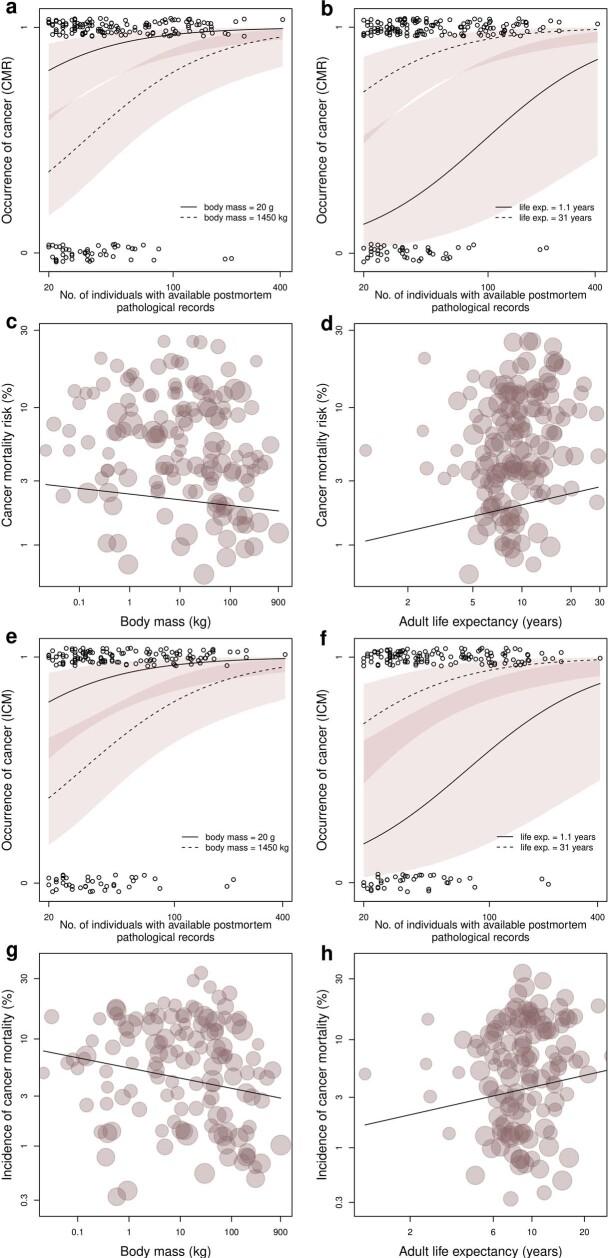
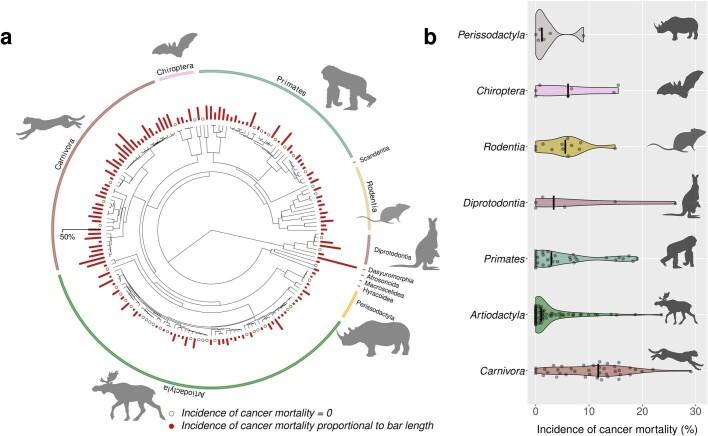
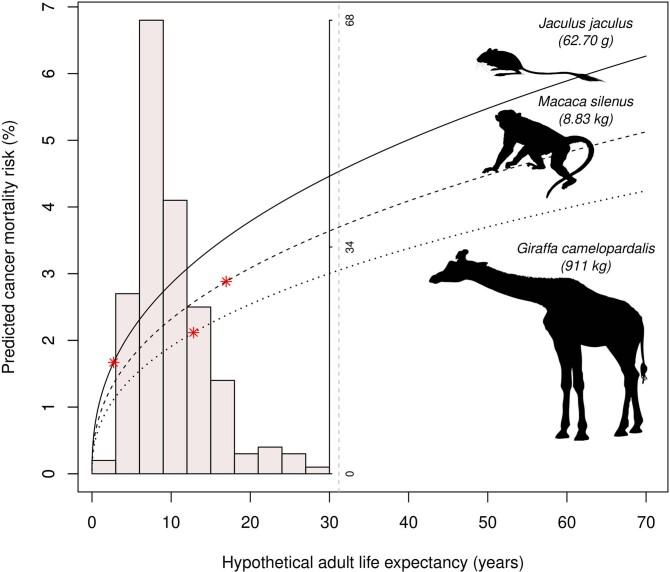
Cancer is a ubiquitous disease of metazoans, predicted to disproportionately affect larger, long-lived organisms owing to their greater number of cell divisions, and thus increased probability of somatic mutations. While elevated cancer risk with larger body size and/or longevity has been documented within species, Peto's paradox indicates the apparent lack of such an association among taxa. Yet, unequivocal empirical evidence for Peto's paradox is lacking, stemming from the difficulty of estimating cancer risk in non-model species. Here we build and analyse a database on cancer-related mortality using data on adult zoo mammals (110,148 individuals, 191 species) and map age-controlled cancer mortality to the mammalian tree of life. We demonstrate the universality and high frequency of oncogenic phenomena in mammals and reveal substantial differences in cancer mortality across major mammalian orders. We show that the phylogenetic distribution of cancer mortality is associated with diet, with carnivorous mammals (especially mammal-consuming ones) facing the highest cancer-related mortality. Moreover, we provide unequivocal evidence for the body size and longevity components of Peto's paradox by showing that cancer mortality risk is largely independent of both body mass and adult life expectancy across species. These results highlight the key role of life-history evolution in shaping cancer resistance and provide major advancements in the quest for natural anticancer defences.
癌症是后生动物普遍存在的疾病,预计会不成比例地影响更大、寿命更长的生物体,因为它们的细胞分裂次数更多,因此体细胞突变的可能性增加。虽然在物种内已经记录到较大的体型和/或较长的寿命与癌症风险升高有关,但 Peto 悖论表明,在分类群中似乎没有这种关联。然而,由于难以估计非模型物种的癌症风险,因此缺乏对 Peto 悖论的明确经验证据。在这里,我们使用动物园哺乳动物的成年个体数据(110,148 个个体,191 个物种)构建和分析了一个与癌症相关死亡率相关的数据库,并将年龄控制的癌症死亡率映射到哺乳动物的生命之树上。我们证明了致癌现象在哺乳动物中的普遍性和高频性,并揭示了主要哺乳动物目之间癌症死亡率的巨大差异。我们表明,癌症死亡率的系统发育分布与饮食有关,肉食性哺乳动物(尤其是捕食哺乳动物)面临着最高的癌症相关死亡率。此外,我们通过表明癌症死亡率风险在很大程度上独立于物种的体重和成年预期寿命,提供了 Peto 悖论的体型和寿命成分的明确证据。这些结果强调了生活史进化在塑造癌症抵抗力方面的关键作用,并为寻找天然抗癌防御提供了重大进展。




 Zotero 插件