
社会规范、回避、未来导向与气候变化倡导沟通意愿之间的关系。
The Relationship between Social Norms, Avoidance, Future Orientation, and Willingness to Engage in Climate Change Advocacy Communications.
机构信息
Department of Health, Behavior and Society, Bloomberg School of Public Health, Johns Hopkins University, Baltimore, MD 21205, USA.
Division of Infectious Diseases, Johns Hopkins University School of Medicine, Baltimore, MD 21205, USA.
出版信息
Int J Environ Res Public Health. 2021 Dec 10;18(24):13037. doi: 10.3390/ijerph182413037.
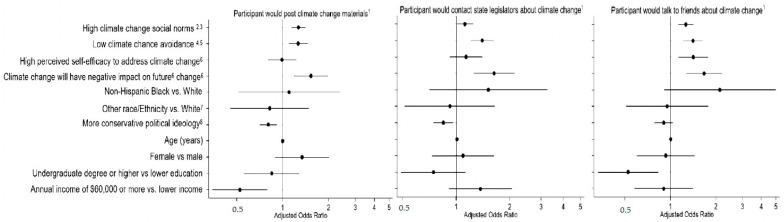
This study examined factors associated with willingness to engage in communication behaviors related to climate change advocacy. Data were collected as part of an online, longitudinal US study beginning in March 2020. Outcomes included willingness to post materials online, contact state legislators, and talk with peers about climate change. Covariates included climate change-related social norms, avoidance of climate change information, and perceptions of the future impact of climate change. A minority of the 586 respondents (23%) reported regular conversations about climate change, while approximately half of the respondents reported willingness to discuss climate change with peers (58%), post materials online (47%), and contact state legislators (46%). Strong predictors of willingness to engage in each climate change communications behaviors included climate change social norms, not avoiding climate change information, and believing that climate change will have a negative impact on the future. Findings indicate the importance of designing programs to foster increased climate change communications in order to promote community-level climate change advocacy norms.
本研究考察了与参与与气候变化倡导相关的沟通行为的意愿相关的因素。数据是作为 2020 年 3 月开始的一项在线纵向美国研究的一部分收集的。结果包括在网上发布材料、联系州议员和与同龄人谈论气候变化的意愿。协变量包括与气候变化相关的社会规范、避免气候变化信息以及对气候变化未来影响的看法。在 586 名受访者中(23%),少数人(23%)报告称经常就气候变化进行对话,而大约一半的受访者表示愿意与同龄人讨论气候变化(58%)、在网上发布材料(47%)和联系州议员(46%)。愿意参与每项气候变化沟通行为的强烈预测因素包括气候变化的社会规范、不回避气候变化信息以及相信气候变化将对未来产生负面影响。研究结果表明,重要的是要设计方案来促进气候变化沟通,以促进社区层面的气候变化倡导规范。
 Zotero 插件