
SARS-CoV-2 与流感病毒双重感染对疾病严重程度的影响:系统评价和荟萃分析。
Impact of Coinfection With SARS-CoV-2 and Influenza on Disease Severity: A Systematic Review and Meta-Analysis.
机构信息
State Key Laboratory for Diagnosis and Treatment of Infectious Diseases, National Clinical Research Centre for Infectious Diseases, Collaborative Innovation Centre for Diagnosis and Treatment of Infectious Diseases, The First Affiliated Hospital, Zhejiang University School of Medicine, Hangzhou, China.
Women's Hospital, School of Medicine, Zhejiang University, Hangzhou, China.
出版信息
Front Public Health. 2021 Dec 10;9:773130. doi: 10.3389/fpubh.2021.773130. eCollection 2021.
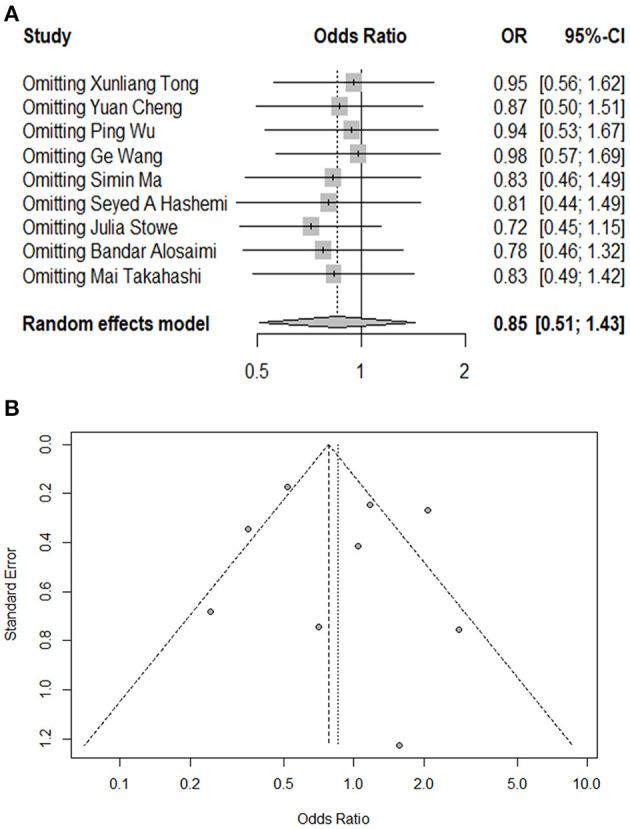
Although coinfection with influenza in COVID-19 patients has drawn considerable attention, it is still not completely understood whether simultaneously infected with these two viruses influences disease severity. We therefore aimed to estimate the impact of coinfected with SARS-CoV-2 and influenza on the disease outcomes compared with the single infection of SARS-CoV-2. We searched the PubMed, Web of Science, Embase, Cochrane Library, China National Knowledge Infrastructure Database (CNKI) to identify relevant articles up to July 9, 2021. Studies that assessed the effect of SARS-CoV-2 and influenza coinfection on disease outcomes or those with sufficient data to calculate risk factors were included. Risk effects were pooled using fixed or random effects model. We ultimately identified 12 studies with 9,498 patients to evaluate the risk effects of SARS-CoV-2 and influenza coinfection on disease severity. Results indicated that coinfection was not significantly associated with mortality (OR = 0.85, 95%CI: 0.51, 1.43; = 0.55, = 76.00%). However, mortality was found significantly decreased in the studies from China (OR = 0.51, 95%CI: 0.39, 0.68; = 26.50%), while significantly increased outside China (OR = 1.56, 95%CI: 1.12, 2.19; = 1.00%). Moreover, a lower risk for critical outcomes was detected among coinfection patients (OR = 0.64, 95%CI: 0.43, 0.97; = 0.04, = 0.00%). Additionally, coinfection patients presented different laboratory indexes compared with the single SARS-CoV-2 infection, including lymphocyte counts and APTT. Our study revealed that coinfection with SARS-CoV-2 and influenza had no effect on overall mortality. However, risk for critical outcomes was lower in coinfection patients and different associations were detected in the studies from different regions and specific laboratory indexes. Further studies on influenza strains and the order of infection were warranted. Systematic testing for influenza coinfection in COVID-19 patients and influenza vaccination should be recommended.
虽然 COVID-19 患者同时感染流感病毒引起了广泛关注,但目前仍不完全清楚同时感染这两种病毒是否会影响疾病的严重程度。因此,我们旨在评估 SARS-CoV-2 和流感同时感染与单纯 SARS-CoV-2 感染相比对疾病结局的影响。我们检索了 PubMed、Web of Science、Embase、Cochrane 图书馆、中国知网数据库(CNKI),截至 2021 年 7 月 9 日,以确定相关文章。纳入评估 SARS-CoV-2 和流感同时感染对疾病结局影响的研究,或有足够数据计算危险因素的研究。采用固定或随机效应模型汇总风险效应。我们最终确定了 12 项研究,共纳入 9498 例患者,以评估 SARS-CoV-2 和流感同时感染对疾病严重程度的风险效应。结果表明,同时感染与死亡率无显著相关性(OR = 0.85,95%CI:0.51,1.43; = 0.55, = 76.00%)。然而,来自中国的研究发现,同时感染患者的死亡率显著降低(OR = 0.51,95%CI:0.39,0.68; = 26.50%),而来自其他国家的研究发现,同时感染患者的死亡率显著升高(OR = 1.56,95%CI:1.12,2.19; = 1.00%)。此外,同时感染患者发生重症结局的风险较低(OR = 0.64,95%CI:0.43,0.97; = 0.04, = 0.00%)。此外,与单纯 SARS-CoV-2 感染相比,同时感染患者的实验室指标不同,包括淋巴细胞计数和 APTT。本研究表明,SARS-CoV-2 和流感同时感染对总体死亡率无影响。然而,同时感染患者发生重症结局的风险较低,且来自不同地区和特定实验室指标的研究存在不同的相关性。需要进一步研究流感毒株和感染顺序。建议对 COVID-19 患者进行流感合并感染的系统检测,并推荐流感疫苗接种。


 Zotero 插件