
[镥]镥-多胺多羧基配体.单克隆抗体片段([Lu]Lu-DOTA.SA.FAPi)和[镥]镥-多胺多羧基配体(单克隆抗体片段)([Lu]Lu-DOTAGA.(SA.FAPi))的人体首次生物分布、药代动力学和剂量学研究结果
First-In-Human Results on the Biodistribution, Pharmacokinetics, and Dosimetry of [Lu]Lu-DOTA.SA.FAPi and [Lu]Lu-DOTAGA.(SA.FAPi).
作者信息
Ballal Sanjana, Yadav Madhav Prasad, Moon Euy Sung, Kramer Vasko S, Roesch Frank, Kumari Samta, Bal Chandrasekhar
机构信息
Department of Nuclear Medicine, AIIMS, Ansari Nagar, New Delhi 110029, India.
Department of Chemistry, Johannes Gutenberg University, 55131 Mainz, Germany.
出版信息
Pharmaceuticals (Basel). 2021 Nov 24;14(12):1212. doi: 10.3390/ph14121212.
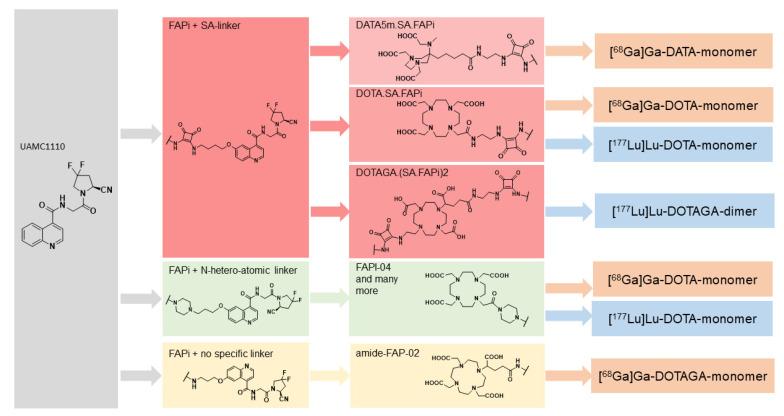
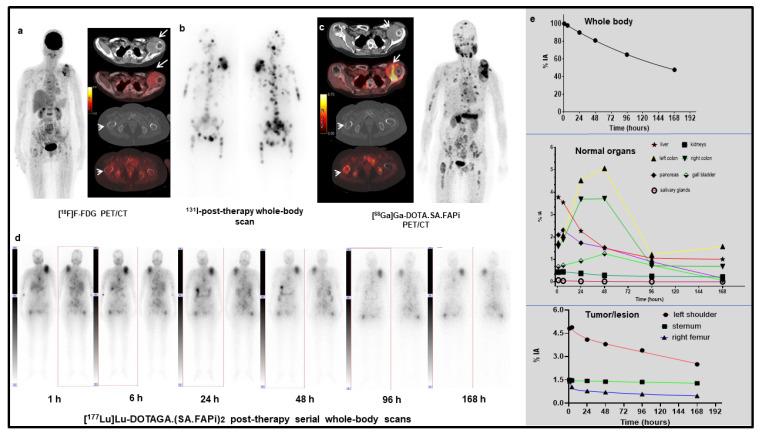
Recently, great interest has been gained regarding fibroblast activation protein (FAP) as an excellent target for theranostics. Several FAP inhibitor molecules such as [Ga]Ga-labelled FAPI-02, 04, 46, and DOTA.SA.FAPi have been introduced and are highly promising molecular targets from the imaging point of view. FAP inhibitors introduced via bifunctional DOTA and DOTAGA chelators offer the possibility to complex Lutetium-177 due to an additional coordination site, and are suitable for theranostic applications owing to the increased tumor accumulation and prolonged tumor retention time. However, for therapeutic applications, very little has been accomplished, mainly due to residence times of the compounds. In an attempt to develop a promising therapeutic radiopharmaceutical, the present study aimed to evaluate and compare the biodistribution, pharmacokinetics, and dosimetry of [Lu]Lu-DOTA.SA.FAPi, and [Lu]Lu-DOTAGA.(SA.FAPi) in patients with various cancers. The FAPi agents, [Lu]Lu-DOTA.SA.FAPi and [Lu]Lu-DOTAGA.(SA.FAPi), were administered in two different groups of patients. Three patients (mean age-50 years) were treated with a median cumulative activity of 2.96 GBq (IQR: 2.2-3 GBq) [Lu]Lu-DOTA.SA.FAPi and seven (mean age-51 years) were treated with 1.48 GBq (IQR: 0.6-1.5) of [Lu]Lu-DOTAGA.(SA.FAPi). Patients in both the groups underwent serial imaging whole-body planar and SPECT/CT scans that were acquired between 1 h and 168 h post-injection (p.i.). The residence time and absorbed dose estimate in the source organs and tumor were calculated using OLINDA/EXM 2.2 software. Time versus activity graphs were plotted to determine the effective half-life (Te) in the whole body and lesions for both the radiotracers. Physiological uptake of [Lu]Lu-DOTA.SA.FAPi was observed in the kidneys, colon, pancreas, liver, gall bladder, oral mucosa, lacrimal glands, and urinary bladder contents. Physiological biodistribution of [Lu]Lu-DOTAGA.(SA.FAPi) involved liver, gall bladder, colon, pancreas, kidneys, and urinary bladder contents, lacrimal glands, oral mucosa, and salivary glands. In the [Lu]Lu-DOTA.SA.FAPi group, the highest absorbed doses were noted in the kidneys (0.618 ± 0.015 Gy/GBq), followed by the colon (right colon: 0.472 Gy/GBq and left colon: 0.430 Gy/GBq). In the [Lu]Lu-DOTAGA.(SA.FAPi) group, the colon received the highest absorbed dose (right colon: 1.160 Gy/GBq and left colon: 2.870 Gy/GBq), and demonstrated a significantly higher mean absorbed dose than [Lu]Lu-DOTA.SA.FAPi ( < 0.011). [Lu]Lu-DOTAGA.(SA.FAPi) had significantly longer median whole-body Te compared to that of [Lu]Lu-DOTA.SA.FAPi [46.2 h (IQR: 38.5-70.1) vs. 23.1 h (IQR: 17.8-31.5); -0.0167]. The Te of tumor lesions was significantly higher for [Lu]Lu-DOTAGA.(SA.FAPi) compared to [Lu]Lu-DOTA.SA.FAPi [86.6 h (IQR: 34.3-94.6) vs. 14 h (IQR: 12.8-15.5); -0.0004]. The median absorbed doses to the lesions were 0.603 (IQR: 0.230-1.810) Gy/GBq and 6.70 (IQR: 3.40-49) Gy/GBq dose per cycle in the [Lu]Lu-DOTA.SA.FAPi, and [Lu]Lu-DOTAGA.(SA.FAPi) groups, respectively. The first clinical dosimetry study demonstrated significantly higher tumor absorbed doses with [Lu]Lu-DOTAGA.(SA.FAPi) compared to [Lu]Lu-DOTA.SA.FAPi. [Lu]Lu-DOTAGA.(SA.FAPi) is safe and unveiled new frontiers to treat various end-stage cancer patients with a theranostic approach.
最近,成纤维细胞活化蛋白(FAP)作为一种出色的诊疗靶点引起了极大关注。已经引入了几种FAP抑制剂分子,如[镓]镓标记的FAPI-02、04、46和DOTA.SA.FAPi,从成像角度来看,它们是非常有前景的分子靶点。通过双功能DOTA和DOTAGA螯合剂引入的FAP抑制剂由于额外的配位位点而具有与镥-177络合的可能性,并且由于肿瘤摄取增加和肿瘤滞留时间延长而适用于诊疗应用。然而,对于治疗应用,进展甚微,主要是由于化合物的停留时间。为了开发一种有前景的治疗性放射性药物,本研究旨在评估和比较[镥]镥-DOTA.SA.FAPi和[镥]镥-DOTAGA.(SA.FAPi)在各种癌症患者中的生物分布、药代动力学和剂量学。FAPi制剂[镥]镥-DOTA.SA.FAPi和[镥]镥-DOTAGA.(SA.FAPi)分别给予两组不同的患者。三名患者(平均年龄50岁)接受了中位累积活度为2.96 GBq(四分位间距:2.2 - 3 GBq)的[镥]镥-DOTA.SA.FAPi治疗,七名患者(平均年龄51岁)接受了1.48 GBq(四分位间距:0.6 - 1.5)的[镥]镥-DOTAGA.(SA.FAPi)治疗。两组患者均在注射后1小时至168小时之间进行了全身平面和SPECT/CT系列成像扫描。使用OLINDA/EXM 2.2软件计算源器官和肿瘤中的停留时间和吸收剂量估计值。绘制时间与活度图以确定两种放射性示踪剂在全身和病变中的有效半衰期(Te)。观察到[镥]镥-DOTA.SA.FAPi在肾脏、结肠、胰腺、肝脏、胆囊、口腔黏膜、泪腺和膀胱内容物中有生理性摄取。[镥]镥-DOTAGA.(SA.FAPi)的生理性生物分布涉及肝脏、胆囊、结肠、胰腺、肾脏、膀胱内容物、泪腺、口腔黏膜和唾液腺。在[镥]镥-DOTA.SA.FAPi组中,肾脏的吸收剂量最高(0.618±0.015 Gy/GBq),其次是结肠(右结肠:0.472 Gy/GBq,左结肠:0.430 Gy/GBq)。在[镥]镥-DOTAGA.(SA.FAPi)组中,结肠接受的吸收剂量最高(右结肠:1.160 Gy/GBq,左结肠:2.870 Gy/GBq),并且其平均吸收剂量显著高于[镥]镥-DOTA.SA.FAPi(<0.011)。与[镥]镥-DOTA.SA.FAPi相比,[镥]镥-DOTAGA.(SA.FAPi)的全身中位Te显著更长[46.2小时(四分位间距:38.5 - 70.1)对23.1小时(四分位间距:17.8 - 31.5);P<0.0167]。与[镥]镥-DOTA.SA.FAPi相比,[镥]镥-DOTAGA.(SA.FAPi)的肿瘤病变Te显著更高[86.6小时(四分位间距:34.3 - 94.6)对14小时(四分位间距:12.8 - 15.5);P<0.0004]。[镥]镥-DOTA.SA.FAPi组和[镥]镥-DOTAGA.(SA.FAPi)组病变的中位吸收剂量分别为0.603(四分位间距:0.230 - 1.810)Gy/GBq和6.70(四分位间距:3.40 - 49)Gy/GBq/周期。首次临床剂量学研究表明,与[镥]镥-DOTA.SA.FAPi相比,[镥]镥-DOTAGA.(SA.FAPi)的肿瘤吸收剂量显著更高。[镥]镥-DOTAGA.(SA.FAPi)是安全的,并为采用诊疗方法治疗各种晚期癌症患者开辟了新的途径。


 Zotero 插件