
鸡冠状病毒灭活疫苗中壳聚糖纳米颗粒和油乳佐剂免疫反应及保护作用的比较评价
Comparative Evaluation of Immune Responses and Protection of Chitosan Nanoparticles and Oil-Emulsion Adjuvants in Avian Coronavirus Inactivated Vaccines in Chickens.
作者信息
Lopes Priscila Diniz, Okino Cintia Hiromi, Fernando Filipe Santos, Pavani Caren, Mariguela Viviane Casagrande, Montassier Maria de Fátima Silva, Montassier Hélio José
机构信息
Department of Veterinary Pathology, School of Agricultural and Veterinarian Sciences, Jaboticabal, São Paulo State University (Unesp), Jaboticabal 14884-900, Brazil.
Embrapa Southeast Livestock, Brazilian Agricultural Research Corporation (Embrapa), Canchim Farm, São Carlos 13560-970, Brazil.
出版信息
Vaccines (Basel). 2021 Dec 9;9(12):1457. doi: 10.3390/vaccines9121457.
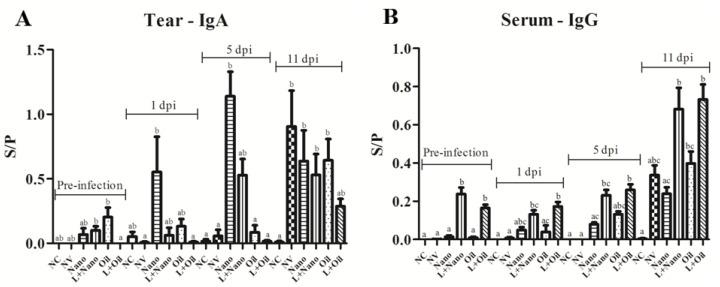
Efficient vaccines are the main strategy to control the avian coronavirus (AvCoV), although several drawbacks related to traditional attenuated and inactivated vaccines have been reported. These counterpoints highlight the importance of developing new alternative vaccines against AvCoV, especially those able to induce long-lasting immune responses. This study evaluated and compared two inactivated vaccines formulated with AvCoV BR-I variants, one composed of chitosan nanoparticles (AvCoV-CS) and the second by Montanide oily adjuvant (AvCoV-O). Both developed vaccines were administered in a single dose or associated with the traditional Mass attenuated vaccine. The AvCoV-CS vaccine administered alone or associated with the Mass vaccine was able to induce strong humoral and cell-mediated immune (CMI) responses and complete protection against IBV virulent infection, wherein single administration was characterized by high IgA antibody levels in the mucosa, whereas when associated with the Mass vaccine, the serum IgG antibody was predominantly observed. On the other hand, single administration of the oily vaccine presented poor humoral and CMI responses and consequently incomplete protection against virulent challenge, but when associated with the Mass vaccine, immune responses were developed, and complete protection against infection was observed. Both of our experimental vaccines were able to induce full protection against virulent IBV challenge. A single dose of AvCoV-CS vaccine was sufficient to achieve complete protection, while AvCoV-O required a previous priming by a Mass strain to complete the protection.
高效疫苗是控制禽冠状病毒(AvCoV)的主要策略,尽管已有报道指出传统减毒疫苗和灭活疫苗存在一些缺点。这些问题凸显了开发新型AvCoV替代疫苗的重要性,特别是那些能够诱导持久免疫反应的疫苗。本研究评估并比较了两种用AvCoV BR-I变体配制的灭活疫苗,一种由壳聚糖纳米颗粒组成(AvCoV-CS),另一种由Montanide油性佐剂组成(AvCoV-O)。两种研发的疫苗均采用单剂量给药,或与传统的Mass减毒疫苗联合使用。单独给药或与Mass疫苗联合使用的AvCoV-CS疫苗能够诱导强烈的体液免疫和细胞介导免疫(CMI)反应,并对传染性支气管炎病毒(IBV)强毒株感染提供完全保护,其中单剂量给药的特点是粘膜中IgA抗体水平较高,而与Mass疫苗联合使用时,主要观察到血清IgG抗体。另一方面,油性疫苗单剂量给药时体液免疫和CMI反应较差,因此对强毒株攻击的保护不完全,但与Mass疫苗联合使用时,可产生免疫反应,并观察到对感染的完全保护。我们的两种实验疫苗均能够诱导对IBV强毒株攻击的完全保护。单剂量的AvCoV-CS疫苗足以实现完全保护,而AvCoV-O则需要先用Mass毒株进行初次免疫才能实现完全保护。


 Zotero 插件