
炎症标志物与临床因素联合列线图预测弥漫性胶质瘤患者的生存。
A nomogram combining inflammatory markers and clinical factors predicts survival in patients with diffuse glioma.
机构信息
Department of Neurosurgery, Guangxi Medical University Cancer Hospital, Nanning Guangxi, P.R. China.
出版信息
Medicine (Baltimore). 2021 Nov 24;100(47):e27972. doi: 10.1097/MD.0000000000027972.
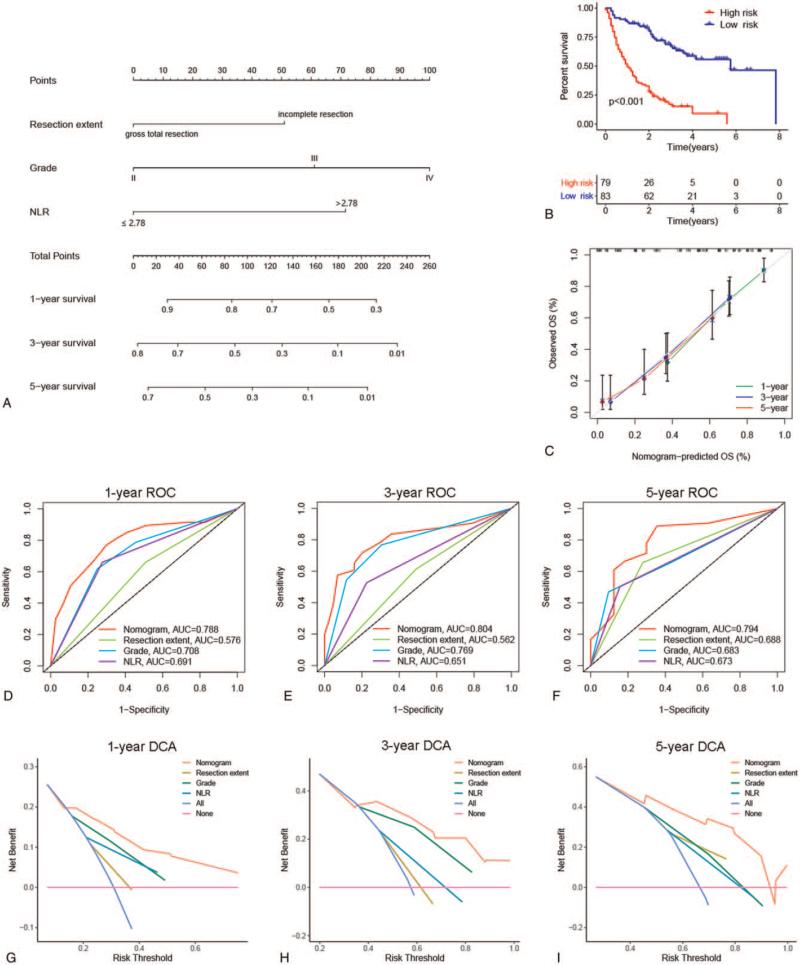
In this study, we aimed to investigate the prognostic value of neutrophil/lymphocyte ratio (NLR), monocyte/lymphocyte ratio (MLR), and platelet/lymphocyte ratio (PLR) in diffuse glioma, and to establish a prognostic nomogram accordingly.The hematologic and clinicopathological data of 162 patients with primary diffuse glioma who received surgical treatment from January 2012 to December 2018 were retrospectively analyzed. Receiver operator characteristic (ROC) curve was carried out to determine the optimal cut-off values for NLR, MLR, PLR, age, and Ki-67 index, respectively. Kaplan-Meier method was used to investigate the correlation between inflammatory indicators and prognosis of glioma patients. Univariate and multivariate Cox regression were performed to evaluate the independent prognostic value of each parameter in glioma. Then, a nomogram was developed to predict 1-, 3-, and 5-year postoperative survival in diffuse glioma patients based on independent prognostic factors. Subsequent time-dependent ROC curve, calibration curve, decision curve analysis (DCA), and concordance index (C-index) were performed to assess the predictive performance of the nomogram.The Kaplan-Meier curve indicated that patients with high levels of NLR, MLR, and PLR had a poor prognosis. In addition, we found that NLR level was associated with World Health Organization (WHO) grade and IDH status of glioma. The multivariate Cox analysis indicated that resection extent, WHO grade, and NLR level were independent prognostic factors, and we established a nomogram that included these three parameters. The evaluation of the nomogram indicated that the nomogram had a good predictive performance, and the addition of NLR could improve the accuracy.NLR, MLR, and PLR were prognostic factors of diffuse glioma. In addition, the nomogram including NLR was reliable for predicting survival of diffuse glioma patients.
在这项研究中,我们旨在探讨中性粒细胞/淋巴细胞比值(NLR)、单核细胞/淋巴细胞比值(MLR)和血小板/淋巴细胞比值(PLR)在弥漫性神经胶质瘤中的预后价值,并据此建立一个预后列线图。
回顾性分析了 2012 年 1 月至 2018 年 12 月接受手术治疗的 162 例原发性弥漫性神经胶质瘤患者的血液学和临床病理数据。分别采用接收者操作特征(ROC)曲线确定 NLR、MLR、PLR、年龄和 Ki-67 指数的最佳截断值。Kaplan-Meier 法分析炎症指标与胶质瘤患者预后的相关性。采用单因素和多因素 Cox 回归分析评估胶质瘤各参数的独立预后价值。然后,根据独立预后因素,建立预测弥漫性神经胶质瘤患者术后 1、3 和 5 年生存的列线图。随后进行时间依赖性 ROC 曲线、校准曲线、决策曲线分析(DCA)和一致性指数(C-index)评估列线图的预测性能。
Kaplan-Meier 曲线表明,NLR、MLR 和 PLR 水平较高的患者预后较差。此外,我们发现 NLR 水平与胶质瘤的世界卫生组织(WHO)分级和 IDH 状态有关。多因素 Cox 分析表明,切除程度、WHO 分级和 NLR 水平是独立的预后因素,我们建立了一个包含这三个参数的列线图。列线图的评估表明,该列线图具有良好的预测性能,加入 NLR 可以提高准确性。
NLR、MLR 和 PLR 是弥漫性神经胶质瘤的预后因素。此外,包含 NLR 的列线图可可靠地预测弥漫性神经胶质瘤患者的生存。


 Zotero 插件