
韩国儿童危重症 COVID-19 病例分析。
Analysis of Critical COVID-19 Cases Among Children in Korea.
机构信息
Department of Pediatrics, Seoul National University Bundang Hospital, Seongnam, Korea.
Department of Pediatrics, Seoul National University College of Medicine, Seoul, Korea.
出版信息
J Korean Med Sci. 2022 Jan 3;37(1):e13. doi: 10.3346/jkms.2022.37.e13.
BACKGROUND
Coronavirus disease 2019 (COVID-19) is generally asymptomatic or mild in otherwise healthy children, however, severe cases may occur. In this study, we report the clinical characteristics of children classified as critical COVID-19 in Korea to provide further insights into risk factors and management in children.
METHODS
This study was a retrospective case series of children < 18 years of age classified as critical COVID-19. Cases were identified by the Korea Disease Control and Prevention Agency surveillance system and medical records were reviewed. Critical COVID-19 was defined as cases with severe illness requiring noninvasive (high flow nasal cannula, continuous positive airway pressure, or bilevel positive airway pressure) or invasive mechanical ventilation, extracorporeal membrane oxygenation (ECMO) or continuous renal replacement therapy (CRRT), between January 20, 2020 and October 7, 2021.
RESULTS
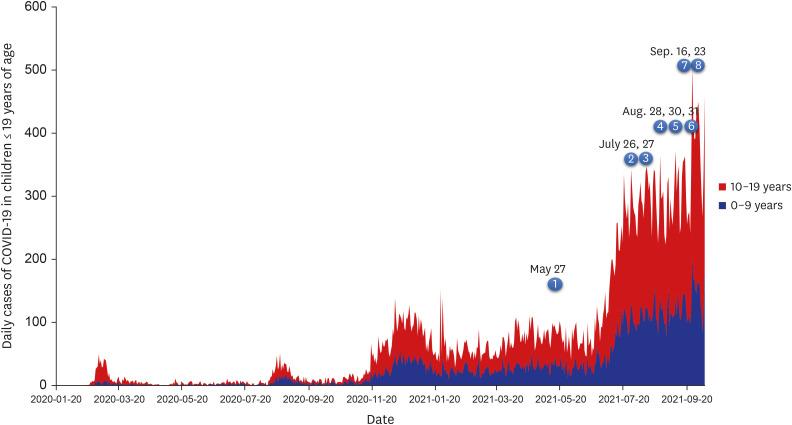
Among 39,146 cases diagnosed with COVID-19 in subjects < 18 years of age, eight cases (0.02%) were identified as critical COVID-19. The median age was 13 years (range 10 month-17 years) and male-to-female ratio was 1:1. Three children had underlying diseases; one child has asthma and major depressive disorder, one child had Lennox-Gastaut syndrome and one child had mental retardation and was newly diagnosed with type 2 diabetes mellitus with the diagnosis of COVID-19. Among the eight children, seven were obese (body mass index range [BMI] median 29.3, range 25.9-38.2, weight-for-length > 97% for infant) and one was overweight (BMI 21.3). All patients had fever, six patients had dyspnea or cough and other accompanied symptoms included sore throat, headache, lethargy and myalgia. Radiologic findings showed pneumonia within 1-8 days after symptom onset. Pneumonia progressed in these children for 2-6 days and was improved within 5-32 days after diagnosis. Among the eight critical cases, remdesivir was administered in six cases. Steroids were provided for all cases. Inotropics were administered in one case. Six cases were treated with noninvasive mechanical ventilator and three required mechanical ventilator. One case required ECMO due to acute respiratory distress syndrome. All cases were admitted to the intensive care unit and admission period ranged from 9-39 days. Among all critical COVID-19 cases < 18 years of age, there were no fatal cases.
CONCLUSION
To develop appropriate policies for children in the COVID-19 pandemic, it is important to monitor and assess the clinical burden in this population.
背景
新型冠状病毒病 2019(COVID-19)在其他健康儿童中通常无症状或症状较轻,但也可能出现严重病例。在本研究中,我们报告了韩国分类为危重型 COVID-19 的儿童的临床特征,以进一步了解儿童的危险因素和管理方法。
方法
本研究是一项回顾性病例系列研究,纳入年龄<18 岁且分类为危重型 COVID-19 的儿童。病例通过韩国疾病控制和预防局监测系统确定,并对病历进行了回顾性分析。危重型 COVID-19 定义为需要无创(高流量鼻导管、持续气道正压通气或双水平气道正压通气)或有创机械通气、体外膜氧合(ECMO)或持续肾脏替代治疗(CRRT)的严重疾病病例,纳入时间为 2020 年 1 月 20 日至 2021 年 10 月 7 日。
结果
在年龄<18 岁的 COVID-19 患者中,有 39146 例,其中 8 例(0.02%)被分类为危重型 COVID-19。中位年龄为 13 岁(范围 10 个月-17 岁),男女比例为 1:1。有 3 例患儿存在基础疾病,其中 1 例患有哮喘和重度抑郁症,1 例患有 Lennox-Gastaut 综合征,1 例为精神发育迟滞,且在诊断 COVID-19 时新诊断为 2 型糖尿病。在这 8 名儿童中,有 7 名肥胖(体重指数范围[BMI]中位数为 29.3,范围为 25.9-38.2,身长体重比大于 97%的婴儿),1 名超重(BMI 为 21.3)。所有患儿均有发热,6 例有呼吸困难或咳嗽,其他伴随症状包括咽痛、头痛、乏力和肌痛。影像学检查显示症状出现后 1-8 天内出现肺炎。这些患儿的肺炎持续 2-6 天,确诊后 5-32 天内好转。在这 8 例危重症患儿中,有 6 例接受了瑞德西韦治疗。所有患儿均给予皮质类固醇治疗。1 例患儿使用了儿茶酚胺类药物。6 例患儿接受无创机械通气治疗,3 例需要机械通气。1 例患儿因急性呼吸窘迫综合征需要 ECMO。所有患儿均入住重症监护病房,住院时间为 9-39 天。在所有年龄<18 岁的危重型 COVID-19 患儿中,无死亡病例。
结论
为制定 COVID-19 大流行期间儿童的适当政策,监测和评估该人群的临床负担非常重要。
 Zotero 插件