
月经周期长度与 2019 冠状病毒病(COVID-19)疫苗接种的关联:一项美国队列研究。
Association Between Menstrual Cycle Length and Coronavirus Disease 2019 (COVID-19) Vaccination: A U.S. Cohort.
机构信息
Department of Obstetrics and Gynecology, Oregon Health & Science University, Portland, Oregon; Natural Cycles USA Corp, New York, New York; the Department of Obstetrics & Gynecology, Women & Infants Hospital, Warren Alpert Medical School of Brown University, Providence, Rhode Island; Oregon Health & Science University-Portland State University, School of Public Health, Portland, Oregon; and the National Institute of Public Health, Center for Population Health Research, Cuernavaca, Morelos, Mexico.
出版信息
Obstet Gynecol. 2022 Apr 1;139(4):481-489. doi: 10.1097/AOG.0000000000004695. Epub 2022 Jan 5.
OBJECTIVE
To assess whether coronavirus disease 2019 (COVID-19) vaccination is associated with changes in cycle or menses length in those receiving vaccination as compared with an unvaccinated cohort.
METHODS
We analyzed prospectively tracked menstrual cycle data using the application "Natural Cycles." We included U.S. residents aged 18-45 years with normal cycle lengths (24-38 days) for three consecutive cycles before the first vaccine dose followed by vaccine-dose cycles (cycles 4-6) or, if unvaccinated, six cycles over a similar time period. We calculated the mean within-individual change in cycle and menses length (three prevaccine cycles vs first- and second-dose cycles in the vaccinated cohort, and the first three cycles vs cycles four and five in the unvaccinated cohort). We used mixed-effects models to estimate the adjusted difference in change in cycle and menses length between the vaccinated and unvaccinated cohorts.
RESULTS
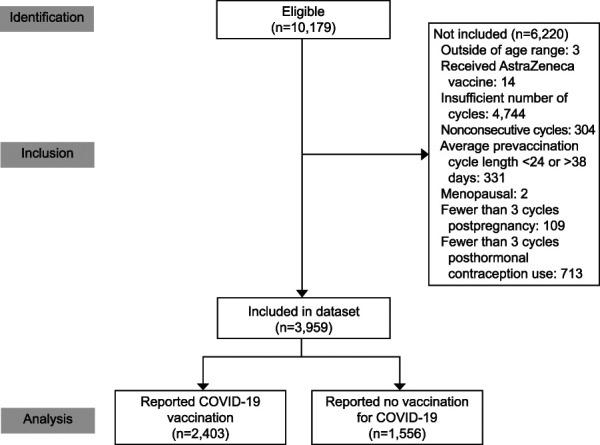
We included 3,959 individuals (vaccinated 2,403; unvaccinated 1,556). Most of the vaccinated cohort received the Pfizer-BioNTech vaccine (55%) (Moderna 35%, Johnson & Johnson/Janssen 7%). Overall, COVID-19 vaccine was associated with a less than 1-day change in cycle length for both vaccine-dose cycles compared with prevaccine cycles (first dose 0.71 day-increase, 98.75% CI 0.47-0.94; second dose 0.91, 98.75% CI 0.63-1.19); unvaccinated individuals saw no significant change compared with three baseline cycles (cycle four 0.07, 98.75% CI -0.22 to 0.35; cycle five 0.12, 98.75% CI -0.15 to 0.39). In adjusted models, the difference in change in cycle length between the vaccinated and unvaccinated cohorts was less than 1 day for both doses (difference in change: first dose 0.64 days, 98.75% CI 0.27-1.01; second dose 0.79 days, 98.75% CI 0.40-1.18). Change in menses length was not associated with vaccination.
CONCLUSION
Coronavirus disease 2019 (COVID-19) vaccination is associated with a small change in cycle length but not menses length.
目的
评估与未接种疫苗的队列相比,接种新冠肺炎(COVID-19)疫苗是否会导致接种疫苗者的周期或经期长度发生变化。
方法
我们使用应用程序“自然周期”对前瞻性跟踪的月经周期数据进行了分析。我们纳入了美国年龄在 18-45 岁之间的居民,这些居民在接种第一剂疫苗前的三个连续周期内具有正常的周期长度(24-38 天),然后是疫苗剂量周期(第 4-6 周期),或者如果未接种疫苗,则在类似时间段内进行六周期。我们计算了个体内的周期和经期长度变化平均值(接种组中前三个疫苗周期与第一剂和第二剂疫苗周期相比,未接种组中前三个周期与第四和第五周期相比)。我们使用混合效应模型估计接种组和未接种组在周期和经期长度变化方面的调整差异。
结果
我们纳入了 3959 名个体(接种组 2403 人,未接种组 1556 人)。接种组中大多数人接种了辉瑞-生物技术公司(Pfizer-BioNTech)疫苗(55%)(莫德纳疫苗 35%,强生/杨森公司 Janssen 疫苗 7%)。总体而言,与接种前周期相比,COVID-19 疫苗接种后疫苗剂量周期的周期长度变化不到 1 天(第一剂增加 0.71 天,98.75%CI 0.47-0.94;第二剂增加 0.91,98.75%CI 0.63-1.19);与三个基线周期相比,未接种疫苗的个体没有明显变化(第四周期增加 0.07,98.75%CI-0.22 至 0.35;第五周期增加 0.12,98.75%CI-0.15 至 0.39)。在调整后的模型中,两剂疫苗之间的周期长度变化差异不到 1 天(变化差异:第一剂 0.64 天,98.75%CI 0.27-1.01;第二剂 0.79 天,98.75%CI 0.40-1.18)。经期长度的变化与接种无关。
结论
COVID-19(新冠肺炎)疫苗接种与周期长度的微小变化有关,但与经期长度无关。

 Zotero 插件