
外源腐胺通过调节甜菜(Beta vulgaris L.)的生理生化特性和基因表达来减轻干旱胁迫的负面影响。
Exogenous putrescine attenuates the negative impact of drought stress by modulating physio-biochemical traits and gene expression in sugar beet (Beta vulgaris L.).
机构信息
Department of Bio-Health Convergence, College of Biomedical Science, Kangwon National University, Chuncheon, Republic of Korea.
Physiology and Sugar Chemistry Division, Bangladesh Sugarcrop Research institute, Ishurdi, Pabna, Bangladesh.
出版信息
PLoS One. 2022 Jan 7;17(1):e0262099. doi: 10.1371/journal.pone.0262099. eCollection 2022.
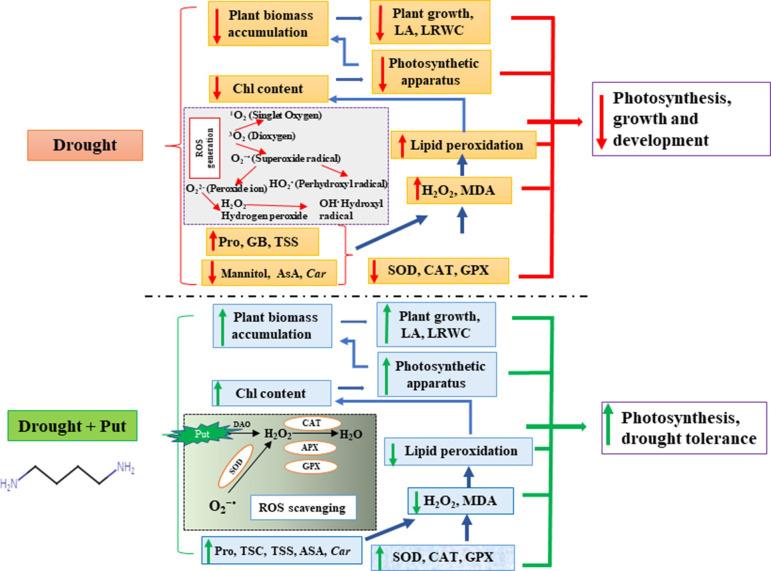
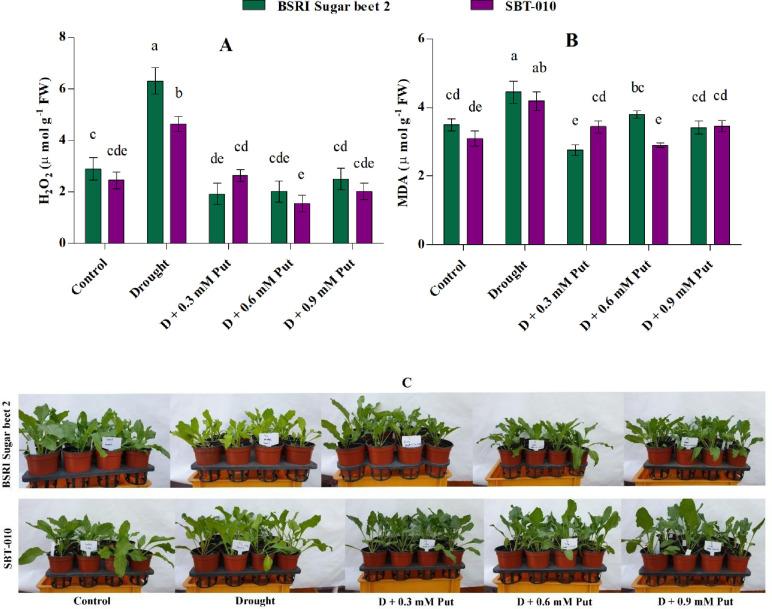
Drought tolerance is a complex trait controlled by many metabolic pathways and genes and identifying a solution to increase the resilience of plants to drought stress is one of the grand challenges in plant biology. This study provided compelling evidence of increased drought stress tolerance in two sugar beet genotypes when treated with exogenous putrescine (Put) at the seedling stage. Morpho-physiological and biochemical traits and gene expression were assessed in thirty-day-old sugar beet seedlings subjected to drought stress with or without Put (0.3, 0.6, and 0.9 mM) application. Sugar beet plants exposed to drought stress exhibited a significant decline in growth and development as evidenced by root and shoot growth characteristics, photosynthetic pigments, antioxidant enzyme activities, and gene expression. Drought stress resulted in a sharp increase in hydrogen peroxide (H2O2) (89.4 and 118% in SBT-010 and BSRI Sugar beet 2, respectively) and malondialdehyde (MDA) (35.6 and 27.1% in SBT-010 and BSRI Sugar beet 2, respectively). These changes were strongly linked to growth retardation as evidenced by principal component analysis (PCA) and heatmap clustering. Importantly, Put-sprayed plants suffered from less oxidative stress as indicated by lower H2O2 and MDA accumulation. They better regulated the physiological processes supporting growth, dry matter accumulation, photosynthetic pigmentation and gas exchange, relative water content; modulated biochemical changes including proline, total soluble carbohydrate, total soluble sugar, and ascorbic acid; and enhanced the activities of antioxidant enzymes and gene expression. PCA results strongly suggested that Put conferred drought tolerance mostly by enhancing antioxidant enzymes activities that regulated homeostasis of reactive oxygen species. These findings collectively provide an important illustration of the use of Put in modulating drought tolerance in sugar beet plants.
耐旱性是一种由许多代谢途径和基因控制的复杂特性,寻找一种提高植物对干旱胁迫适应能力的解决方案是植物生物学中的重大挑战之一。本研究在幼苗期用外源腐胺(Put)处理两种甜菜基因型时,提供了耐旱性提高的有力证据。在有或没有 Put(0.3、0.6 和 0.9 mM)处理的情况下,对 30 天大的甜菜幼苗进行形态生理和生化特性及基因表达评估。暴露于干旱胁迫下的甜菜植物的生长和发育显著下降,这表现在根和茎的生长特征、光合色素、抗氧化酶活性和基因表达上。干旱胁迫导致过氧化氢(H2O2)急剧增加(在 SBT-010 和 BSRI Sugar beet 2 中分别增加了 89.4%和 118%)和丙二醛(MDA)增加(在 SBT-010 和 BSRI Sugar beet 2 中分别增加了 35.6%和 27.1%)。这些变化与生长迟缓密切相关,这一点可以从主成分分析(PCA)和热图聚类中得到证明。重要的是,喷施 Put 的植物受到的氧化应激较小,表现为 H2O2 和 MDA 积累较少。它们更好地调节了支持生长、干物质积累、光合色素和气体交换、相对水含量的生理过程;调节了脯氨酸、总可溶性碳水化合物、总可溶性糖和抗坏血酸等生化变化;增强了抗氧化酶的活性和基因表达。PCA 结果强烈表明,Put 通过增强抗氧化酶的活性来提高甜菜植物的耐旱性,而这些酶的活性调节了活性氧的内稳态。这些发现共同为在甜菜植物中使用 Put 来调节耐旱性提供了重要的例证。




 Zotero 插件