
美国预期寿命城乡差距不断扩大:心血管疾病和其他主要死因的贡献。
The growing rural-urban divide in US life expectancy: contribution of cardiovascular disease and other major causes of death.
机构信息
Harvard Center for Population and Development Studies, Harvard T.H. Chan School of Public Health, Cambridge, MA, USA.
Max Planck Institute for Demographic Research, Rostock, Germany.
出版信息
Int J Epidemiol. 2022 Jan 6;50(6):1970-1978. doi: 10.1093/ije/dyab158. Epub 2021 Aug 12.
BACKGROUND
The US rural disadvantage in life expectancy (LE) relative to urban areas has grown over time. We measured the contribution of cardiovascular disease (CVD), drug-overdose deaths (DODs) and other major causes of death to LE trends in rural and urban counties and the rural-urban LE gap.
METHODS
Counterfactual life tables and cause-of-death decompositions were constructed using data on all US deaths in 1999-2019 (N = 51 998 560) from the Centers for Disease Control and Prevention.
RESULTS
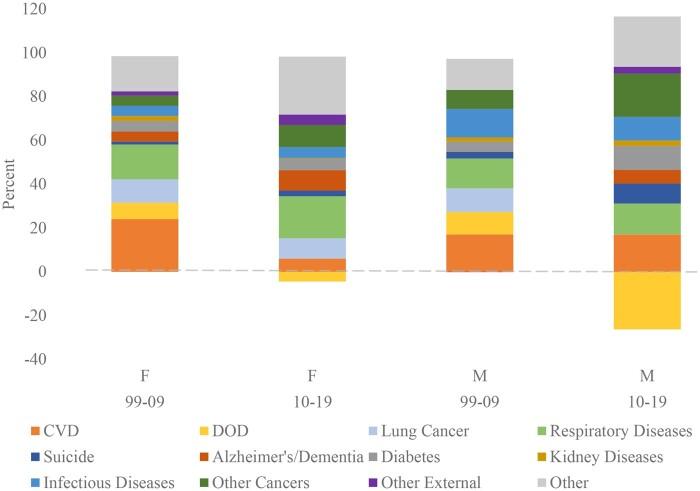
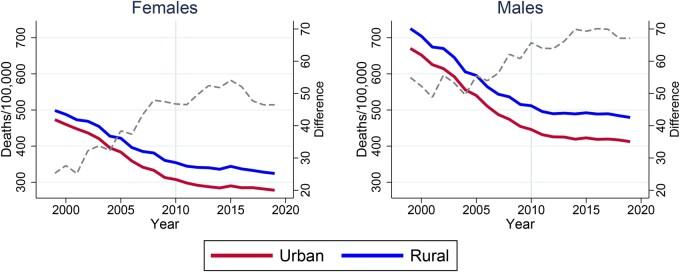
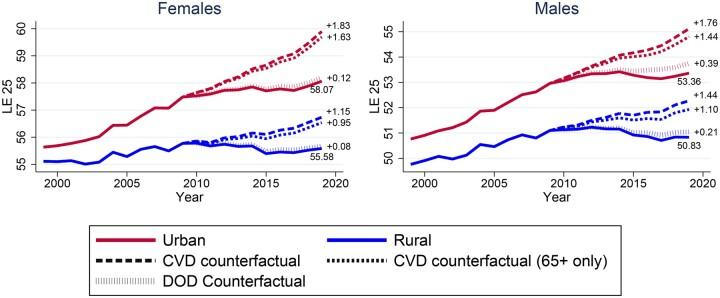
During 1999-2009, rural and urban counties experienced robust LE gains, but urban LE increased by 1.19 years more in women and 0.86 years more in men compared with rural LE. During 2010-2019, rural counties experienced absolute declines in LE (women -0.20, men -0.30 years), whereas urban counties experienced modest increases (women 0.55, men 0.29 years). Counterfactual analysis showed that slowed CVD-mortality declines, particularly in ages 65+ years, were the main reason why rural LE stopped increasing after 2010. However, slow progress in CVD-mortality influenced LE trends more in urban areas. If CVD-mortality had continued to decline at its pre-2010 pace, the rural-urban LE gap would have grown even more post 2010. DODs and other causes of death also contributed to the LE trends and differences in each period, but their impact in comparison to that of CVD was relatively small.
CONCLUSIONS
Rural disadvantage in LE continues to grow, but at a slower pace than pre 2010. This slowdown is more attributable to adverse trends in CVD and DOD mortality in urban areas than improvements in rural areas.
背景
美国农村地区的预期寿命(LE)相对于城市地区的劣势随着时间的推移而不断扩大。我们测量了心血管疾病(CVD)、药物过量死亡(DODs)和其他主要死因对农村和城市县 LE 趋势以及农村-城市 LE 差距的贡献。
方法
使用疾病控制与预防中心(CDC)在 1999-2019 年期间所有美国死亡数据(N=51998560),构建了假设生命表和死因分解。
结果
在 1999-2009 年期间,农村和城市县的 LE 均有显著增长,但与农村 LE 相比,女性 LE 增加了 1.19 年,男性 LE 增加了 0.86 年。在 2010-2019 年期间,农村县的 LE 出现了绝对下降(女性 -0.20 年,男性 -0.30 年),而城市县的 LE 仅略有增加(女性 0.55 年,男性 0.29 年)。假设分析表明,CVD 死亡率下降放缓,特别是在 65 岁以上人群中,是农村 LE 在 2010 年后停止增长的主要原因。然而,CVD 死亡率的缓慢进展对城市地区的 LE 趋势影响更大。如果 CVD 死亡率继续按照 2010 年前的速度下降,那么 2010 年后农村-城市 LE 差距将进一步扩大。DODs 和其他死因也对每个时期的 LE 趋势和差异产生了影响,但与 CVD 相比,其影响相对较小。
结论
农村地区在 LE 方面的劣势仍在继续扩大,但速度比 2010 年前有所放缓。这种放缓更多归因于城市地区 CVD 和 DOD 死亡率的不利趋势,而不是农村地区的改善。

 Zotero 插件