
跨种族孟德尔随机化研究揭示了心血管代谢因素与慢性肾脏病之间的因果关系。
Trans-ethnic Mendelian-randomization study reveals causal relationships between cardiometabolic factors and chronic kidney disease.
机构信息
MRC Integrative Epidemiology Unit (IEU), Bristol Medical School, University of Bristol, Oakfield House, Oakfield Grove, Bristol, UK.
Renal Division, Peking University First Hospital, Peking University Institute of Nephrology, Key Laboratory of Renal Disease, Ministry of Health of China, Key Laboratory of Chronic Kidney Disease Prevention and Treatment (Peking University), Ministry of Education, Beijing, P. R. China.
出版信息
Int J Epidemiol. 2022 Jan 6;50(6):1995-2010. doi: 10.1093/ije/dyab203. Epub 2021 Oct 20.
BACKGROUND
This study was to systematically test whether previously reported risk factors for chronic kidney disease (CKD) are causally related to CKD in European and East Asian ancestries using Mendelian randomization.
METHODS
A total of 45 risk factors with genetic data in European ancestry and 17 risk factors in East Asian participants were identified as exposures from PubMed. We defined the CKD by clinical diagnosis or by estimated glomerular filtration rate of <60 ml/min/1.73 m2. Ultimately, 51 672 CKD cases and 958 102 controls of European ancestry from CKDGen, UK Biobank and HUNT, and 13 093 CKD cases and 238 118 controls of East Asian ancestry from Biobank Japan, China Kadoorie Biobank and Japan-Kidney-Biobank/ToMMo were included.
RESULTS
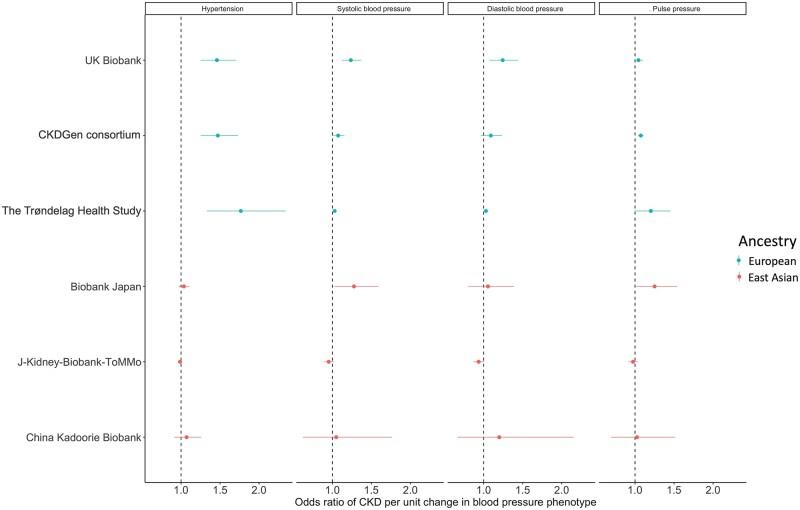
Eight risk factors showed reliable evidence of causal effects on CKD in Europeans, including genetically predicted body mass index (BMI), hypertension, systolic blood pressure, high-density lipoprotein cholesterol, apolipoprotein A-I, lipoprotein(a), type 2 diabetes (T2D) and nephrolithiasis. In East Asians, BMI, T2D and nephrolithiasis showed evidence of causality on CKD. In two independent replication analyses, we observed that increased hypertension risk showed reliable evidence of a causal effect on increasing CKD risk in Europeans but in contrast showed a null effect in East Asians. Although liability to T2D showed consistent effects on CKD, the effects of glycaemic phenotypes on CKD were weak. Non-linear Mendelian randomization indicated a threshold relationship between genetically predicted BMI and CKD, with increased risk at BMI of >25 kg/m2.
CONCLUSIONS
Eight cardiometabolic risk factors showed causal effects on CKD in Europeans and three of them showed causality in East Asians, providing insights into the design of future interventions to reduce the burden of CKD.
背景
本研究旨在通过孟德尔随机化,系统检验先前报道的慢性肾脏病(CKD)风险因素是否与欧洲和东亚血统人群的 CKD 有因果关系。
方法
共从 PubMed 中确定了 45 个欧洲血统的风险因素和 17 个东亚参与者的风险因素作为暴露因素。我们将 CKD 定义为临床诊断或肾小球滤过率<60 ml/min/1.73 m2。最终,纳入了 51,672 例欧洲血统的 CKD 病例和 958,102 例对照者,分别来自 CKDGen、英国生物银行和 HUNT 研究;纳入了 13,093 例东亚血统的 CKD 病例和 238,118 例对照者,分别来自日本生物银行、中国慢性病前瞻性研究和日本-肾脏生物银行/ToMMo。
结果
有 8 个风险因素在欧洲人群中显示出与 CKD 有因果关系的可靠证据,包括遗传预测的体重指数(BMI)、高血压、收缩压、高密度脂蛋白胆固醇、载脂蛋白 A-I、脂蛋白(a)、2 型糖尿病(T2D)和肾结石。在东亚人群中,BMI、T2D 和肾结石与 CKD 有因果关系。在两项独立的复制分析中,我们观察到高血压风险增加在欧洲人群中显示出与 CKD 风险增加有可靠的因果关系,但在东亚人群中则显示出无效。尽管 T2D 的易感性对 CKD 有一致的影响,但血糖表型对 CKD 的影响较弱。非线性孟德尔随机化表明,遗传预测的 BMI 与 CKD 之间存在阈值关系,BMI 增加>25 kg/m2 时风险增加。
结论
有 8 个心血管代谢风险因素在欧洲人群中与 CKD 有因果关系,其中 3 个在东亚人群中也有因果关系,这为设计未来减少 CKD 负担的干预措施提供了新的思路。


 Zotero 插件