
生殖因素对女性肠型胃 Lauren 型胃癌的影响:韩国多中心回顾性研究。
Effects of Reproductive Factors on Lauren Intestinal-Type Gastric Cancers in Females: A Multicenter Retrospective Study in South Korea.
机构信息
Division of Gastrointestinal Surgery, Department of Surgery, Incheon St. Mary's Hospital, College of Medicine, The Catholic University of Korea, Incheon, Korea.
Department of Internal Medicine, Gyeongsang National University Changwon Hospital, Gyeongsang National University College of Medicine, Changwon, Korea.
出版信息
Gut Liver. 2022 Sep 15;16(5):706-715. doi: 10.5009/gnl210293. Epub 2022 Jan 7.
BACKGROUND/AIMS: Gastric cancers (GCs), particularly the Lauren intestinal type, show a male predominance. The aim of this study was to investigate the effects of reproductive factors on GCs in females, according to Lauren classification.
METHODS
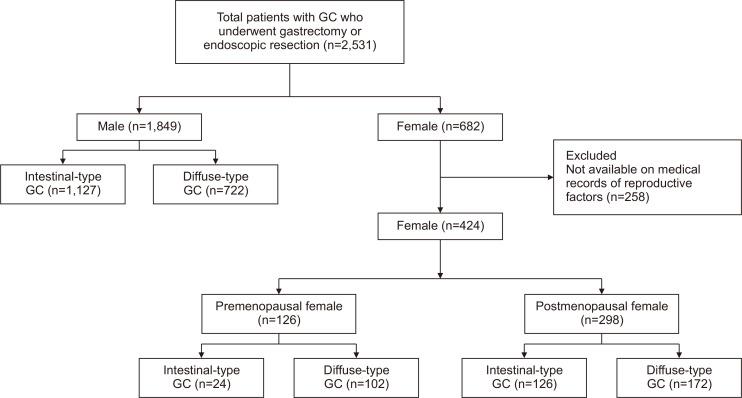
Medical records of 1,849 males and 424 females who underwent radical gastrectomy or endoscopic resection for GCs between 2010 and 2018 were reviewed. The incidences of intestinal-type GCs were compared between males and groups of females stratified according to postmenopausal period. Associations between reproductive factors in females and intestinaltype GCs were analyzed using multivariate models.
RESULTS
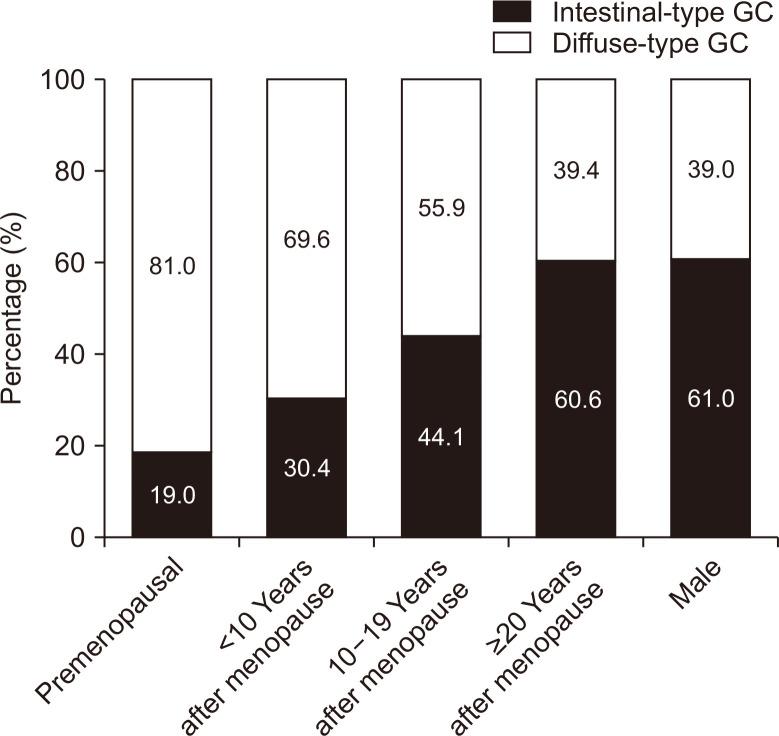
The proportions of intestinal-type GCs were significantly lower in premenopausal (19%), less than 10 years postmenopausal (30.4%), and 10 to 19 years postmenopausal females (44.1%) than in males (61.0%) (p<0.05 for all). Females ≥20 years postmenopause had a proportion of intestinal-type GCs similar to that in males (60.6% vs 61.0%; p=0.948). Multivariate analysis revealed that age (odds ratio [OR], 1.075; 95% confidence interval [CI], 1.039 to 1.113; p<0.001) and parity ≥3 (OR, 1.775; 95% CI, 1.012 to 3.114; p=0.045) were positively associated with an increased risk of intestinal-type GCs in postmenopausal females, while long fertility duration (OR, 1.147; 95% CI, 1.043 to 1.261; p=0.005) was positively associated with an increased risk of intestinal-type GCs in premenopausal females.
CONCLUSIONS
There were no significant differences in the proportions of intestinal-type GCs between males and females ≥20 years postmenopause, suggesting that female reproductive factors play a role in the prevention of intestinal-type GC.
背景/目的:胃癌(GCs),特别是肠型,表现为男性优势。本研究旨在根据Lauren 分类,探讨生殖因素对女性 GCs 的影响。
方法
回顾 2010 年至 2018 年间接受根治性胃切除术或内镜下切除术的 1849 名男性和 424 名女性的病历。比较男性和绝经后不同阶段女性组肠型 GCs 的发生率。采用多变量模型分析女性生殖因素与肠型 GCs 的关系。
结果
绝经前(19%)、绝经后 10 年以内(30.4%)和绝经后 10-19 年(44.1%)女性的肠型 GCs 比例明显低于男性(61.0%)(p<0.05 均)。绝经后≥20 年的女性肠型 GCs 比例与男性相似(60.6%与 61.0%;p=0.948)。多变量分析显示,年龄(比值比[OR],1.075;95%置信区间[CI],1.039 至 1.113;p<0.001)和产次≥3(OR,1.775;95%CI,1.012 至 3.114;p=0.045)与绝经后女性肠型 GCs 风险增加呈正相关,而较长的生育期(OR,1.147;95%CI,1.043 至 1.261;p=0.005)与绝经前女性肠型 GCs 风险增加呈正相关。
结论
绝经后≥20 年的男性和女性肠型 GCs 比例无显著差异,提示女性生殖因素在预防肠型 GC 中起作用。
 Zotero 插件