
伊布替尼联合奥滨尤妥珠单抗、苯丁酸氮芥联合奥滨尤妥珠单抗一线治疗慢性淋巴细胞白血病:随机、III 期 iLLUMINATE 试验的最终分析。
First-line treatment of chronic lymphocytic leukemia with ibrutinib plus obinutuzumab chlorambucil plus obinutuzumab: final analysis of the randomized, phase III iLLUMINATE trial.
机构信息
Hospital de la Santa Creu i Sant Pau, Autonomous University of Barcelona, Barcelona, Spain.
3rd Medical Department, Paracelsus Medical University, Salzburg Cancer Research Institute-CCCIT, Salzburg, Austria.
出版信息
Haematologica. 2022 Sep 1;107(9):2108-2120. doi: 10.3324/haematol.2021.279012.
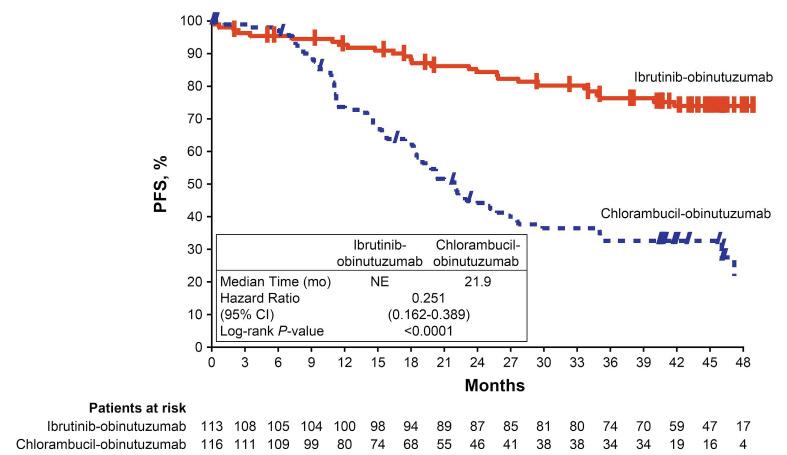
iLLUMINATE is a randomized, open-label phase III study of ibrutinib plus obinutuzumab (n=113) versus chlorambucil plus obinutuzumab (n=116) as first-line therapy for patients with chronic lymphocytic leukemia or small lymphocytic lymphoma. Eligible patients were aged ≥65 years, or <65 years with coexisting conditions. Patients received oral ibrutinib 420 mg once daily until disease progression or unacceptable toxicity or six cycles of oral chlorambucil, each in combination with six cycles of intravenous obinutuzumab. After a median follow-up of 45 months (range, 0.2-52), median progression-free survival continued to be significantly longer in the ibrutinib plus obinutuzumab arm than in the chlorambucil plus obinutuzumab arm (median not reached versus 22 months; hazard ratio=0.25; 95% confidence interval: 0.16-0.39; P<0.0001). The best overall rate of undetectable minimal residual disease (<0.01% by flow cytometry) remained higher with ibrutinib plus obinutuzumab (38%) than with chlorambucil plus obinutuzumab (25%). With a median treatment duration of 42 months, 13 months longer than the primary analysis, no new safety signals were identified for ibrutinib. As is typical for ibrutinib-based regimens, common grade ≥3 adverse events were most prevalent in the first 6 months of ibrutinib plus obinutuzumab treatment and generally decreased over time, except for hypertension. In this final analysis with up to 52 months of follow-up (median 45 months), ibrutinib plus obinutuzumab showed sustained clinical benefit, in terms of progression- free survival, in first-line treatment of chronic lymphocytic leukemia, including in patients with high-risk features. ClinicalTrials.gov identifier: NCT02264574.
ILLUMINATE 是一项随机、开放标签的 III 期研究,比较伊布替尼联合奥滨尤妥珠单抗(n=113)与苯丁酸氮芥联合奥滨尤妥珠单抗(n=116)作为初治慢性淋巴细胞白血病或小淋巴细胞淋巴瘤患者的一线治疗方案。入组患者年龄≥65 岁,或<65 岁但合并有其他疾病。患者接受伊布替尼 420mg 口服,每日一次,直至疾病进展或无法耐受毒性,或接受苯丁酸氮芥口服治疗 6 个周期,每个周期联合奥滨尤妥珠单抗静脉输注 6 个周期。中位随访 45 个月(范围:0.2-52)后,伊布替尼联合奥滨尤妥珠单抗组中位无进展生存期(PFS)持续显著长于苯丁酸氮芥联合奥滨尤妥珠单抗组(中位未达到 vs 22 个月;风险比[HR]=0.25;95%置信区间[CI]:0.16-0.39;P<0.0001)。伊布替尼联合奥滨尤妥珠单抗组完全缓解(流式细胞术检测微小残留病灶<0.01%)和伴非常好的部分缓解(VGPR)率更高(38%),而苯丁酸氮芥联合奥滨尤妥珠单抗组为 25%。中位治疗时间为 42 个月,比主要分析延长了 13 个月,伊布替尼无新的安全性信号。与基于伊布替尼的方案一样,伊布替尼联合奥滨尤妥珠单抗治疗的前 6 个月最常见的≥3 级不良事件,且随着时间推移一般会减少,除高血压外。在这项最终分析中,随访时间最长达 52 个月(中位 45 个月),伊布替尼联合奥滨尤妥珠单抗在慢性淋巴细胞白血病的一线治疗中持续显示出临床获益,包括高风险特征的患者。临床试验注册:NCT02264574。



 Zotero 插件