
新冠大流行对英格兰儿童感染的间接影响:基于人群的观察性研究。
Indirect effects of the covid-19 pandemic on childhood infection in England: population based observational study.
机构信息
Oxford Vaccine Group, Department of Paediatrics, University of Oxford, Oxford, UK
NIHR Oxford Biomedical Research Centre, Oxford, UK.
出版信息
BMJ. 2022 Jan 12;376:e067519. doi: 10.1136/bmj-2021-067519.
OBJECTIVE
To assess the impact of the covid-19 pandemic on hospital admission rates and mortality outcomes for childhood respiratory infections, severe invasive infections, and vaccine preventable disease in England.
DESIGN
Population based observational study of 19 common childhood respiratory, severe invasive, and vaccine preventable infections, comparing hospital admission rates and mortality outcomes before and after the onset of the pandemic in England.
SETTING
Hospital admission data from every NHS hospital in England from 1 March 2017 to 30 June 2021 with record linkage to national mortality data.
POPULATION
Children aged 0-14 years admitted to an NHS hospital with a selected childhood infection from 1 March 2017 to 30 June 2021.
MAIN OUTCOME MEASURES
For each infection, numbers of hospital admissions every month from 1 March 2017 to 30 June 2021, percentage changes in the number of hospital admissions before and after 1 March 2020, and adjusted odds ratios to compare 60 day case fatality outcomes before and after 1 March 2020.
RESULTS
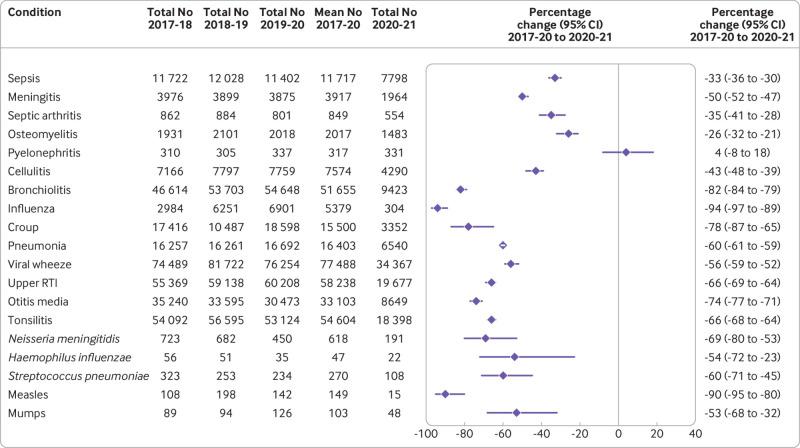
After 1 March 2020, substantial and sustained reductions in hospital admissions were found for all but one of the 19 infective conditions studied. Among the respiratory infections, the greatest percentage reductions were for influenza (mean annual number admitted between 1 March 2017 and 29 February 2020 was 5379 and number of children admitted from 1 March 2020 to 28 February 2021 was 304, 94% reduction, 95% confidence interval 89% to 97%), and bronchiolitis (from 51 655 to 9423, 82% reduction, 95% confidence interval 79% to 84%). Among the severe invasive infections, the greatest reduction was for meningitis (50% reduction, 47% to 52%). For the vaccine preventable infections, reductions ranged from 53% (32% to 68%) for mumps to 90% (80% to 95%) for measles. Reductions were seen across all demographic subgroups and in children with underlying comorbidities. Corresponding decreases were also found for the absolute numbers of 60 day case fatalities, although the proportion of children admitted for pneumonia who died within 60 days increased (age-sex adjusted odds ratio 1.71, 95% confidence interval 1.43 to 2.05). More recent data indicate that some respiratory infections increased to higher levels than usual after May 2021.
CONCLUSIONS
During the covid-19 pandemic, a range of behavioural changes (adoption of non-pharmacological interventions) and societal strategies (school closures, lockdowns, and restricted travel) were used to reduce transmission of SARS-CoV-2, which also reduced admissions for common and severe childhood infections. Continued monitoring of these infections is required as social restrictions evolve.
目的
评估新冠疫情对英格兰儿童呼吸道感染、严重侵袭性感染和疫苗可预防疾病的住院率和死亡率结局的影响。
设计
对 19 种常见的儿童呼吸道、严重侵袭性和疫苗可预防感染进行基于人群的观察性研究,比较英格兰大流行前后的住院率和死亡率结局。
地点
2017 年 3 月 1 日至 2021 年 6 月 30 日期间,英国每个国民保健服务(NHS)医院的入院数据,并与全国死亡率数据进行记录链接。
人群
2017 年 3 月 1 日至 2021 年 6 月 30 日期间,因选定的儿童感染而入住 NHS 医院的 0-14 岁儿童。
主要观察指标
对于每种感染,2017 年 3 月 1 日至 2021 年 6 月 30 日期间,每月的住院人数;大流行前和大流行后(2020 年 3 月 1 日之前)住院人数的百分比变化;以及比较 2020 年 3 月 1 日前后 60 天病死率的调整比值比。
结果
在 2020 年 3 月 1 日之后,研究的 19 种感染性疾病中,除了一种疾病外,其他所有疾病的住院率都出现了大幅且持续的下降。在呼吸道感染中,最大的百分比降幅出现在流感(2017 年 3 月 1 日至 2020 年 2 月 29 日期间,平均每年住院人数为 5379 人,2020 年 3 月 1 日至 2021 年 2 月 28 日期间,住院人数为 304 人,下降 94%,95%置信区间为 89%至 97%)和细支气管炎(从 51655 人降至 9423 人,下降 82%,95%置信区间为 79%至 84%)。在严重侵袭性感染中,降幅最大的是脑膜炎(下降 50%,47%至 52%)。对于疫苗可预防的感染,降幅范围从腮腺炎的 53%(32%至 68%)到麻疹的 90%(80%至 95%)。所有亚组人群和有基础合并症的儿童中都出现了降幅。尽管肺炎患儿住院 60 天内死亡的比例增加(年龄和性别调整后的比值比为 1.71,95%置信区间为 1.43 至 2.05),但与 60 天病死率相关的绝对人数也有所下降。最近的数据表明,自 2021 年 5 月以来,一些呼吸道感染的水平上升到了高于正常的水平。
结论
在新冠疫情期间,采用了一系列行为改变(非药物干预措施的采用)和社会策略(学校关闭、封锁和限制旅行)来减少 SARS-CoV-2 的传播,这也降低了常见和严重儿童感染的住院率。随着社会限制的演变,需要继续监测这些感染。


 Zotero 插件