
约旦经验:新冠疫情期间的互联网药店药品配送平台
Jordanian experience: The internet pharmacy drug delivery platform during the COVID-19.
作者信息
Hammour Khawla Abu, Abdeljalil Mariam, Manaseer Qusai, Al-Manaseer Bayan
机构信息
Department of Biopharmaceutics and Clinical Pharmacy, Faculty of Pharmacy, The University of Jordan, Amman 11942 Jordan.
Faculty of Medicine/The University of Jordan, Amman 11942 Jordan.
出版信息
Health Policy Technol. 2022 Mar;11(1):100596. doi: 10.1016/j.hlpt.2022.100596. Epub 2022 Jan 7.
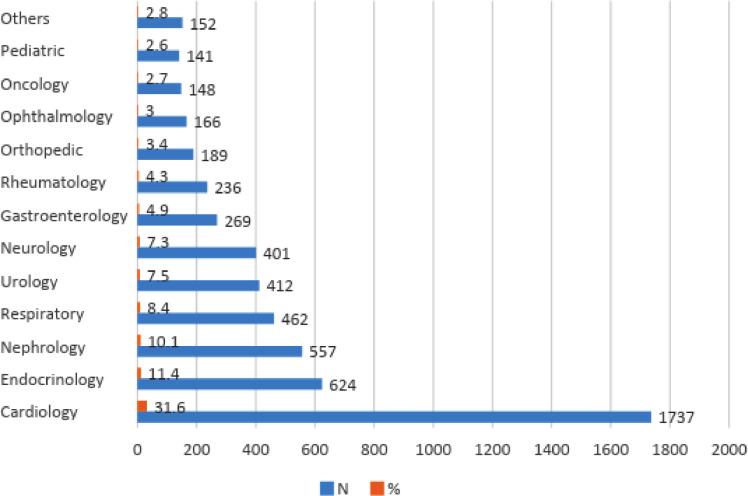
The present study aimed to see how well the newly designed internet hospital drug delivery platform model worked in the pharmacy department during the COVID-19 pandemic to make it easier for patients to get their prescribed drugs during the home quarantine. The internet hospital drug delivery platform was designed and activated by the pharmacy department in collaboration with the information technology department. The pharmacy department, in partnership with the information technology department, built and launched the internet hospital drug delivery platform (IHDD) immediately after the Jordanian government declared a full lockdown. During the quarantine, a total of 5994 prescriptions, including 28494 medications, were delivered to 4853 patients. The majority of the patients ( = 1835; 37.8%) were aged 60 to 74.Nearly three quarters (4722; 78.8%) of the patients were from Amman, the capital of Jordan, and the top five online prescription departments were cardiology ( 1737, 31.6%), endocrinology ( 624, 11.4%), nephrology ( 557, 10.1%), respiratory ( 462, 8.4%), and neurology ( 412, 7.5%). The IHDD platform was found to be efficient and convenient because it handled the challenge of precisely delivering medications to patients on time. To meet the pandemic's challenge, the pharmacy department has extended its inventive powers. In addition to safeguarding the environment, health technology was used to provide a coordinated, systematic program for the administration of medications. The pharmacy department, in partnership with the information technology department, built and deployed the internet hospital drug distribution infrastructure shortly after Jordan's government proclaimed a full lockdown. During the quarantine, a total of 5994 prescriptions, including 28494 medications, were delivered to 4853 patients. The majority of the patients ( 1835; 37.8%) were between the ages of 60 and 74.Nearly three quarters (4722; 78.8%) of the patients were from Amman, the capital of Jordan, and the top five online prescription departments were cardiology ( 1737, 31.6%), endocrinology ( 624, 11.4%), nephrology ( 557, 10.1%), respiratory ( 462, 8.4%), and urology ( 412, 7.5%). The pharmacy department has expanded its capabilities creatively to face the challenge posed by the pandemic. Health technology was utilized to ensure a coordinated, systematic program for the delivery of medications, in addition to preserving the safety of the dedicated staff.
本研究旨在观察新设计的互联网医院药品配送平台模式在新冠疫情期间药房的运行情况,以便让患者在居家隔离期间更便捷地获取处方药。互联网医院药品配送平台由药房与信息技术部门合作设计并启用。在约旦政府宣布全面封锁后,药房与信息技术部门立即构建并推出了互联网医院药品配送平台(IHDD)。在隔离期间,共向4853名患者配送了5994张处方,包括28494种药品。大多数患者(1835人,占37.8%)年龄在60至74岁之间。近四分之三(4722人,占78.8%)的患者来自约旦首都安曼,在线处方量排名前五的科室是心脏病科(1737例,占31.6%)、内分泌科(624例,占11.4%)、肾内科(557例,占10.1%)、呼吸科(462例,占8.4%)和神经科(412例,占7.5%)。结果发现,IHDD平台高效且便捷,因为它成功应对了按时精确配送药品给患者的挑战。为应对疫情挑战,药房发挥了创新能力。除保护环境外,还利用健康技术提供了一个协调、系统的用药管理方案。在约旦政府宣布全面封锁后不久,药房与信息技术部门合作构建并部署了互联网医院药品配送基础设施。在隔离期间,共向4853名患者配送了5994张处方,包括28494种药品。大多数患者(1835人,占37.8%)年龄在60至74岁之间。近四分之三(4722人,占78.8%)的患者来自约旦首都安曼,在线处方量排名前五的科室是心脏病科(1737例,占31.6%)、内分泌科(624例,占11.4%)、肾内科(557例,占10.1%)、呼吸科(462例,占8.4%)和泌尿外科(412例,占7.5%)。药房创造性地扩展了其能力,以应对疫情带来的挑战。除了保障专门工作人员的安全外,还利用健康技术确保了一个协调、系统的药品配送方案。

 Zotero 插件