
单细胞分析揭示了 MDM2 抑制后 TP53 突变克隆的选择。
Single-cell analysis reveals selection of TP53-mutated clones after MDM2 inhibition.
机构信息
Assistance Publique - Hôpitaux de Paris (AP-HP), Hopital Saint-Louis, laboratoire de Biologie Cellulaire, Paris, France.
Université de Paris, U1131 INSERM, Institut de Recherche Saint-Louis (IRSL), Paris, France.
出版信息
Blood Adv. 2022 May 10;6(9):2813-2823. doi: 10.1182/bloodadvances.2021005867.
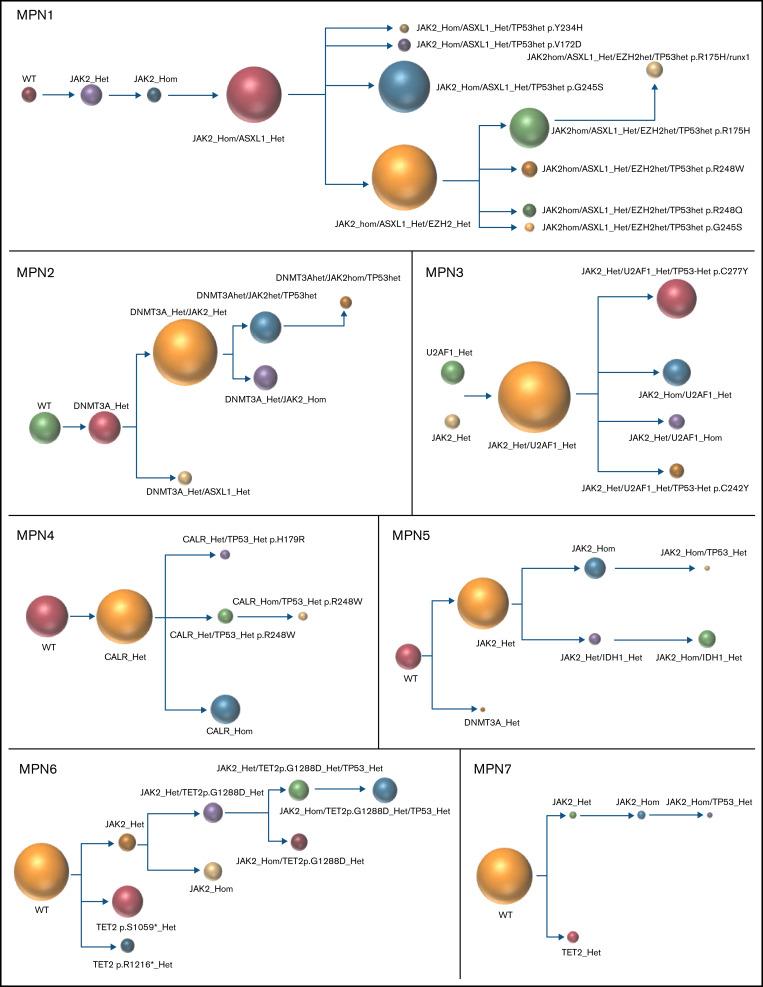
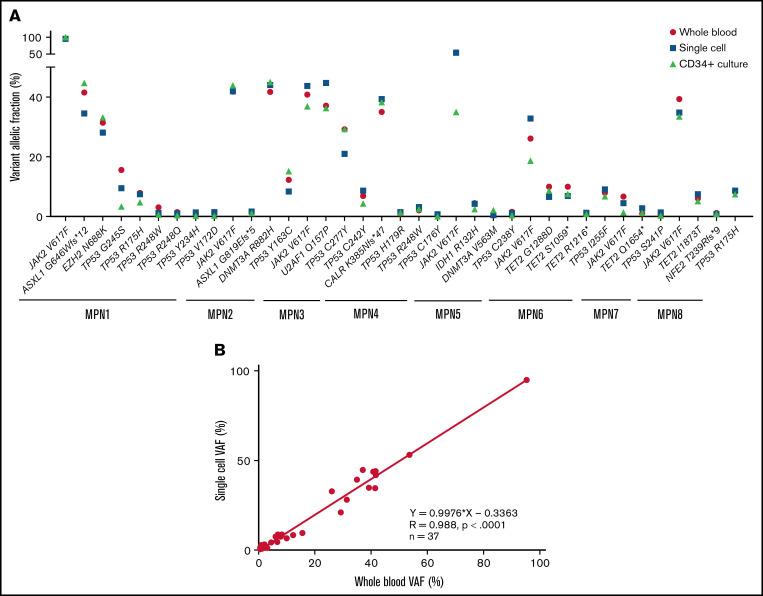
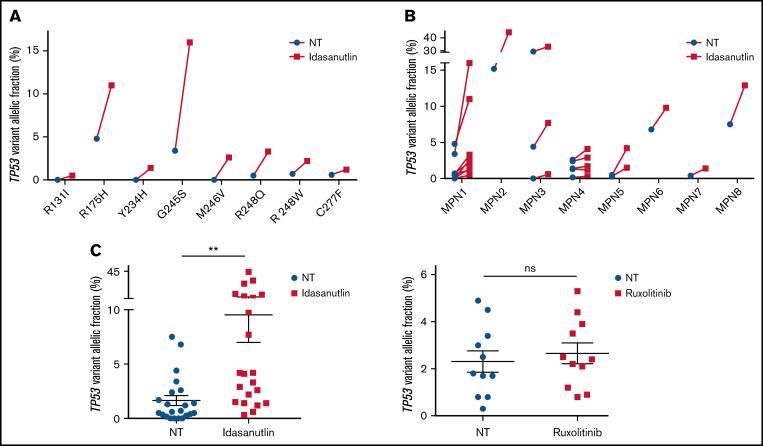
The mechanisms of transformation of chronic myeloproliferative neoplasms (MPN) to leukemia are largely unknown, but TP53 mutations acquisition is considered a key event in this process. p53 is a main tumor suppressor, but mutations in this protein per se do not confer a proliferative advantage to the cells, and a selection process is needed for the expansion of mutant clones. MDM2 inhibitors may rescue normal p53 from degradation and have been evaluated in a variety of cancers with promising results. However, the impact of these drugs on TP53-mutated cells is underexplored. We report herein evidence of a direct effect of MDM2 inhibition on the selection of MPN patients' cells harboring TP53 mutations. To decipher whether these mutations can arise in a specific molecular context, we used a DNA single-cell approach to determine the clonal architecture of TP53-mutated cells. We observed that TP53 mutations are late events in MPN, mainly occurring in the driver clone, whereas clonal evolution frequently consists of sequential branching instead of linear consecutive acquisition of mutations in the same clone. At the single-cell level, the presence of additional mutations does not influence the selection of TP53 mutant cells by MDM2 inhibitor treatment. Also, we describe an in vitro test allowing to predict the emergence of TP53 mutated clones. Altogether, this is the first demonstration that a drug treatment can directly favor the emergence of TP53-mutated subclones in MPN.
慢性骨髓增殖性肿瘤(MPN)向白血病转化的机制在很大程度上尚不清楚,但 TP53 突变的获得被认为是这一过程中的关键事件。p53 是一种主要的肿瘤抑制因子,但该蛋白的突变本身并不能赋予细胞增殖优势,需要一个选择过程来扩大突变克隆。MDM2 抑制剂可以挽救正常的 p53 免于降解,并已在多种癌症中进行了评估,结果有一定前景。然而,这些药物对 TP53 突变细胞的影响还没有得到充分的探索。我们在此报告了 MDM2 抑制对携带 TP53 突变的 MPN 患者细胞选择的直接影响的证据。为了解释这些突变是否可以在特定的分子背景下产生,我们使用 DNA 单细胞方法来确定 TP53 突变细胞的克隆结构。我们观察到,TP53 突变是 MPN 的晚期事件,主要发生在驱动克隆中,而克隆进化通常由顺序分支组成,而不是在同一克隆中连续获得突变。在单细胞水平上,额外突变的存在并不影响 MDM2 抑制剂治疗对 TP53 突变细胞的选择。此外,我们还描述了一种体外测试,可以预测 TP53 突变克隆的出现。总之,这是第一个证明药物治疗可以直接促进 MPN 中 TP53 突变亚克隆的出现的证据。


 Zotero 插件