
一项基于网络和移动设备的干预措施,用于乳腺癌治疗女性管理与淋巴水肿相关的慢性疼痛和症状:一项随机临床试验的结果
A Web- and Mobile-Based Intervention for Women Treated for Breast Cancer to Manage Chronic Pain and Symptoms Related to Lymphedema: Results of a Randomized Clinical Trial.
作者信息
Fu Mei Rosemary, Axelrod Deborah, Guth Amber A, Scagliola Joan, Rampertaap Kavita, El-Shammaa Nardin, Qiu Jeanna M, McTernan Melissa L, Frye Laura, Park Christopher S, Yu Gary, Tilley Charles, Wang Yao
机构信息
School of Nursing-Camden, Rutgers University, Camden, NJ, United States.
Department of Surgery, School of Medicine, New York University, New York, NY, United States.
出版信息
JMIR Cancer. 2022 Jan 17;8(1):e29485. doi: 10.2196/29485.
BACKGROUND
The-Optimal-Lymph-Flow (TOLF) is a patient-centered, web- and mobile-based mHealth system that delivers safe, easy, and feasible digital therapy of lymphatic exercises and limb mobility exercises.
OBJECTIVE
The purpose of this randomized clinical trial (RCT) was to evaluate the effectiveness of the web- and mobile-based TOLF system for managing chronic pain and symptoms related to lymphedema. The primary outcome includes pain reduction, and the secondary outcomes focus on symptom relief, limb volume difference measured by infrared perometer, BMI, and quality of life (QOL) related to pain. We hypothesized that participants in the intervention group would have improved pain and symptom experiences, limb volume difference, BMI, and QOL.
METHODS
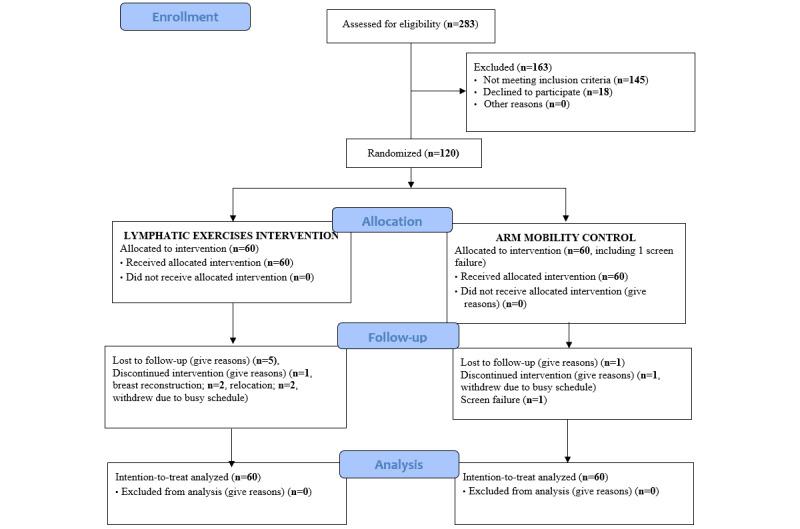
A parallel RCT with a control-experimental, pre- and posttest, and repeated-measures design were used. A total of 120 patients were recruited face-to-face at the point of care during clinical visits. Patients were randomized according to pain in a 1:1 ratio into either the arm precaution (AP) control group to improve limb mobility and arm protection or The-Optimal-Lymph flow (TOLF) intervention group to promote lymph flow and limb mobility. Trial outcomes were evaluated at baseline and at week 12 after the intervention. Descriptive statistics, Fisher exact tests, Wilcoxon rank-sum tests, t test, and generalized linear mixed effects models were performed for data analysis.
RESULTS
At the study endpoint of 12 weeks, significantly fewer patients in the TOLF intervention group compared with the AP control group reported chronic pain (45% [27/60] vs 70% [42/60]; odds ratio [OR] 0.39, 95% CI 0.17-0.90; P=.02). Patients who received the TOLF intervention were significantly more likely to achieve a complete reduction in pain (50% [23/46] vs 22% [11/51]; OR 3.56, 95% CI 1.39-9.76; P=.005) and soreness (43% [21/49] vs 22% [11/51]; OR 2.60, 95% CI 1.03-6.81; P=.03). Significantly lower median severity scores were found in the TOLF group for chronic pain (MedTOLF=0, IQR 0-1 vs MedAP=1, IQR 0-2; P=.02) and general bodily pain (MedTOLF=1, IQR=0-1.5 vs MedAP=1, IQR 1-3; P=.04). Compared with the AP control group, significantly fewer patients in the TOLF group reported arm/hand swelling (P=.04), heaviness (P=.03), redness (P=.03), and limited movement in shoulder (P=.02) and arm (P=.03). No significant differences between the TOLF and AP groups were found in complete reduction of aching (P=.12) and tenderness (P=.65), mean numbers of lymphedema symptom reported (P=.11), ≥5% limb volume differences (P=.48), and BMI (P=.12).
CONCLUSIONS
The TOLF intervention had significant benefits for breast cancer survivors to manage chronic pain, soreness, general bodily pain, arm/hand swelling, heaviness, and impaired limb mobility. The intervention resulted in a 13% reduction (from 40% [24/60] to 27% [16/60]) in proportions of patients who took pain medications compared with the AP control group, which had a 5% increase (from 40% [24/60] to 45% [27/60]). A 12% reduction (from 27% [16/60] to 15% [9/60]) in proportions of patients with ≥5% limb volume differences was found in the TOLF intervention, while a 5% increase in the AP control group (from 40% [24/60] to 45% [27/60]) was found. In conclusion, the TOLF intervention can be a better choice for breast cancer survivors to reduce chronic pain and limb volume.
TRIAL REGISTRATION
Clinicaltrials.gov NCT02462226; https://clinicaltrials.gov/ct2/show/NCT02462226.
INTERNATIONAL REGISTERED REPORT IDENTIFIER (IRRID): RR2-10.2196/resprot.5104.
背景
最佳淋巴引流(The-Optimal-Lymph-Flow,TOLF)是一种以患者为中心的、基于网络和移动设备的移动健康(mHealth)系统,可提供安全、简便且可行的淋巴运动和肢体活动锻炼的数字疗法。
目的
本随机临床试验(RCT)的目的是评估基于网络和移动设备的TOLF系统对管理与淋巴水肿相关的慢性疼痛和症状的有效性。主要结局包括疼痛减轻,次要结局侧重于症状缓解、通过红外周长仪测量的肢体体积差异、体重指数(BMI)以及与疼痛相关的生活质量(QOL)。我们假设干预组的参与者在疼痛和症状体验、肢体体积差异、BMI和QOL方面会有所改善。
方法
采用平行RCT,采用对照-实验、前后测和重复测量设计。在临床就诊时于护理点面对面招募了总共120名患者。根据疼痛情况以1:1的比例将患者随机分为手臂预防(AP)对照组以改善肢体活动能力和手臂保护,或最佳淋巴引流(TOLF)干预组以促进淋巴流动和肢体活动能力。在基线和干预后第12周评估试验结局。进行描述性统计、Fisher精确检验、Wilcoxon秩和检验、t检验和广义线性混合效应模型进行数据分析。
结果
在12周的研究终点,与AP对照组相比,TOLF干预组报告慢性疼痛的患者明显更少(45%[27/60]对70%[42/60];优势比[OR]0.39,95%置信区间[CI]0.17 - 0.90;P = 0.02)。接受TOLF干预的患者更有可能实现疼痛完全缓解(50%[23/46]对22%[11/51];OR 3.56,95%CI 1.39 - 9.76;P = 0.005)和酸痛缓解(43%[21/49]对22%[11/51];OR 2.60,95%CI 1.03 - 6.81;P = 0.03)。TOLF组慢性疼痛(MedTOLF = 0,四分位间距[IQR]0 - 1对MedAP = 1,IQR 0 - 2;P = 0.02)和全身疼痛(MedTOLF = 1,IQR = 0 - 1.5对MedAP = 1,IQR 1 - 3;P = 0.04)的中位数严重程度得分显著更低。与AP对照组相比,TOLF组报告手臂/手部肿胀(P = 0.04)、沉重感(P = 0.03)、发红(P = 0.03)以及肩部(P = 0.02)和手臂(P = 0.03)活动受限的患者明显更少。在疼痛完全缓解(P = 0.12)和压痛(P = 0.6
 Zotero 插件