
在巴西发现一种新型严重急性呼吸综合征冠状病毒2(SARS-CoV-2)P.1亚谱系,为关注变异株的出现机制提供了新见解。
Identification of a novel SARS-CoV-2 P.1 sub-lineage in Brazil provides new insights about the mechanisms of emergence of variants of concern.
作者信息
Gräf Tiago, Bello Gonzalo, Venas Taina Moreira Martins, Pereira Elisa Cavalcante, Paixão Anna Carolina Dias, Appolinario Luciana Reis, Lopes Renata Serrano, Mendonça Ana Carolina Da Fonseca, da Rocha Alice Sampaio Barreto, Motta Fernando Couto, Gregianini Tatiana Schäffer, Salvato Richard Steiner, Fernandes Sandra Bianchini, Rovaris Darcita Buerger, Cavalcanti Andrea Cony, Leite Anderson Brandão, Riediger Irina, Debur Maria do Carmo, Bernardes André Felipe Leal, Ribeiro-Rodrigues Rodrigo, Grinsztejn Beatriz, Alves do Nascimento Valdinete, de Souza Victor Costa, Gonçalves Luciana, da Costa Cristiano Fernandes, Mattos Tirza, Dezordi Filipe Zimmer, Wallau Gabriel Luz, Naveca Felipe Gomes, Delatorre Edson, Siqueira Marilda Mendonça, Resende Paola Cristina
机构信息
Plataforma de Vigilância Molecular, Instituto Gonçalo Moniz, Fiocruz, Salvador, Bahia 40296-710, Brazil.
Laboratório de AIDS e Imunologia Molecular, Instituto Oswaldo Cruz, Fiocruz, Rio de Janeiro 21040-900, Brazil.
出版信息
Virus Evol. 2021 Dec 15;7(2):veab091. doi: 10.1093/ve/veab091. eCollection 2021 Dec.
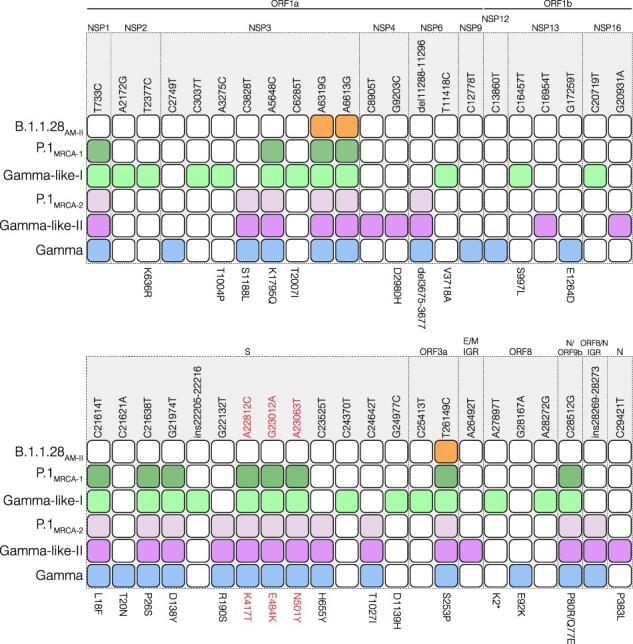
One of the most remarkable severe acute respiratory syndrome coronavirus 2 (SARS-CoV-2) variants of concern (VOC) features is the significant number of mutations they acquired. However, the specific factors that drove the emergence of such variants since the second half of 2020 are not fully resolved. In this study, we describe a new SARS-CoV-2 P.1 sub-lineage circulating in Brazil, denoted here as Gamma-like-II, that as well as the previously described lineage Gamma-like-I shares several lineage-defining mutations with the VOC Gamma. Reconstructions of ancestor sequences support that most lineage-defining mutations of the Spike (S) protein, including those at the receptor-binding domain (RBD), accumulated at the first P.1 ancestor. In contrast, mutations outside the S protein were mostly fixed at subsequent steps. Our evolutionary analyses estimate that P.1-ancestral strains carrying RBD mutations of concern probably circulated cryptically in the Amazonas for several months before the emergence of the VOC Gamma. Unlike the VOC Gamma, the other P.1 sub-lineages displayed a much more restricted dissemination and accounted for a low fraction (<2 per cent) of SARS-CoV-2 infections in Brazil in 2021. The stepwise diversification of lineage P.1 through multiple inter-host transmissions is consistent with the hypothesis that partial immunity acquired from natural SARS-CoV-2 infections in heavily affected regions might have been a major driving force behind the natural selection of some VOCs. The lag time between the emergence of the P.1 ancestor and the expansion of the VOC Gamma and the divergent epidemic trajectories of P.1 sub-lineages support a complex interplay between the emergence of mutations of concern and viral spread in Brazil.
严重急性呼吸综合征冠状病毒2(SARS-CoV-2)的关注变异株(VOC)最显著的特征之一是它们获得了大量突变。然而,自2020年下半年以来促使此类变异株出现的具体因素尚未完全明确。在本研究中,我们描述了一种在巴西流行的新型SARS-CoV-2 P.1亚谱系,在此称为类伽马-II,它与先前描述的类伽马-I谱系一样,与VOC伽马共享多个谱系定义突变。祖先序列的重建支持了刺突(S)蛋白的大多数谱系定义突变,包括受体结合域(RBD)的那些突变,在第一个P.1祖先中积累。相比之下,S蛋白之外的突变大多在后续步骤中固定下来。我们的进化分析估计,携带相关RBD突变的P.1祖先菌株可能在VOC伽马出现之前,在亚马孙州隐匿传播了数月。与VOC伽马不同,其他P.1亚谱系的传播范围要小得多,在2021年巴西的SARS-CoV-2感染中占比很低(<2%)。谱系P.1通过多次宿主间传播的逐步多样化,与以下假设一致:在受影响严重地区从自然SARS-CoV-2感染中获得的部分免疫力可能是一些VOC自然选择背后的主要驱动力。P.1祖先出现与VOC伽马扩张之间的时间间隔以及P.1亚谱系不同的流行轨迹,支持了巴西相关突变出现与病毒传播之间的复杂相互作用。


 Zotero 插件