
日本女性中首次接种 HPV 疫苗年龄与疫苗有效性的关系。
Human papillomavirus vaccine effectiveness by age at first vaccination among Japanese women.
机构信息
Department of Obstetrics and Gynecology, Showa University School of Medicine, Tokyo, Japan.
Department of Gynecologic Oncology, Hyogo Cancer Center, Hyogo, Japan.
出版信息
Cancer Sci. 2022 Apr;113(4):1428-1434. doi: 10.1111/cas.15270. Epub 2022 Feb 2.
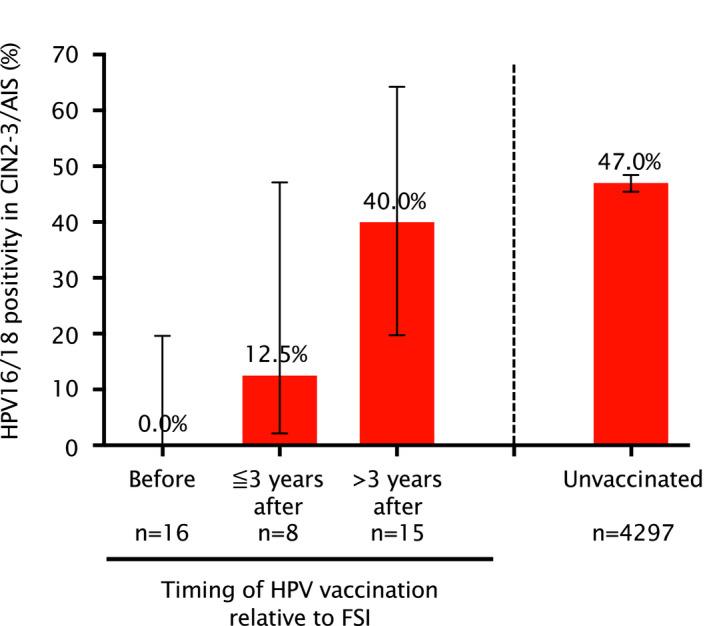
In Japan, the National Immunization Program against human papillomavirus (HPV) targets girls aged 12-16 years, and catch-up vaccination is recommended for young women up to age 26 years. Because HPV infection rates increase soon after sexual debut, we evaluated HPV vaccine effectiveness by age at first vaccination. Along with vaccination history, HPV genotyping results from 5795 women younger than 40 years diagnosed with cervical intraepithelial neoplasia grade 2-3 (CIN2-3), adenocarcinoma in situ (AIS), or invasive cervical cancer were analyzed. The attribution of vaccine-targeted types HPV16 or HPV18 to CIN2-3/AIS was 47.0% for unvaccinated women (n = 4297), but 0.0%, 13.0%, 35.7%, and 39.6% for women vaccinated at ages 12-15 years (n = 36), 16-18 years (n = 23), 19-22 years (n = 14), and older than 22 years (n = 91), respectively, indicating the greater effectiveness of HPV vaccination among those initiating vaccination at age 18 years or younger (P < .001). This finding was supported by age at first sexual intercourse; among women with CIN2-3/AIS, only 9.2% were sexually active by age 14 years, but the percentage quickly increased to 47.2% by age 16 and 77.1% by age 18. Additionally, the HPV16/18 prevalence in CIN2-3/AIS was 0.0%, 12.5%, and 40.0% for women vaccinated before (n = 16), within 3 years (n = 8), and more than 3 years after (n = 15) first intercourse, respectively (P = .004). In conclusion, our data appear to support routine HPV vaccination for girls aged 12-14 years and catch-up vaccination for adolescents aged 18 years and younger in Japan.
在日本,针对人乳头瘤病毒(HPV)的国家免疫计划针对 12-16 岁的女孩,建议对 26 岁以下的年轻女性进行补种疫苗。因为 HPV 感染率在初次性行为后不久就会上升,所以我们通过初次接种疫苗的年龄评估了 HPV 疫苗的有效性。我们结合接种史,对 5795 名年龄小于 40 岁的被诊断为宫颈上皮内瘤变 2-3 级(CIN2-3)、原位腺癌(AIS)或浸润性宫颈癌的女性的 HPV 基因分型结果进行了分析。未接种疫苗的女性(n=4297)中,疫苗针对的 HPV16 或 HPV18 归因于 CIN2-3/AIS 的比例为 47.0%,而接种年龄为 12-15 岁(n=36)、16-18 岁(n=23)、19-22 岁(n=14)和 22 岁以上(n=91)的女性中,这一比例分别为 0.0%、13.0%、35.7%和 39.6%,这表明在 18 岁或以下开始接种疫苗的人群中,HPV 疫苗接种的效果更大(P<0.001)。这一发现得到了初次性行为年龄的支持;在患有 CIN2-3/AIS 的女性中,只有 9.2%的人在 14 岁时有性行为,但这一比例很快在 16 岁时增加到 47.2%,在 18 岁时增加到 77.1%。此外,在 CIN2-3/AIS 中,接种疫苗前(n=16)、接种疫苗后 3 年内(n=8)和接种疫苗后 3 年以上(n=15)的女性中 HPV16/18 的患病率分别为 0.0%、12.5%和 40.0%(P=0.004)。总之,我们的数据似乎支持在日本为 12-14 岁的女孩进行常规 HPV 疫苗接种,并为 18 岁及以下的青少年进行补种疫苗。


 Zotero 插件