
医护人员前瞻性研究中BNT162b2 mRNA新冠疫苗的不良反应及抗体滴度
Adverse Effects and Antibody Titers in Response to the BNT162b2 mRNA COVID-19 Vaccine in a Prospective Study of Healthcare Workers.
作者信息
Coggins Si'Ana A, Laing Eric D, Olsen Cara H, Goguet Emilie, Moser Matthew, Jackson-Thompson Belinda M, Samuels Emily C, Pollett Simon D, Tribble David R, Davies Julian, Illinik Luca, Hollis-Perry Monique, Maiolatesi Santina E, Duplessis Christopher A, Ramsey Kathleen F, Reyes Anatalio E, Alcorta Yolanda, Wong Mimi A, Wang Gregory, Ortega Orlando, Parmelee Edward, Lindrose Alyssa R, Snow Andrew L, Malloy Allison M W, Letizia Andrew G, Ewing Daniel, Powers John H, Schully Kevin L, Burgess Timothy H, Broder Christopher C, Mitre Edward
机构信息
Department of Microbiology and Immunology, Uniformed Services University of the Health Sciences, Bethesda, Maryland, USA.
Henry M. Jackson Foundation for the Advancement of Military Medicine, Inc., Bethesda, Maryland, USA.
出版信息
Open Forum Infect Dis. 2021 Nov 20;9(1):ofab575. doi: 10.1093/ofid/ofab575. eCollection 2022 Jan.
BACKGROUND
The relationship between postvaccination symptoms and strength of antibody responses is unclear. The goal of this study was to determine whether adverse effects caused by vaccination with the Pfizer/BioNTech BNT162b2 vaccine are associated with the magnitude of vaccine-induced antibody levels.
METHODS
We conducted a single-center, observational cohort study consisting of generally healthy adult participants that were not severely immunocompromised, had no history of coronavirus disease 2019, and were seronegative for severe acute respiratory syndrome coronavirus 2 (SARS-CoV-2) spike protein before vaccination. Severity of vaccine-associated symptoms was obtained through participant-completed questionnaires. Testing for immunoglobulin G antibodies against SARS-CoV-2 spike protein and receptor-binding domain was conducted using microsphere-based multiplex immunoassays performed on serum samples collected at monthly visits. Neutralizing antibody titers were determined by microneutralization assays.
RESULTS
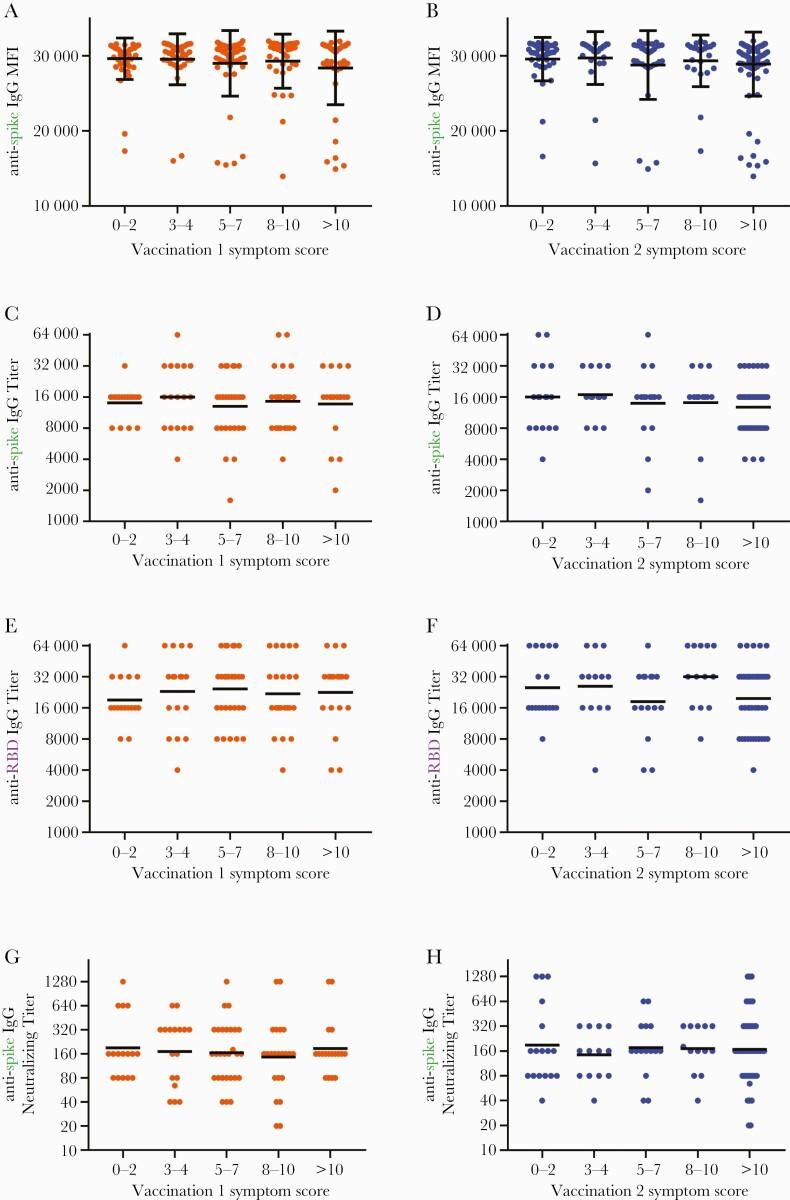
Two hundred six participants were evaluated (69.4% female, median age 41.5 years old). We found no correlation between vaccine-associated symptom severity scores and vaccine-induced antibody titers 1 month after vaccination. We also observed that (1) postvaccination symptoms were inversely correlated with age and weight and more common in women, (2) systemic symptoms were more frequent after the second vaccination, (3) high symptom scores after first vaccination were predictive of high symptom scores after second vaccination, and (4) older age was associated with lower titers.
CONCLUSIONS
Lack of postvaccination symptoms after receipt of the BNT162b2 vaccine does not equate to lack of vaccine-induced antibodies 1 month after vaccination.
背景
接种疫苗后的症状与抗体反应强度之间的关系尚不清楚。本研究的目的是确定接种辉瑞/生物科技公司的BNT162b2疫苗引起的不良反应是否与疫苗诱导的抗体水平大小相关。
方法
我们进行了一项单中心观察性队列研究,研究对象为一般健康的成年参与者,这些参与者没有严重免疫功能低下,没有2019冠状病毒病病史,并且在接种疫苗前对严重急性呼吸综合征冠状病毒2(SARS-CoV-2)刺突蛋白血清学阴性。通过参与者填写的问卷获取疫苗相关症状的严重程度。使用基于微球的多重免疫测定法对每月随访时采集的血清样本进行针对SARS-CoV-2刺突蛋白和受体结合域的免疫球蛋白G抗体检测。通过微量中和试验测定中和抗体滴度。
结果
对206名参与者进行了评估(69.4%为女性,中位年龄41.5岁)。我们发现接种疫苗1个月后,疫苗相关症状严重程度评分与疫苗诱导的抗体滴度之间没有相关性。我们还观察到:(1)接种疫苗后的症状与年龄和体重呈负相关,在女性中更常见;(2)第二次接种后全身症状更频繁;(3)第一次接种后症状评分高可预测第二次接种后症状评分高;(4)年龄较大与滴度较低相关。
结论
接种BNT162b2疫苗后没有接种疫苗后的症状并不等同于接种疫苗1个月后没有疫苗诱导的抗体。


 Zotero 插件