
肌肉线粒体能量学可预测功能良好的老年人活动能力下降:巴尔的摩老龄化纵向研究。
Muscle mitochondrial energetics predicts mobility decline in well-functioning older adults: The baltimore longitudinal study of aging.
机构信息
Translational Gerontology Branch, National Institute on Aging, National Institutes of Health, Baltimore, Maryland, USA.
Laboratory of Clinical Investigation, National Institute on Aging, National Institutes of Health, Baltimore, Maryland, USA.
出版信息
Aging Cell. 2022 Feb;21(2):e13552. doi: 10.1111/acel.13552. Epub 2022 Jan 20.
BACKGROUND
Muscle mitochondrial dysfunction is associated with poor mobility in aging. Whether mitochondrial dysfunction predicts subsequent mobility decline is unknown.
METHODS
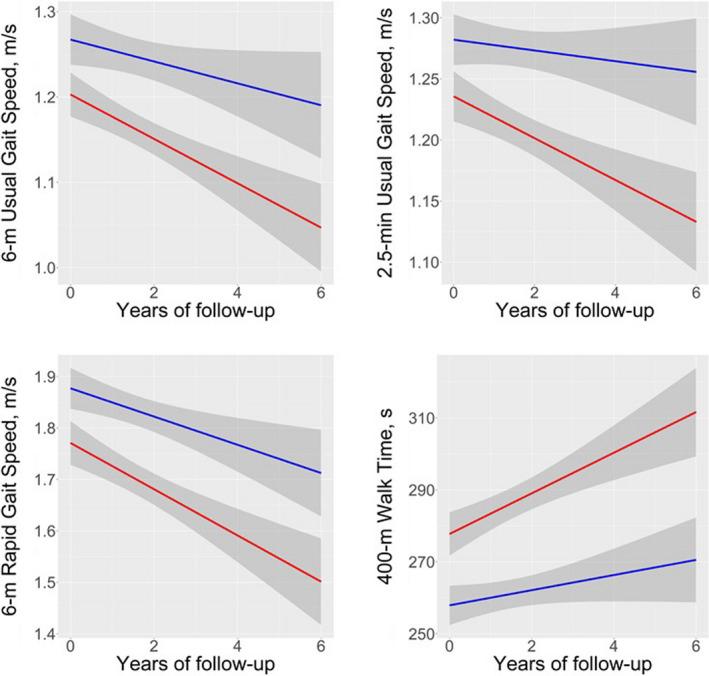
We examined 380 cognitively normal participants aged 60 and older (53%women, 22%Black) who were well-functioning (gait speed ≥ 1.0 m/s) and free of Parkinson's disease and stroke at baseline and had data on baseline skeletal muscle oxidative capacity and one or more mobility assessments during an average 2.5 years. Muscle oxidative capacity was measured by phosphorus magnetic resonance spectroscopy as the post-exercise recovery rate of phosphocreatine (k ). Mobility was measured by four walking tests. Associations of baseline k with mobility changes were examined using linear mixed-effects models, adjusted for covariates. In a subset, we examined whether changes in muscle strength and mass affected these associations by adjusting for longitudinal muscle strength, lean mass, and fat mass.
RESULTS
Lower baseline k was associated with greater decline in all four mobility measures (β, p-value: (0.036, 0.020) 6-m usual gait speed; (0.029, 0.038) 2.5-min usual gait speed; (0.034, 0.011) 6-m rapid gait speed; (-0.042, <0.001) 400-m time). In the subset, further adjustment for longitudinal muscle strength, lean mass, and fat mass attenuated longitudinal associations with changes in mobility (Δβ reduced 26-63%).
CONCLUSION
Among initially well-functioning older adults, worse muscle mitochondrial function predicts mobility decline, and part of this longitudinal association is explained by decline in muscle strength and mass. Our findings suggest that worse mitochondrial function contributes to mobility decline with aging. These findings need to be verified in studies correlating longitudinal changes in mitochondrial function, muscle, and mobility performance.
背景
肌肉线粒体功能障碍与衰老过程中的行动不便有关。线粒体功能障碍是否预示着随后的行动能力下降尚不清楚。
方法
我们研究了 380 名认知正常的 60 岁及以上老年人(53%为女性,22%为黑人),他们在基线时行动能力良好(步速≥1.0m/s),且无帕金森病和中风,并且在平均 2.5 年期间有基线骨骼肌氧化能力和一项或多项移动性评估的数据。肌肉氧化能力通过磷磁共振光谱法测量,以磷酸肌酸(PCr)的运动后恢复率(k)表示。移动性通过四项步行测试进行测量。使用线性混合效应模型,在调整协变量后,检查基线 k 值与移动性变化的关联。在一个子集中,我们通过调整纵向肌肉力量、瘦体重和脂肪量来检查肌肉力量和质量的变化是否会影响这些关联。
结果
较低的基线 k 值与所有四项移动性测量指标的下降幅度更大相关(β,p 值:(0.036,0.020)6m 通常的步行速度;(0.029,0.038)2.5min 通常的步行速度;(0.034,0.011)6m 快速步行速度;(-0.042,<0.001)400m 时间)。在子集中,进一步调整纵向肌肉力量、瘦体重和脂肪量会减弱与移动性变化的纵向关联(Δβ 降低 26-63%)。
结论
在最初行动能力良好的老年人中,肌肉线粒体功能越差预示着移动能力下降,而这种纵向关联的一部分可以通过肌肉力量和质量的下降来解释。我们的发现表明,线粒体功能障碍更差是导致衰老过程中移动能力下降的原因之一。这些发现需要在与线粒体功能、肌肉和移动性能的纵向变化相关的研究中进行验证。
 Zotero 插件