
高度近亲繁殖的挪威 Lundehund 的遗传挽救。
Genetic Rescue of the Highly Inbred Norwegian Lundehund.
机构信息
Department of Nature, Environment and Health, Queen Maud University College, Thrond Nergaards Veg 7, 7044 Trondheim, Norway.
Department of Chemistry and Bioscience, Aalborg University, Fredrik Bajers Vej 7H, 9220 Aalborg Øst, Denmark.
出版信息
Genes (Basel). 2022 Jan 17;13(1):163. doi: 10.3390/genes13010163.
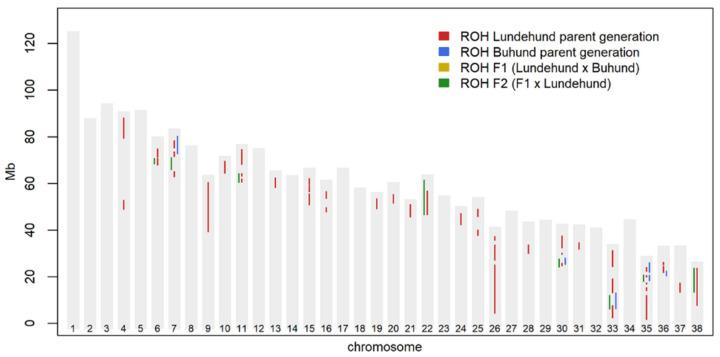
Augmenting the genetic diversity of small, inbred populations by the introduction of new individuals is often termed "genetic rescue". An example is the Norwegian Lundehund, a small spitz dog with inbreeding-related health problems that is being crossed with three Nordic breeds, including the Norwegian Buhund. Conservation breeding decisions for the (typically) small number of outcrossed individuals are vital for managing the rescue process, and we genotyped the Lundehund ( = 12), the Buhund ( = 12), their crosses (F1, = 7) and first-generation backcrosses to the Lundehund (F2, = 12) with >170,000 single nucleotide polymorphism loci to compare their levels of genetic diversity. We predicted that genome-wide diversity in F2 dogs would be higher than in the Lundehund but lower than in the F1 and the Buhund, and the heterozygosity values showed the expected patterns. We also found that runs of homozygosity, extended chromosomal regions of homozygous genotypes inherited from a common ancestor, were reduced in F2 individuals compared with Lundehund individuals. Our analyses demonstrate the benefits of outcrossing but indicate that some of the acquired genetic diversity is lost following immediate backcrossing. Additional breeding among F2 crosses could therefore merit from further consideration in genetic rescue management.
通过引入新个体来增加小而近交种群的遗传多样性通常被称为“遗传拯救”。一个例子是挪威 Lundehund,一种小型的尖嘴犬,由于近亲繁殖而存在健康问题,目前正在与包括挪威 Buhund 在内的三个北欧犬种进行杂交。对于(通常)少量的杂交个体的保护繁殖决策对于管理拯救过程至关重要,我们对 Lundehund(n = 12)、Buhund(n = 12)、它们的杂交种(F1,n = 7)和第一代回交 Lundehund(F2,n = 12)进行了 >170,000 个单核苷酸多态性位点的基因分型,以比较它们的遗传多样性水平。我们预测 F2 犬的全基因组多样性将高于 Lundehund,但低于 F1 和 Buhund,杂合度值显示出预期的模式。我们还发现,与 Lundehund 个体相比,F2 个体中的纯合子区域(从共同祖先遗传的纯合基因型的延伸染色体区域)减少了。我们的分析表明了杂交的好处,但表明在立即回交后,一些获得的遗传多样性会丢失。因此,在遗传拯救管理中,进一步考虑 F2 杂交种之间的额外繁殖可能是值得的。


 Zotero 插件