
雄激素性秃发中人类毛囊的组织工程与再生:文献综述
Tissue Engineering and Regeneration of the Human Hair Follicle in Androgenetic Alopecia: Literature Review.
作者信息
Llamas-Molina José María, Carrero-Castaño Alejandro, Ruiz-Villaverde Ricardo, Campos Antonio
机构信息
Department of Dermatology, Hospital Universitario San Cecilio, 18016 Granada, Spain.
Department of Anatomical Pathology, Hospital Universitario San Cecilio, 18016 Granada, Spain.
出版信息
Life (Basel). 2022 Jan 14;12(1):117. doi: 10.3390/life12010117.
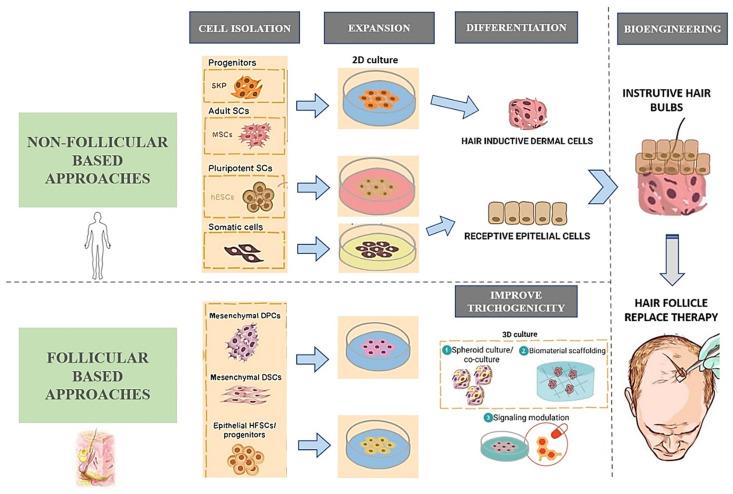
Androgenetic alopecia (AGA) is an androgen-dependent process and represents the most frequent non-scarring alopecia. Treatments for AGA do not always achieve a satisfactory result for the patient, and sometimes cause side effects that lead to discontinuation of treatment. AGA therapeutics currently includes topical and oral drugs, as well as follicular unit micro-transplantation techniques. Tissue engineering (TE) is postulated as one of the possible future solutions to the problem and aims to develop fully functional hair follicles that maintain their cyclic rhythm in a physiological manner. However, despite its great potential, reconstitution of fully functional hair follicles is still a challenge to overcome and the knowledge gained of the key processes in hair follicle morphogenesis and biology has not yet been translated into effective replacement therapies in clinical practice. To achieve this, it is necessary to research and develop new approaches, techniques and biomaterials. In this review, present and emerging hair follicle bioengineering strategies are evaluated. The current problems of these bioengineering techniques are discussed, as well as the advantages and disadvantages, and the future prospects for the field of TE and successful hair follicle regeneration.
雄激素性脱发(AGA)是一个雄激素依赖的过程,是最常见的非瘢痕性脱发。AGA的治疗方法对患者来说并不总是能取得令人满意的效果,有时还会引起副作用,导致治疗中断。目前AGA的治疗方法包括局部和口服药物,以及毛囊单位微移植技术。组织工程(TE)被认为是未来解决该问题的可能方法之一,其目标是开发出能以生理方式维持其周期性节律的功能完全正常的毛囊。然而,尽管其潜力巨大,但重建功能完全正常的毛囊仍然是一个有待克服的挑战,而且在毛囊形态发生和生物学关键过程中所获得的知识尚未转化为临床实践中的有效替代疗法。要实现这一点,有必要研究和开发新的方法、技术和生物材料。在这篇综述中,对当前和新兴的毛囊生物工程策略进行了评估。讨论了这些生物工程技术当前存在的问题,以及优缺点,还有组织工程领域和成功的毛囊再生的未来前景。

 Zotero 插件