
低收入和中等收入国家非传染性疾病的多种共存疾病:系统评价和荟萃分析。
Multimorbidity of non-communicable diseases in low-income and middle-income countries: a systematic review and meta-analysis.
机构信息
Julius Global Health, Julius Center for Health Sciences and Primary Care, University Medical Centre, Utrecht, The Netherlands.
Princess Máxima Center for Pediatric Oncology, Utrecht, Netherlands.
出版信息
BMJ Open. 2022 Jan 21;12(1):e049133. doi: 10.1136/bmjopen-2021-049133.
INTRODUCTION
Multimorbidity is a major public health challenge, with a rising prevalence in low/middle-income countries (LMICs). This review aims to systematically synthesise evidence on the prevalence, patterns and factors associated with multimorbidity of non-communicable diseases (NCDs) among adults residing in LMICs.
METHODS
We conducted a systematic review and meta-analysis of articles reporting prevalence, determinants, patterns of multimorbidity of NCDs among adults aged >18 years in LMICs. For the PROSPERO registered review, we searched PubMed, EMBASE and Cochrane libraries for articles published from 2009 till 30 May 2020. Studies were included if they reported original research on multimorbidity of NCDs among adults in LMICs.
RESULTS
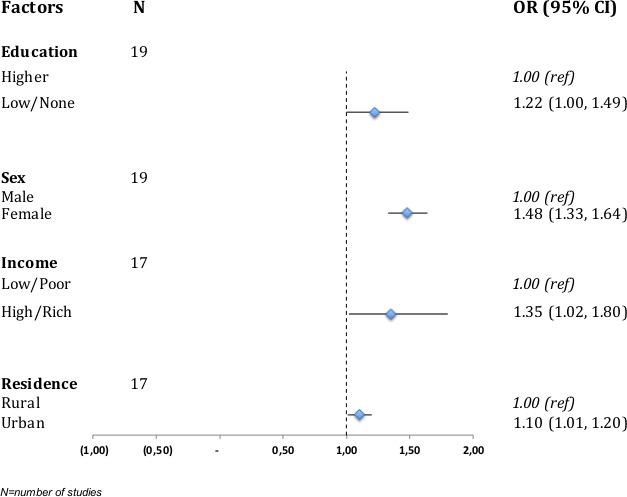
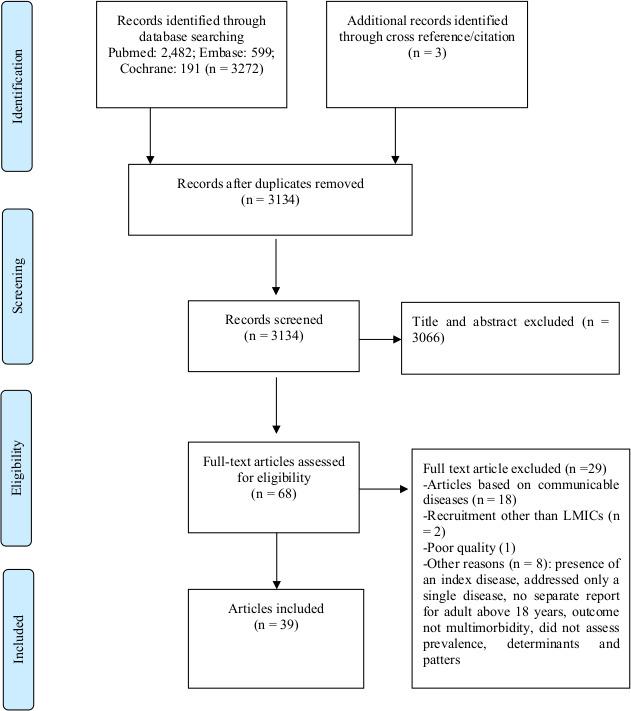
The systematic search yielded 3272 articles; 39 articles were included, with a total of 1 220 309 participants. Most studies used self-reported data from health surveys. There was a large variation in the prevalence of multimorbidity; 0.7%-81.3% with a pooled prevalence of 36.4% (95% CI 32.2% to 40.6%). Prevalence of multimorbidity increased with age, and random effect meta-analyses showed that female sex, OR (95% CI): 1.48, 1.33 to 1.64, being well-off, 1.35 (1.02 to 1.80), and urban residence, 1.10 (1.01 to 1.20), respectively were associated with higher odds of NCD multimorbidity. The most common multimorbidity patterns included cardiometabolic and cardiorespiratory conditions.
CONCLUSION
Multimorbidity of NCDs is an important problem in LMICs with higher prevalence among the aged, women, people who are well-off and urban dwellers. There is the need for longitudinal data to access the true direction of multimorbidity and its determinants, establish causation and identify how trends and patterns change over time.
PROSPERO REGISTRATION NUMBER
CRD42019133453.
简介
多病共存是一个主要的公共卫生挑战,在低收入和中等收入国家(LMICs)的患病率不断上升。本综述旨在系统综合关于 LMICs 中成年人患非传染性疾病(NCDs)的多病共存的患病率、模式和相关因素的证据。
方法
我们对 2009 年至 2020 年 5 月 30 日期间在 PubMed、EMBASE 和 Cochrane 图书馆中发表的关于 LMICs 中成年人 NCD 多病共存的患病率、决定因素和模式的文章进行了系统综述和荟萃分析。对于 PROSPERO 注册的综述,我们检索了文献。纳入的研究如果报告了 LMIC 中成年人 NCD 多病共存的原始研究。
结果
系统搜索产生了 3272 篇文章;纳入了 39 篇文章,共有 1220309 名参与者。大多数研究使用来自健康调查的自我报告数据。多病共存的患病率差异很大;0.7%-81.3%,汇总患病率为 36.4%(95%CI 32.2%至 40.6%)。多病共存的患病率随着年龄的增长而增加,随机效应荟萃分析显示,女性,比值比(95%CI):1.48,1.33 至 1.64,富裕,1.35(1.02 至 1.80),和城市居住,1.10(1.01 至 1.20),分别与 NCD 多病共存的更高几率相关。最常见的多病共存模式包括心血管代谢和心肺疾病。
结论
NCD 多病共存是 LMICs 的一个重要问题,在老年人、女性、富裕人群和城市居民中患病率更高。需要进行纵向数据以了解多病共存的真实趋势和决定因素,确定因果关系,并确定趋势和模式随时间的变化。
PROSPERO 注册号:CRD42019133453。

 Zotero 插件