
艾伯塔省超越乳腺癌(AMBER)队列研究:全队列的基线描述。
The Alberta moving beyond breast cancer (AMBER) cohort study: baseline description of the full cohort.
机构信息
Department of Cancer Epidemiology and Prevention Research, Cancer Care Alberta, Alberta Health Services, Holy Cross Center, 2210-2nd St SW, Calgary, AB, T2S 3C3, Canada.
Department of Oncology, Cumming School of Medicine, University of Calgary, Calgary, AB, Canada.
出版信息
Cancer Causes Control. 2022 Mar;33(3):441-453. doi: 10.1007/s10552-021-01539-6. Epub 2022 Jan 22.
PURPOSE
The Alberta Moving Beyond Breast Cancer (AMBER) Study is an ongoing prospective cohort study investigating how direct measures of physical activity (PA), sedentary behavior (SB), and health-related fitness (HRF) are associated with survival after breast cancer.
METHODS
Women in Alberta with newly diagnosed stage I (≥ T1c) to IIIc breast cancer were recruited between 2012 and 2019. Baseline assessments were completed within 90 days of surgery. Measurements included accelerometers to measure PA and SB; a graded treadmill test with gas exchange analysis to measure cardiorespiratory fitness (VO); upper and lower body muscular strength and endurance; dual-X-ray absorptiometry to measure body composition; and questionnaires to measure self-reported PA and SB.
RESULTS
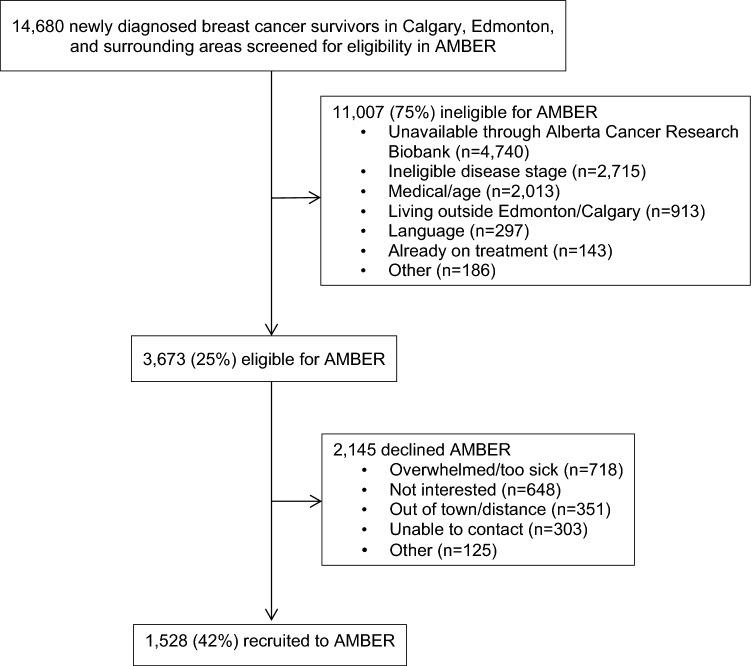
At baseline, the 1528 participants' mean age was 56 ± 11 years, 59% were post-menopausal, 62% had overweight/obesity, and 55% were diagnosed with stage II or III disease. Based on device measurements, study participants spent 8.9 ± 1.7 h/day sedentary, 4.4 ± 1.2 h/day in light-intensity activity, 0.9 ± 0.5 h/day in moderate-intensity activity, and 0.2 ± 0.2 h/day in vigorous-intensity activity. For those participants who reached VO, the average aerobic fitness level was 26.6 ± 6 ml/kg/min. Average body fat was 43 ± 7.1%.
CONCLUSION
We have established a unique cohort of breast cancer survivors with a wealth of data on PA, SB, and HRF obtained through both direct and self-reported measurements. Study participants are being followed for at least ten years to assess all outcomes after breast cancer. These data will inform clinical and public health guidelines on PA, SB, and HRF for improving breast cancer outcomes.
目的
艾伯塔省超越乳腺癌(AMBER)研究是一项正在进行的前瞻性队列研究,旨在调查直接测量的身体活动(PA)、久坐行为(SB)和健康相关体能(HRF)与乳腺癌后生存的关系。
方法
2012 年至 2019 年期间,在艾伯塔省招募了新诊断为 I 期(≥T1c)至 IIIc 期乳腺癌的女性。在手术后 90 天内完成基线评估。测量包括测量 PA 和 SB 的加速度计;使用气体交换分析进行分级跑步机测试以测量心肺功能(VO);上半身和下半身肌肉力量和耐力;双能 X 线吸收法测量身体成分;以及测量自我报告的 PA 和 SB 的问卷。
结果
在基线时,1528 名参与者的平均年龄为 56±11 岁,59%处于绝经后状态,62%超重/肥胖,55%诊断为 II 期或 III 期疾病。根据设备测量结果,研究参与者每天有 8.9±1.7 小时处于久坐状态,4.4±1.2 小时处于低强度活动状态,0.9±0.5 小时处于中强度活动状态,0.2±0.2 小时处于高强度活动状态。对于达到 VO 的参与者,平均有氧健身水平为 26.6±6ml/kg/min。平均体脂肪为 43±7.1%。
结论
我们已经建立了一个独特的乳腺癌幸存者队列,通过直接和自我报告的测量方法获得了大量关于 PA、SB 和 HRF 的数据。研究参与者正在进行至少十年的随访,以评估乳腺癌后的所有结局。这些数据将为改善乳腺癌结局的 PA、SB 和 HRF 临床和公共卫生指南提供信息。
 Zotero 插件