
炎症相关 microRNAs 参与应激性生活事件暴露和创伤聚焦心理治疗在治疗抵抗性抑郁患者中的作用。
Inflammation-related microRNAs are involved in stressful life events exposure and in trauma-focused psychotherapy in treatment-resistant depressed patients.
机构信息
Division of Biology and Genetics, Department of Molecular and Translational Medicine, University of Brescia, Brescia, Italy.
Genetics Unit, IRCCS Istituto Centro San Giovanni Di Dio Fatebenefratelli, Psychiatric Unit, IRCCS Istituto Centro S. Giovanni di Dio, Brescia, Italy.
出版信息
Eur J Psychotraumatol. 2021 Dec 21;12(1):1987655. doi: 10.1080/20008198.2021.1987655. eCollection 2021.
BACKGROUND
About 30% of major depressive disorder (MDD) patients are classified as resistant to treatment (treatment-resistant depression, TRD). Among the factors associated with unfavourable treatment outcomes, stressful life events play a relevant role, and trauma-focused psychotherapy has been successfully proposed for the treatment of patients with a history of such events. Stressful experiences are related to enhanced inflammation and, recently, microRNAs (miRNAs) have emerged as potential mediators of the association between these experiences and psychiatric disorders. To date, no study has explored the effects of stressful life events on miRNAs in MDD patients.
OBJECTIVE
The objective of the present study was to assess possible miRNA blood expression alterations in TRD patients induced by the exposure to stressful life events and to investigate the effects of trauma-focused psychotherapy on the expression profiles of the same miRNAs, as well as their possible predictivity in relation to therapy outcome.
METHOD
The basal levels (T0) of seven candidate miRNAs (miR-15a/miR-29a/miR-125b/miR-126/miR-146a/miR-195/let-7f) were measured in the whole blood of 41 TRD patients. A subgroup of patients ( = 21) underwent trauma-focused psychotherapy; for all of them, miRNA levels were also longitudinally assessed (T4: after 4 weeks of treatment; T8: end of treatment; T12: follow-up visit), contextually to clinical evaluations.
RESULTS
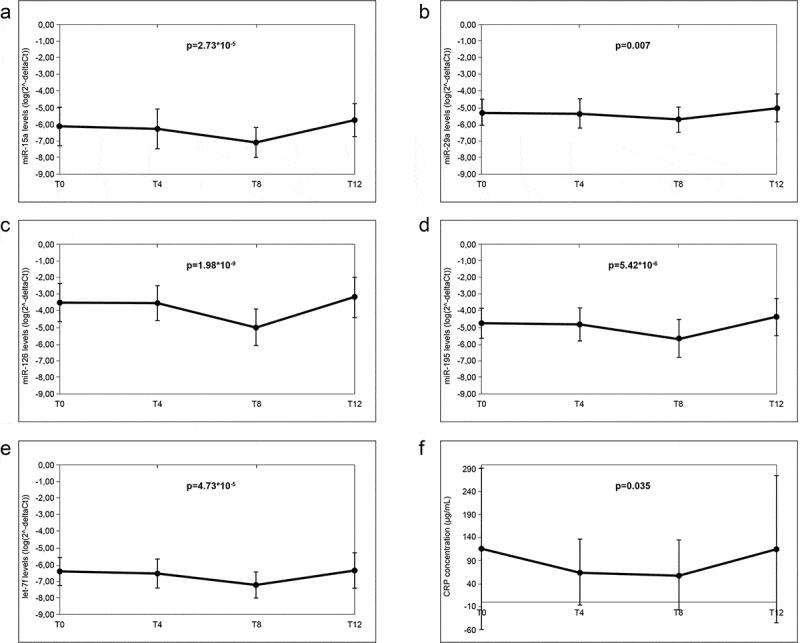
miR-146a levels negatively correlated with recent stressful life event scores ( = .001), whereas the levels of miR-15a, miR-29a, miR-126, miR-195, and let-7f changed during the psychotherapy (best = 1.98*10). miR-29a was also identified as a response predictor, with lower baseline levels predicting non-response ( = .019) or worse improvement in mood symptoms ( = .032).
CONCLUSIONS
The study results could contribute to clarify the underlying molecular mechanisms and to identify novel biomarkers of stressful experiences and response to targeted treatments.
背景
约 30%的重度抑郁症(MDD)患者被归类为治疗抵抗(TRD)。在与不良治疗结果相关的因素中,应激性生活事件起着重要作用,创伤聚焦心理治疗已成功应用于治疗有此类事件史的患者。应激体验与炎症增强有关,最近,microRNAs(miRNAs)已成为这些体验与精神疾病之间关联的潜在介导物。迄今为止,尚无研究探讨应激性生活事件对 MDD 患者 miRNA 的影响。
目的
本研究旨在评估应激性生活事件对 TRD 患者血液中 miRNA 表达变化的影响,并探讨创伤聚焦心理治疗对相同 miRNA 表达谱的影响,以及它们在治疗结果方面的可能预测性。
方法
在 41 例 TRD 患者的全血中测量了七种候选 miRNA(miR-15a/miR-29a/miR-125b/miR-126/miR-146a/miR-195/let-7f)的基础水平(T0)。患者亚组(n=21)接受了创伤聚焦心理治疗;对所有人,也进行了纵向评估(T4:治疗 4 周后;T8:治疗结束时;T12:随访时),同时进行临床评估。
结果
miR-146a 水平与近期应激性生活事件评分呈负相关(r=−.001),而 miR-15a、miR-29a、miR-126、miR-195 和 let-7f 的水平在心理治疗过程中发生了变化(最佳 r=1.98*10)。miR-29a 也被鉴定为反应预测因子,较低的基线水平预示着无反应(r=0.019)或情绪症状改善较差(r=0.032)。
结论
研究结果有助于阐明应激体验和靶向治疗反应的潜在分子机制,并确定新的生物标志物。

 Zotero 插件