
注射用胶原酶治疗掌腱膜挛缩症的成本效益及患者预后
Cost-Effectiveness and Patient Outcomes of Injectable Collagenase to Treat Dupuytren's Contracture.
作者信息
Sahemey Rajpreet S, Dhillon Govind S, Sagoo Karanjeet S, Srinivas Kuntrapaka
机构信息
Trauma & Orthopaedics, University Hospital Coventry, Coventry, GBR.
Orthopaedic Surgery, Lister Hospital, Hertfordshire, GBR.
出版信息
Cureus. 2021 Dec 20;13(12):e20530. doi: 10.7759/cureus.20530. eCollection 2021 Dec.
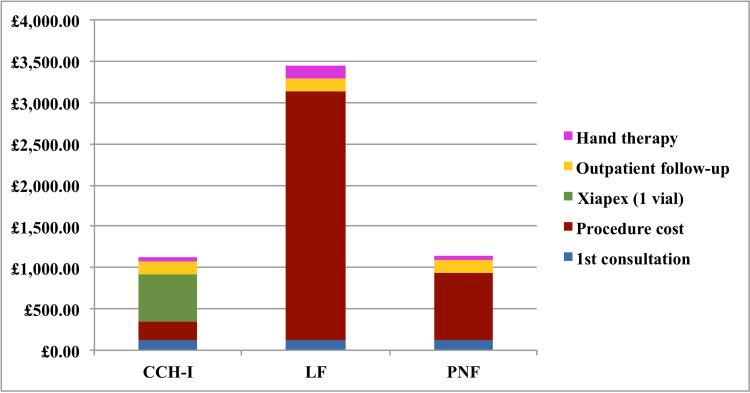
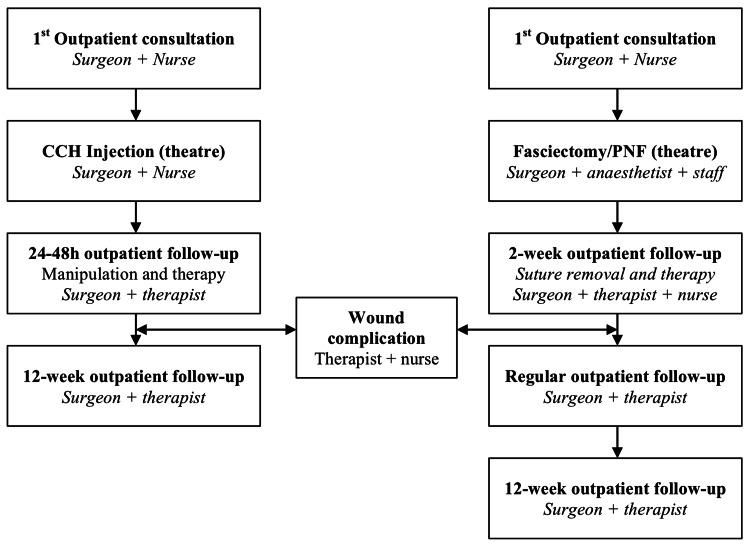
Introduction Dupuytren's contracture is a disabling and progressive flexion contracture of the hand that is often treated by a surgical release. Collagenase clostridium histolyticum injection (CCH-I) was introduced to the UK in 2011 as an alternative and less invasive treatment for contracture. The purpose of this study was to evaluate the cost-effectiveness and patient-reported outcome measures (PROMs) of treating Dupuytren's contracture with collagenase compared to surgery. Methods A retrospective review identified 151 patients who underwent CCH-I (n=94), limited fasciectomy (LF; n=38) and percutaneous needle fasciotomy (PNF; n=19). Outcomes included PROMs (satisfaction, QuickDASH), complication rates (recurrence, reintervention) and direct costs. Results Standardised treatment costs for CCH-I, LF and PNF were £1,125.82, £3,438.28 and £1,143.32 respectively. Collagenase presented a cost-benefit of £88,205 had the LF/PNF group undergone CCH-I. At a mean six-year follow-up, there were no significant differences in complication rates (=0.621) or QuickDASH scores (p=0.157). Collagenase-treated patients reported the highest satisfaction and lowest recurrence rates. Discussion Collagenase presents a significant cost reduction with superior PROMs relative to surgery for treating single-digit contracture. Conclusion Outpatient CCH-I is a cost-effective treatment with fewer clinical encounters, a similar risk profile to LF/PNF and high levels of patient satisfaction, which warrants serious consideration in light of overburdened waiting lists due to COVID-19.
引言
杜普伊特伦挛缩症是一种导致手部功能丧失且呈进行性发展的屈曲挛缩症,通常通过手术松解进行治疗。溶组织梭状芽孢杆菌胶原酶注射(CCH - I)于2011年被引入英国,作为一种替代性的、侵入性较小的挛缩症治疗方法。本研究的目的是评估与手术相比,使用胶原酶治疗杜普伊特伦挛缩症的成本效益和患者报告的结局指标(PROMs)。
方法
一项回顾性研究确定了151例接受CCH - I治疗(n = 94)、有限筋膜切除术(LF;n = 38)和经皮针状筋膜切开术(PNF;n = 19)的患者。结局指标包括PROMs(满意度、QuickDASH)、并发症发生率(复发、再次干预)和直接成本。
结果
CCH - I、LF和PNF的标准化治疗成本分别为1,125.82英镑、3,438.28英镑和1,143.32英镑。如果LF/PNF组接受CCH - I治疗,胶原酶的成本效益为88,205英镑。在平均六年的随访中,并发症发生率(p = 0.621)或QuickDASH评分(p = 0.157)没有显著差异。接受胶原酶治疗的患者报告的满意度最高,复发率最低。
讨论
与手术治疗单指挛缩症相比,胶原酶可显著降低成本,且具有更好的PROMs。
结论
门诊CCH - I是一种具有成本效益的治疗方法,临床就诊次数较少,风险状况与LF/PNF相似,患者满意度高。鉴于COVID - 19导致候诊名单负担过重,这值得认真考虑。
 Zotero 插件