
肾结石病与心血管事件:一项基于孟德尔随机化的双向因果关系研究
Kidney stone disease and cardiovascular events: a study on bidirectional causality based on mendelian randomization.
作者信息
Zhao Yuanyuan, Fan Yang, Wang Mengru, Yu Chenguang, Zhou Mengchen, Jiang Dan, Du Dunfeng, Chen Shanshan, Tu Xin
机构信息
Institute of Organ Transplantation, Tongji Hospital, Tongji Medical College, Huazhong University of Science and Technology, Wuhan, China.
Key Laboratory of Organ Transplantation, Ministry of Education, Wuhan, China.
出版信息
Transl Androl Urol. 2021 Dec;10(12):4344-4352. doi: 10.21037/tau-21-899.
BACKGROUND
Kidney stone disease (KSD) has been reported to be associated with several cardiovascular diseases. However, the causality between the conditions remains unknown. In the study, we performed a study on bidirectional causality by two-sample Mendelian randomization (MR) to investigate the causality between KSD and cardiovascular diseases including coronary atherosclerosis, hypertension, and cardiomyopathy.
METHODS
In the recent study, we performed a bidirectional two-sample MR study using available genome-wide association summary data from the online database MRBASE. We identified genetic variants associated with KSD in one European population from UK Biobank (version 2, n=462,933). Two phenotypes of samples were chosen from the population to define our genetic instrumental variables: (I) samples with the phenotype of kidney stone/ureter stone/bladder stone (ukb-b-8297), and (II) samples with the phenotype of kidney stone surgery/lithotripsy (ukb-b-13537). For cardiovascular diseases, we picked up another independent European population from FinnGen Biobank (n=93,421). We selected the exposure and outcome SNPs and then performed the two-sample MR using R package.
RESULTS
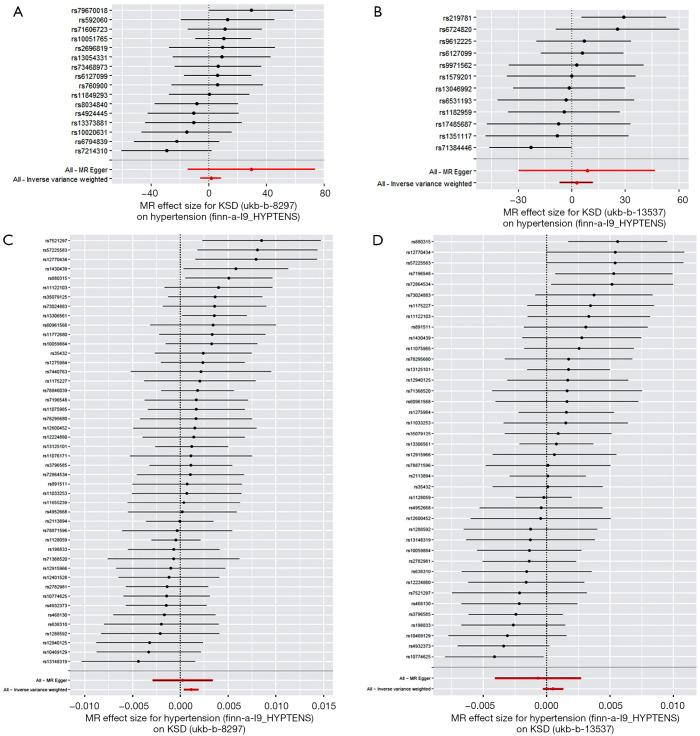
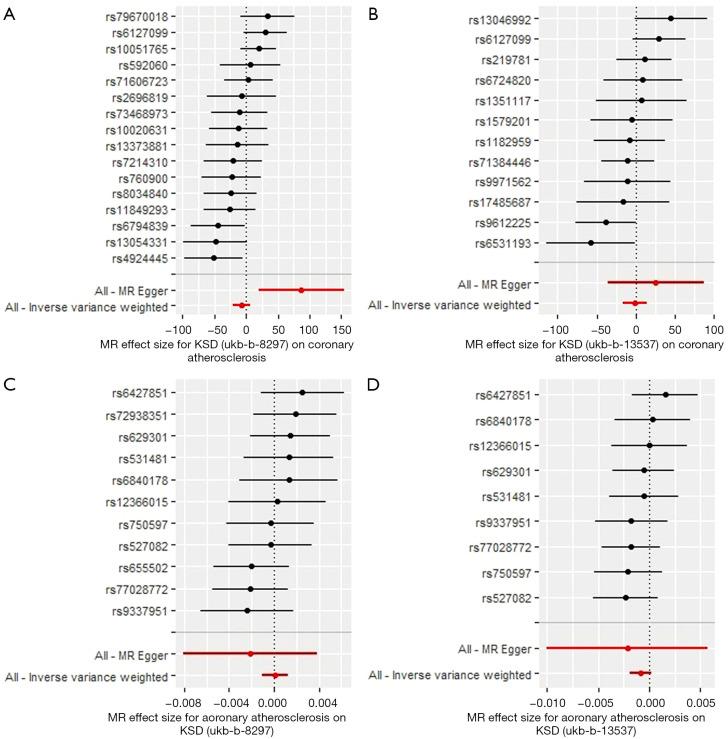
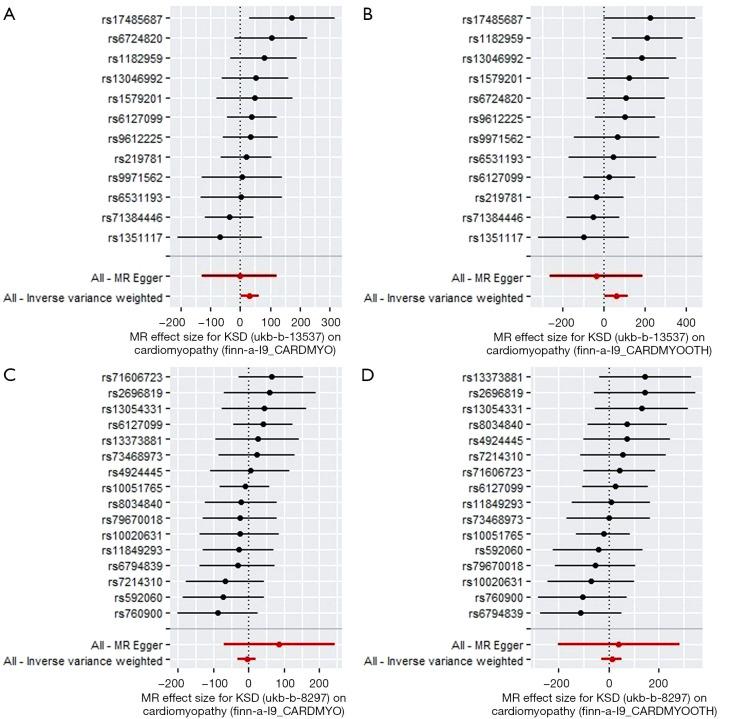
After bidirectional causality by two-sample MR, we verified that genetic predisposition to KSD could increase the risk of coronary atherosclerosis (OR: 4.45×1037; SE=±7.80×10, P for MR-Egger =0.024) and cardiomyopathy (OR: 5.35×10; SE=±7.18×10, P for IVW=0.045 for finn-a-I9_CARDMYO, and OR: 3.60×10; SE=±3.26×10, P for IVW=0.041 for finn-a-I9_CARDMYOOTH) when we used ukb-b-13537 as exposure group. Furthermore, hypertension could increase the risk of KSD (OR: 1.001; SE=±1.00, P for IVW=0.003) when we used ukb-b-8297 as exposure group, without detected pleiotropy bias (P>0.05).
CONCLUSIONS
We confirmed KSD may trigger causal pathological processes including coronary atherosclerosis and cardiomyopathy. Furthermore, hypertension may causally affect KSD.
背景
据报道,肾结石疾病(KSD)与多种心血管疾病有关。然而,这些疾病之间的因果关系仍不清楚。在本研究中,我们通过两样本孟德尔随机化(MR)进行了一项双向因果关系研究,以探讨KSD与包括冠状动脉粥样硬化、高血压和心肌病在内的心血管疾病之间的因果关系。
方法
在最近的研究中,我们使用在线数据库MRBASE中可用的全基因组关联汇总数据进行了一项双向两样本MR研究。我们在来自英国生物银行(版本2,n = 462,933)的一个欧洲人群中确定了与KSD相关的基因变异。从该人群中选择了两种样本表型来定义我们的基因工具变量:(I)具有肾结石/输尿管结石/膀胱结石表型的样本(ukb-b-8297),以及(II)具有肾结石手术/碎石术表型的样本(ukb-b-13537)。对于心血管疾病,我们从芬兰基因生物银行中选取了另一个独立的欧洲人群(n = 93,421)。我们选择了暴露和结局单核苷酸多态性(SNP),然后使用R包进行两样本MR分析。
结果
通过两样本MR进行双向因果关系分析后,当我们使用ukb-b-13537作为暴露组时,我们验证了KSD的遗传易感性会增加冠状动脉粥样硬化(比值比:4.45×1037;标准误=±7.80×10,MR-Egger检验的P值=0.024)和心肌病(比值比:5.35×10;标准误=±7.18×10,finn-a-I9_CARDMYO的IVW检验的P值=0.045,以及比值比:3.60×10;标准误=±3.26×10,finn-a-I9_CARDMYOOTH的IVW检验的P值=0.041)的风险。此外,当我们使用ukb-b-8297作为暴露组时,高血压会增加KSD的风险(比值比:1.001;标准误=±1.00,IVW检验的P值=0.003),且未检测到多效性偏差(P>0.05)。
结论
我们证实KSD可能引发包括冠状动脉粥样硬化和心肌病在内的因果病理过程。此外,高血压可能因果性地影响KSD。
 Zotero 插件