
脑淀粉样血管病的蛋白质组学分析显示与 CADASIL 存在重叠,突出了 HTRA1 及其底物的积累。
Proteomic profiling in cerebral amyloid angiopathy reveals an overlap with CADASIL highlighting accumulation of HTRA1 and its substrates.
机构信息
Institute for Stroke and Dementia Research (ISD), Klinikum der Universität München, Ludwig-Maximilians-Universität München, Feodor-Lynen-Straße 17, 81377, Munich, Germany.
Chair of Proteomics and Bioanalytics, Technical University of Munich (TUM), Freising, Germany.
出版信息
Acta Neuropathol Commun. 2022 Jan 24;10(1):6. doi: 10.1186/s40478-021-01303-6.
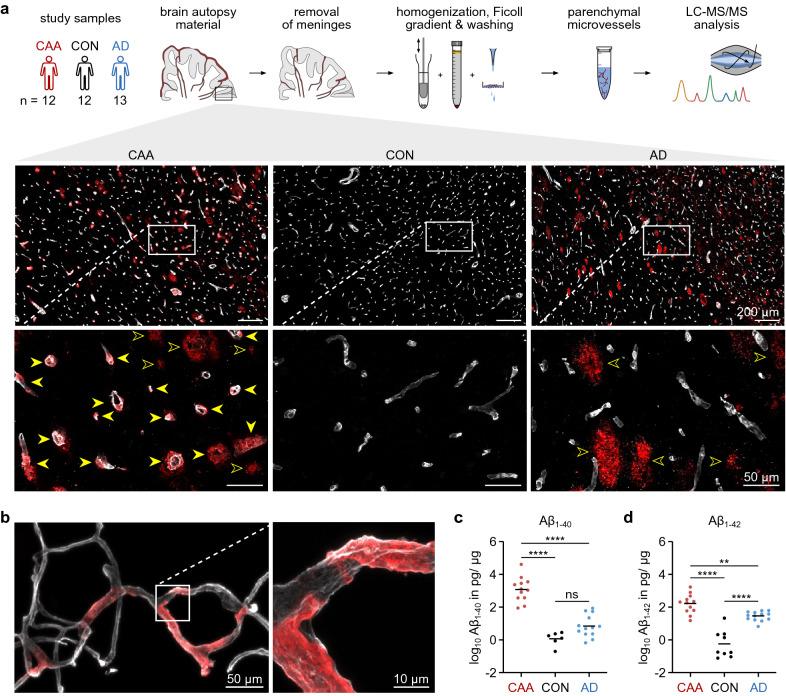
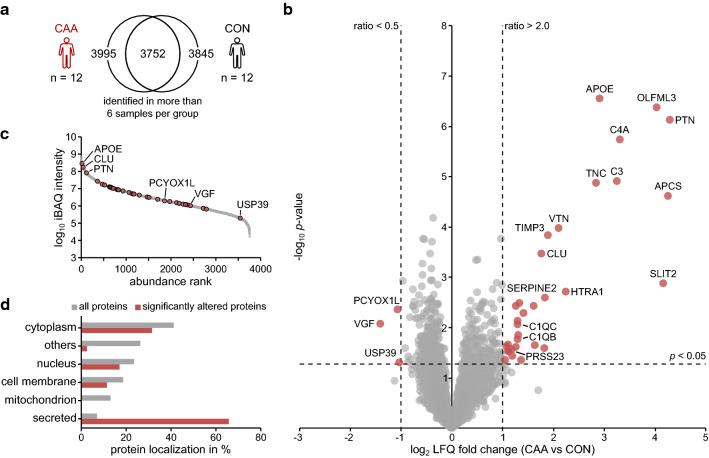
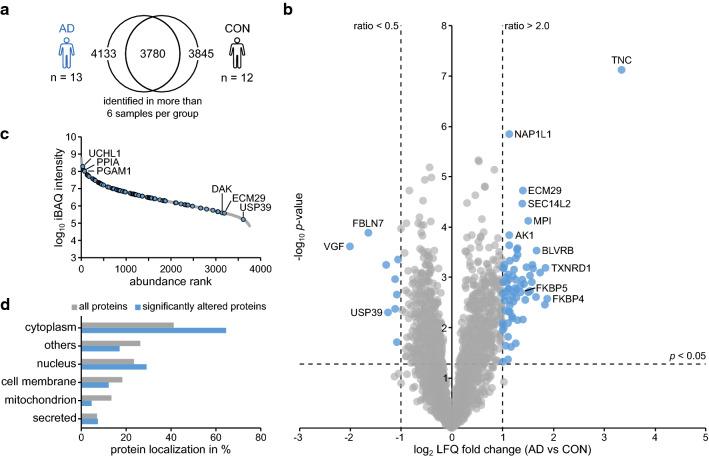
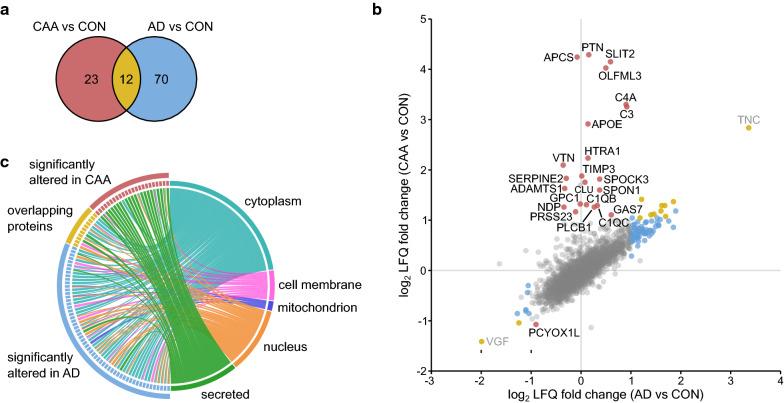
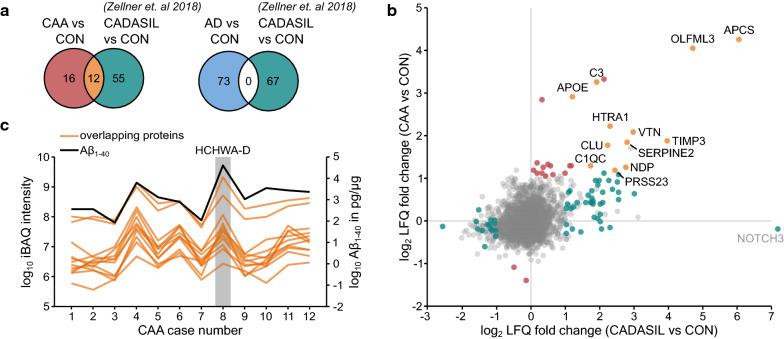
Cerebral amyloid angiopathy (CAA) is an age-related condition and a major cause of intracerebral hemorrhage and cognitive decline that shows close links with Alzheimer's disease (AD). CAA is characterized by the aggregation of amyloid-β (Aβ) peptides and formation of Aβ deposits in the brain vasculature resulting in a disruption of the angioarchitecture. Capillaries are a critical site of Aβ pathology in CAA type 1 and become dysfunctional during disease progression. Here, applying an advanced protocol for the isolation of parenchymal microvessels from post-mortem brain tissue combined with liquid chromatography tandem mass spectrometry (LC-MS/MS), we determined the proteomes of CAA type 1 cases (n = 12) including a patient with hereditary cerebral hemorrhage with amyloidosis-Dutch type (HCHWA-D), and of AD cases without microvascular amyloid pathology (n = 13) in comparison to neurologically healthy controls (n = 12). ELISA measurements revealed microvascular Aβ levels to be exclusively enriched in CAA samples (mean: > 3000-fold compared to controls). The proteomic profile of CAA type 1 was characterized by massive enrichment of multiple predominantly secreted proteins and showed significant overlap with the recently reported brain microvascular proteome of patients with cerebral autosomal-dominant arteriopathy with subcortical infarcts and leukoencephalopathy (CADASIL), a hereditary cerebral small vessel disease (SVD) characterized by the aggregation of the Notch3 extracellular domain. We found this overlap to be largely attributable to the accumulation of high-temperature requirement protein A1 (HTRA1), a serine protease with an established role in the brain vasculature, and several of its substrates. Notably, this signature was not present in AD cases. We further show that HTRA1 co-localizes with Aβ deposits in brain capillaries from CAA type 1 patients indicating a pathologic recruitment process. Together, these findings suggest a central role of HTRA1-dependent protein homeostasis in the CAA microvasculature and a molecular connection between multiple types of brain microvascular disease.
脑淀粉样血管病(Cerebral amyloid angiopathy,CAA)是一种与年龄相关的疾病,也是导致脑出血和认知能力下降的主要原因,与阿尔茨海默病(Alzheimer's disease,AD)密切相关。CAA 的特征是淀粉样β(amyloid-β,Aβ)肽的聚集和 Aβ 在脑脉管系统中的沉积,导致血管结构的破坏。在 CAA 1 型中,毛细血管是 Aβ 病理学的关键部位,并且在疾病进展过程中变得功能失调。在这里,我们应用一种从尸检脑组织中分离实质微血管的先进方案,结合液相色谱串联质谱(liquid chromatography tandem mass spectrometry,LC-MS/MS),确定了 12 例 CAA 1 型病例(包括 1 例遗传性脑淀粉样血管病伴荷兰型出血(hereditary cerebral hemorrhage with amyloidosis-Dutch type,HCHWA-D)患者)、13 例无微血管淀粉样病理学的 AD 病例(阿尔茨海默病)与 12 例神经健康对照者的蛋白质组学图谱。ELISA 测量显示,微血管 Aβ 水平仅在 CAA 样本中富集(与对照组相比,平均值:>3000 倍)。CAA 1 型的蛋白质组学特征是多种主要分泌蛋白的大量富集,并与最近报道的具有脑常染色体显性动脉病伴皮质下梗死和白质脑病(cerebral autosomal-dominant arteriopathy with subcortical infarcts and leukoencephalopathy,CADASIL)的患者脑微血管蛋白质组学显著重叠,CADASIL 是一种遗传性脑小血管病(small vessel disease,SVD),其特征是 Notch3 细胞外结构域的聚集。我们发现这种重叠在很大程度上归因于高温需求蛋白 A1(high-temperature requirement protein A1,HTRA1)的积累,HTRA1 是一种在脑脉管系统中具有既定作用的丝氨酸蛋白酶,及其几种底物。值得注意的是,这种特征在 AD 病例中不存在。我们进一步表明,HTRA1 与 CAA 1 型患者脑毛细血管中的 Aβ 沉积共定位,表明存在病理性募集过程。综上所述,这些发现表明 HTRA1 依赖性蛋白质动态平衡在 CAA 微血管中的核心作用,以及多种脑微血管疾病之间的分子联系。

 Zotero 插件