
空间分析确定三阴性乳腺癌(TNBC)辅助治疗反应的预后特征。
Spatial Profiling Identifies Prognostic Features of Response to Adjuvant Therapy in Triple Negative Breast Cancer (TNBC).
作者信息
Kulasinghe Arutha, Monkman James, Shah Esha T, Matigian Nicholas, Adams Mark N, O'Byrne Ken
机构信息
University of Queensland Diamantina Institute, The University of Queensland, Brisbane, QLD, Australia.
School of Biomedical Sciences, Centre for Genomics and Personalised Health, Queensland University of Technology, Brisbane, QLD, Australia.
出版信息
Front Oncol. 2022 Jan 10;11:798296. doi: 10.3389/fonc.2021.798296. eCollection 2021.
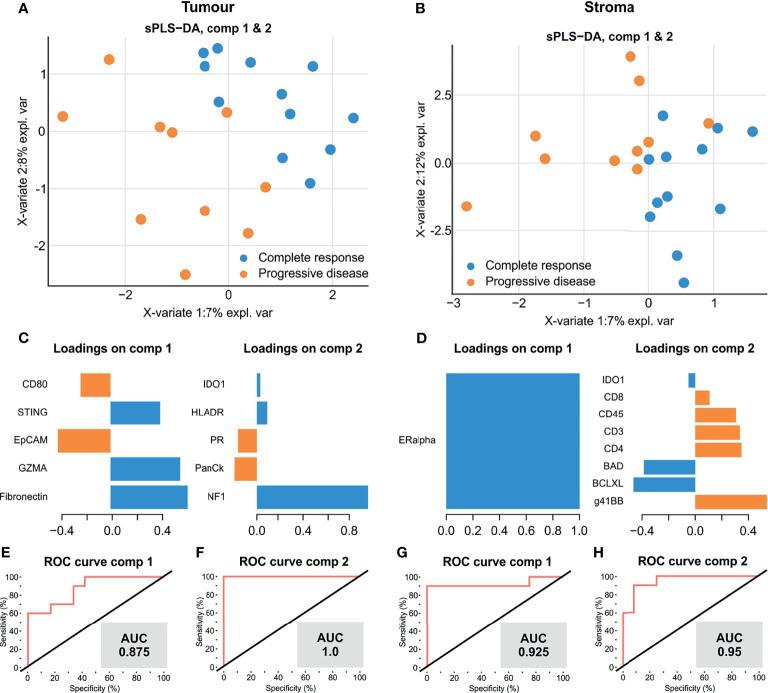
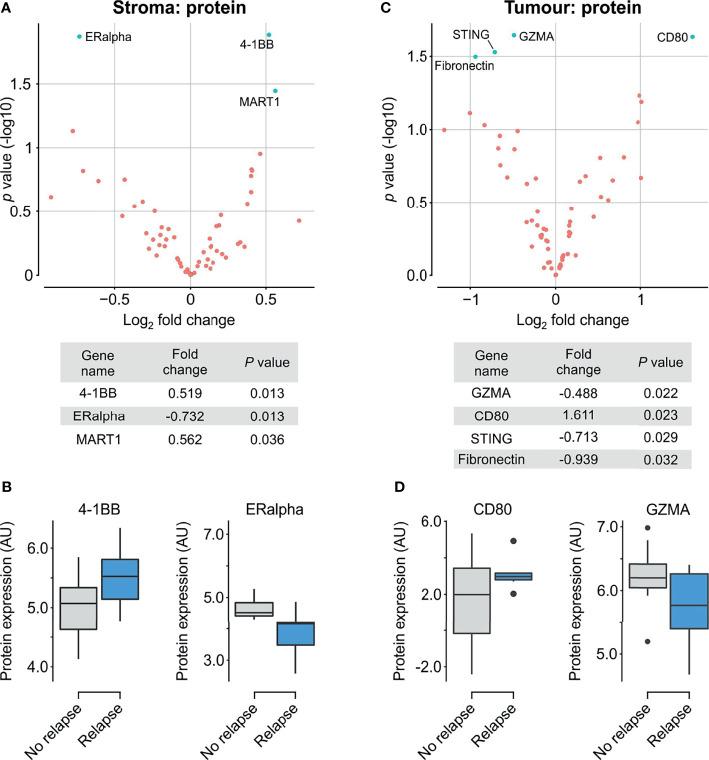
Triple-negative breast cancer (TNBC) is an aggressive subtype of breast cancer that has few effective treatment options due to its lack of targetable hormone receptors. Whilst the degree of tumour infiltrating lymphocytes (TILs) has been shown to associate with therapy response and prognosis, deeper characterization of the molecular diversity that may mediate chemotherapeutic response is lacking. Here we applied targeted proteomic analysis of both chemotherapy sensitive and resistant TNBC tissue samples by the Nanostring GeoMx Digital Spatial Platform (DSP). By quantifying 68 targets in the tumour and tumour microenvironment (TME) compartments and performing differential expression analysis between responsive and non-responsive tumours, we show that increased ER-alpha expression and decreased 4-1BB and MART1 within the stromal compartments is associated with adjuvant chemotherapy response. Similarly, higher expression of GZMA, STING and fibronectin and lower levels of CD80 were associated with response within tumour compartments. Univariate overall-survival (OS) analysis of stromal proteins supported these findings, with ER-alpha expression (HR=0.19, p=0.0012) associated with better OS while MART1 expression (HR=2.3, p=0.035) was indicative of poorer OS. Proteins within tumour compartments consistent with longer OS included PD-L1 (HR=0.53, p=0.023), FOXP3 (HR=0.5, p=0.026), GITR (HR=0.51, p=0.036), SMA (HR=0.59, p=0.043), while EPCAM (HR=1.7, p=0.045), and CD95 (HR=4.9, p=0.046) expression were associated with shorter OS. Our data provides early insights into the levels of these markers in the TNBC tumour microenvironment, and their association with chemotherapeutic response and patient survival.
三阴性乳腺癌(TNBC)是一种侵袭性乳腺癌亚型,由于缺乏可靶向的激素受体,有效的治疗选择很少。虽然肿瘤浸润淋巴细胞(TILs)的程度已被证明与治疗反应和预后相关,但缺乏对可能介导化疗反应的分子多样性的深入表征。在这里,我们通过Nanostring GeoMx数字空间平台(DSP)对化疗敏感和耐药的TNBC组织样本进行了靶向蛋白质组分析。通过量化肿瘤和肿瘤微环境(TME)区室中的68个靶点,并对反应性和无反应性肿瘤进行差异表达分析,我们发现基质区室中ER-α表达增加以及4-1BB和MART1表达降低与辅助化疗反应相关。同样,GZMA、STING和纤连蛋白的较高表达以及CD80的较低水平与肿瘤区室中的反应相关。对基质蛋白的单因素总生存期(OS)分析支持了这些发现,ER-α表达(HR=0.19,p=0.0012)与更好的OS相关,而MART1表达(HR=2.3,p=0.035)表明OS较差。与较长OS一致的肿瘤区室中的蛋白质包括PD-L1(HR=0.53,p=0.023)、FOXP3(HR=0.5,p=0.026)、GITR(HR=0.51,p=0.036)、SMA(HR=0.59,p=0.043),而EPCAM(HR=1.7,p=0.045)和CD95(HR=4.9,p=0.046)表达与较短OS相关。我们的数据为TNBC肿瘤微环境中这些标志物的水平及其与化疗反应和患者生存的关联提供了早期见解。


 Zotero 插件