
降钙素基因相关肽偏头痛治疗药物引起的便秘:通过降钙素基因相关肽在肠道中的运动刺激和促分泌功能的拮抗作用来解释
Constipation Caused by Anti-calcitonin Gene-Related Peptide Migraine Therapeutics Explained by Antagonism of Calcitonin Gene-Related Peptide's Motor-Stimulating and Prosecretory Function in the Intestine.
作者信息
Holzer Peter, Holzer-Petsche Ulrike
机构信息
Division of Pharmacology, Otto Loewi Research Centre, Medical University of Graz, Graz, Austria.
出版信息
Front Physiol. 2022 Jan 11;12:820006. doi: 10.3389/fphys.2021.820006. eCollection 2021.
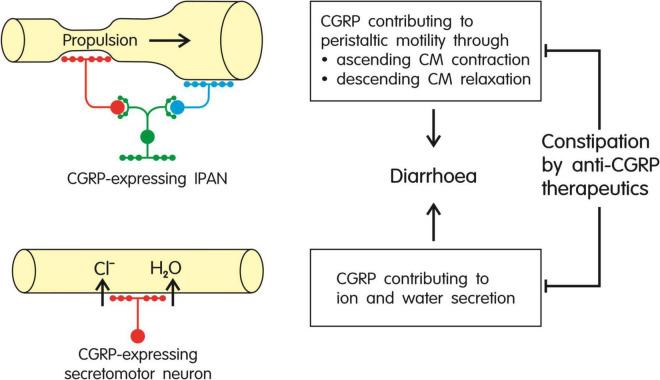
The development of small-molecule calcitonin gene-related peptide (CGRP) receptor antagonists (gepants) and of monoclonal antibodies targeting the CGRP system has been a major advance in the management of migraine. In the randomized controlled trials before regulatory approval, the safety of these anti-CGRP migraine therapeutics was considered favorable and to stay within the expected profile. Post-approval real-world surveys reveal, however, constipation to be a major adverse event which may affect more than 50% of patients treated with erenumab (an antibody targeting the CGRP receptor), fremanezumab or galcanezumab (antibodies targeting CGRP). In this review article we address the question whether constipation caused by inhibition of CGRP signaling can be mechanistically deduced from the known pharmacological actions and pathophysiological implications of CGRP in the digestive tract. CGRP in the gut is expressed by two distinct neuronal populations: extrinsic primary afferent nerve fibers and distinct neurons of the intrinsic enteric nervous system. In particular, CGRP is a major messenger of enteric sensory neurons which in response to mucosal stimulation activate both ascending excitatory and descending inhibitory neuronal pathways that enable propulsive (peristaltic) motor activity to take place. In addition, CGRP is able to stimulate ion and water secretion into the intestinal lumen. The motor-stimulating and prosecretory actions of CGRP combine in accelerating intestinal transit, an activity profile that has been confirmed by the ability of CGRP to induce diarrhea in mice, dogs and humans. We therefore conclude that the constipation elicited by antibodies targeting CGRP or its receptor results from interference with the physiological function of CGRP in the small and large intestine in which it contributes to the maintenance of peristaltic motor activity, ion and water secretion and intestinal transit.
小分子降钙素基因相关肽(CGRP)受体拮抗剂(gepants)以及靶向CGRP系统的单克隆抗体的研发是偏头痛治疗领域的一项重大进展。在监管批准前的随机对照试验中,这些抗CGRP偏头痛治疗药物的安全性被认为良好,且在预期范围内。然而,批准后的真实世界调查显示,便秘是一种主要的不良事件,可能影响超过50%接受erenumab(一种靶向CGRP受体的抗体)、fremanezumab或galcanezumab(靶向CGRP的抗体)治疗的患者。在这篇综述文章中,我们探讨了一个问题,即由CGRP信号抑制引起的便秘是否可以从CGRP在消化道中的已知药理作用和病理生理影响中通过机制推导得出。肠道中的CGRP由两种不同的神经元群体表达:外在初级传入神经纤维和内在肠神经系统的不同神经元。特别是,CGRP是肠感觉神经元的主要信使,它对黏膜刺激做出反应,激活上行兴奋性和下行抑制性神经元通路,从而使推进性(蠕动)运动活动得以发生。此外,CGRP能够刺激离子和水分泌到肠腔内。CGRP的运动刺激和促分泌作用共同加速肠道运输,这一活性特征已通过CGRP在小鼠、狗和人类中诱导腹泻的能力得到证实。因此,我们得出结论,靶向CGRP或其受体的抗体引起的便秘是由于干扰了CGRP在小肠和大肠中的生理功能,而CGRP在其中有助于维持蠕动运动活动、离子和水分泌以及肠道运输。


 Zotero 插件