
AS03 佐剂新型冠状病毒 2 重组蛋白疫苗(CoV2 preS dTM)在健康成年人中的安全性和免疫原性:一项 2 期、随机、剂量发现、多中心研究的中期结果。
Safety and immunogenicity of an AS03-adjuvanted SARS-CoV-2 recombinant protein vaccine (CoV2 preS dTM) in healthy adults: interim findings from a phase 2, randomised, dose-finding, multicentre study.
机构信息
Sanofi Pasteur, Reading, UK.
Charles R Drew University of Medicine and Science, Los Angeles, CA, USA.
出版信息
Lancet Infect Dis. 2022 May;22(5):636-648. doi: 10.1016/S1473-3099(21)00764-7. Epub 2022 Jan 25.
BACKGROUND
We evaluated our SARS-CoV-2 prefusion spike recombinant protein vaccine (CoV2 preS dTM) with different adjuvants, unadjuvanted, and in a one-injection and two-injection dosing schedule in a previous phase 1-2 study. Based on interim results from that study, we selected a two-injection schedule and the AS03 adjuvant for further clinical development. However, lower than expected antibody responses, particularly in older adults, and higher than expected reactogenicity after the second vaccination were observed. In the current study, we evaluated the safety and immunogenicity of an optimised formulation of CoV2 preS dTM adjuvanted with AS03 to inform progression to phase 3 clinical trial.
METHODS
This phase 2, randomised, parallel-group, dose-ranging study was done in adults (≥18 years old), including those with pre-existing medical conditions, those who were immunocompromised (except those with recent organ transplant or chemotherapy) and those with a potentially increased risk for severe COVID-19, at 20 clinical research centres in the USA and Honduras. Women who were pregnant or lactating or, for those of childbearing potential, not using an effective method of contraception or abstinence, and those who had received a COVID-19 vaccine, were excluded. Participants were randomly assigned (1:1:1) using an interactive response technology system, with stratification by age (18-59 years and ≥60 years), rapid serodiagnostic test result (positive or negative), and high-risk medical conditions (yes or no), to receive two injections (day 1 and day 22) of 5 7mu;g (low dose), 10 7mu;g (medium dose), or 15 7mu;g (high dose) CoV2 preS dTM antigen with fixed AS03 content. All participants and outcome assessors were masked to group assignment; unmasked study staff involved in vaccine preparation were not involved in safety outcome assessments. All laboratory staff performing the assays were masked to treatment. The primary safety objective was to describe the safety profile in all participants, for each candidate vaccine formulation. Safety endpoints were evaluated for all randomised participants who received at least one dose of the study vaccine (safety analysis set), and are presented here for the interim study period (up to day 43). The primary immunogenicity objective was to describe the neutralising antibody titres to the D614G variant 14 days after the second vaccination (day 36) in participants who were SARS-CoV-2 naive who received both injections, provided samples at day 1 and day 36, did not have protocol deviations, and did not receive an authorised COVID-19 vaccine before day 36. Neutralising antibodies were measured using a pseudovirus neutralisation assay and are presented here up to 14 days after the second dose. As a secondary immunogenicity objective, we assessed neutralising antibodies in non-naive participants. This trial is registered with ClinicalTrials.gov (NCT04762680) and is closed to new participants for the cohort reported here.
FINDINGS
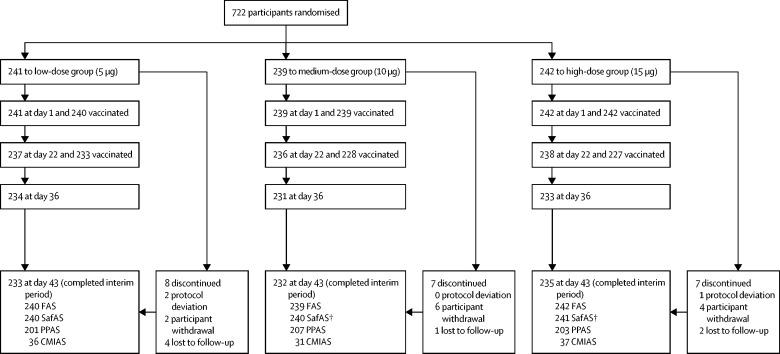
Of 722 participants enrolled and randomly assigned between Feb 24, 2021, and March 8, 2021, 721 received at least one injection (low dose=240, medium dose=239, and high dose=242). The proportion of participants reporting at least one solicited adverse reaction (injection site or systemic) in the first 7 days after any vaccination was similar between treatment groups (217 [91%] of 238 in the low-dose group, 213 [90%] of 237 in the medium-dose group, and 218 [91%] of 239 in the high-dose group); these adverse reactions were transient, were mostly mild to moderate in intensity, and occurred at a higher frequency and intensity after the second vaccination. Four participants reported immediate unsolicited adverse events; two (one each in the low-dose group and medium-dose group) were considered by the investigators to be vaccine related and two (one each in the low-dose and high-dose groups) were considered unrelated. Five participants reported seven vaccine-related medically attended adverse events (two in the low-dose group, one in the medium-dose group, and four in the high-dose group). No vaccine-related serious adverse events and no adverse events of special interest were reported. Among participants naive to SARS-CoV-2 at day 36, 158 (98%) of 162 in the low-dose group, 166 (99%) of 168 in the medium-dose group, and 163 (98%) of 166 in the high-dose group had at least a two-fold increase in neutralising antibody titres to the D614G variant from baseline. Neutralising antibody geometric mean titres (GMTs) at day 36 for participants who were naive were 2189 (95% CI 1744-2746) for the low-dose group, 2269 (1792-2873) for the medium-dose group, and 2895 (2294-3654) for the high-dose group. GMT ratios (day 36: day 1) were 107 (95% CI 85-135) in the low-dose group, 110 (87-140) in the medium-dose group, and 141 (111-179) in the high-dose group. Neutralising antibody titres in non-naive adults 21 days after one injection tended to be higher than titres after two injections in adults who were naive, with GMTs 21 days after one injection for participants who were non-naive being 3143 (95% CI 836-11 815) in the low-dose group, 2338 (593-9226) in the medium-dose group, and 7069 (1361-36 725) in the high-dose group.
INTERPRETATION
Two injections of CoV2 preS dTM-AS03 showed acceptable safety and reactogenicity, and robust immunogenicity in adults who were SARS-CoV-2 naive and non-naive. These results supported progression to phase 3 evaluation of the 10 7mu;g antigen dose for primary vaccination and a 5 7mu;g antigen dose for booster vaccination.
FUNDING
Sanofi Pasteur and Biomedical Advanced Research and Development Authority.
背景
我们评估了使用不同佐剂、无佐剂以及在之前的 1-2 期研究中的一剂和两剂接种方案的 SARS-CoV-2 融合前刺突重组蛋白疫苗(CoV2 preS dTM)。基于该研究的中期结果,我们选择了两剂接种方案和 AS03 佐剂进行进一步的临床开发。然而,在老年人中观察到的抗体反应低于预期,在第二次接种后观察到的反应原性高于预期。在目前的研究中,我们评估了 CoV2 preS dTM 与 AS03 联合使用的优化配方的安全性和免疫原性,为进入 3 期临床试验提供信息。
方法
这项 2 期、随机、平行组、剂量范围研究在美国和洪都拉斯的 20 个临床研究中心进行,纳入了成年人(≥18 岁),包括有基础医疗条件的成年人、免疫功能低下者(除近期器官移植或化疗的患者外)和有 COVID-19 重症高风险的成年人。排除了孕妇或哺乳期妇女、有生育能力的妇女(除非使用有效的避孕方法或禁欲)以及已经接种过 COVID-19 疫苗的妇女。参与者使用交互式反应技术系统(1:1:1)随机分配,按年龄(18-59 岁和≥60 岁)、快速血清诊断检测结果(阳性或阴性)和高风险医疗条件(是或否)分层,接受 2 剂(第 1 天和第 22 天)5μg(低剂量)、10μg(中剂量)或 15μg(高剂量)的 CoV2 preS dTM 抗原,并用固定 AS03 含量佐剂。所有参与者和结局评估者均对分组情况设盲;未参与疫苗准备的未盲研究人员不参与安全性结局评估。所有进行检测的实验室工作人员对治疗情况设盲。主要安全性目标是描述所有接受研究疫苗的参与者的安全性概况(每个候选疫苗制剂)。安全性终点在至少接受一剂研究疫苗的所有随机参与者中进行评估(安全性分析集),并在此期间进行报告(直至第 43 天)。主要免疫原性目标是描述在两剂疫苗接种后第 14 天(第 36 天),首次接受 SARS-CoV-2 疫苗接种且接受两剂疫苗接种、在第 1 天和第 36 天提供样本、无方案偏差且在第 36 天之前未接种过获授权的 COVID-19 疫苗的参与者中,针对 D614G 变异的中和抗体滴度。中和抗体使用假病毒中和测定法进行测量,并在此处报告至第二次剂量后 14 天。作为次要免疫原性目标,我们评估了非初免参与者中的中和抗体。这项试验在 ClinicalTrials.gov 注册(NCT04762680),目前针对报告的这组参与者已关闭入组。
发现
在 2021 年 2 月 24 日至 2021 年 3 月 8 日期间招募并随机分配的 722 名参与者中,721 名至少接受了一剂(低剂量组=240 名,中剂量组=239 名,高剂量组=242 名)。在任何疫苗接种后 7 天内,报告至少一种注射部位或全身不良事件的参与者比例在治疗组之间相似(低剂量组 217 [91%],中剂量组 213 [90%],高剂量组 218 [91%]);这些不良反应是短暂的,大多为轻度至中度,第二次接种后频率和强度更高。4 名参与者报告了即时的非预期不良事件;其中 2 名(低剂量组和中剂量组各 1 名)被研究者认为与疫苗相关,2 名(低剂量组和高剂量组各 1 名)被认为与疫苗无关。5 名参与者报告了 7 例与疫苗相关的需要医疗干预的不良事件(低剂量组 2 例,中剂量组 1 例,高剂量组 4 例)。没有报告与疫苗相关的严重不良事件和特别关注的不良事件。在第 36 天对 SARS-CoV-2 初免的参与者中,低剂量组 162 名(98%)、中剂量组 168 名(99%)和高剂量组 166 名(98%)的中和抗体滴度对 D614G 变异体均至少增加了两倍。在第 36 天对初免的参与者,低剂量组的中和抗体几何平均滴度(GMT)为 2189(95%CI 1744-2746),中剂量组为 2269(1792-2873),高剂量组为 2895(2294-3654)。GMT 比值(第 36 天:第 1 天)在低剂量组为 107(95%CI 85-135),在中剂量组为 110(87-140),在高剂量组为 141(111-179)。在初免的成年人中,一剂接种后 21 天的中和抗体滴度趋于高于初免成年人两剂接种后的滴度,非初免成年人一剂接种后的 GMT 为低剂量组 3143(95%CI 836-11 815),中剂量组 2338(593-9226),高剂量组 7069(1361-36 725)。
解释
CoV2 preS dTM-AS03 的两剂接种显示出可接受的安全性和反应原性,以及对初免和非初免的成年人的强大免疫原性。这些结果支持进入 3 期评估 10μg 抗原剂量作为初级疫苗接种和 5μg 抗原剂量作为加强疫苗接种。
资金
赛诺菲巴斯德和生物医学高级研究与发展局。



 Zotero 插件