
Toll 样受体 8 激动剂主要通过靶向 CD56CD16 亚群改善 NK 细胞功能。
Toll-like receptor 8 agonists improve NK-cell function primarily targeting CD56CD16 subset.
机构信息
Department of Immunology, Bambino Gesu Pediatric Hospital, Roma, Italy.
Confocal Microscopy Core Facility, Bambino Gesu Pediatric Hospital, Roma, Italy.
出版信息
J Immunother Cancer. 2022 Jan;10(1). doi: 10.1136/jitc-2021-003385.
BACKGROUND
Toll-like receptors (TLRs) are pattern-recognition sensors mainly expressed in innate immune cells that directly recognize conserved pathogen structures (pathogen-associated molecular patterns-PAMPs). Natural killer (NK) cells have been described to express different endosomal TLRs triggered by RNA and DNA sequences derived from both viruses and bacteria. This study was addressed to establish which endosomal TLR could directly mediate NK activation and function after proper stimuli. It was also important to establish the most suitable TLR agonist to be used as adjuvant in tumor vaccines or in combined cancer immunotherapies.
METHODS
We assessed endosomal TLR expression in total NK cells by using RT-qPCR and western blotting technique. In some experiments, we purified CD56CD16 and CD56CD16 cells subsets by using NK Cell Isolation Kit Activation marker, cytokine production, CD107a expression and cytotoxicity assay were evaluated by flow cytometry. Cytokine release was quantified by ELISA. NK cells obtained from ovarian ascites underwent the same analyses.
RESULTS
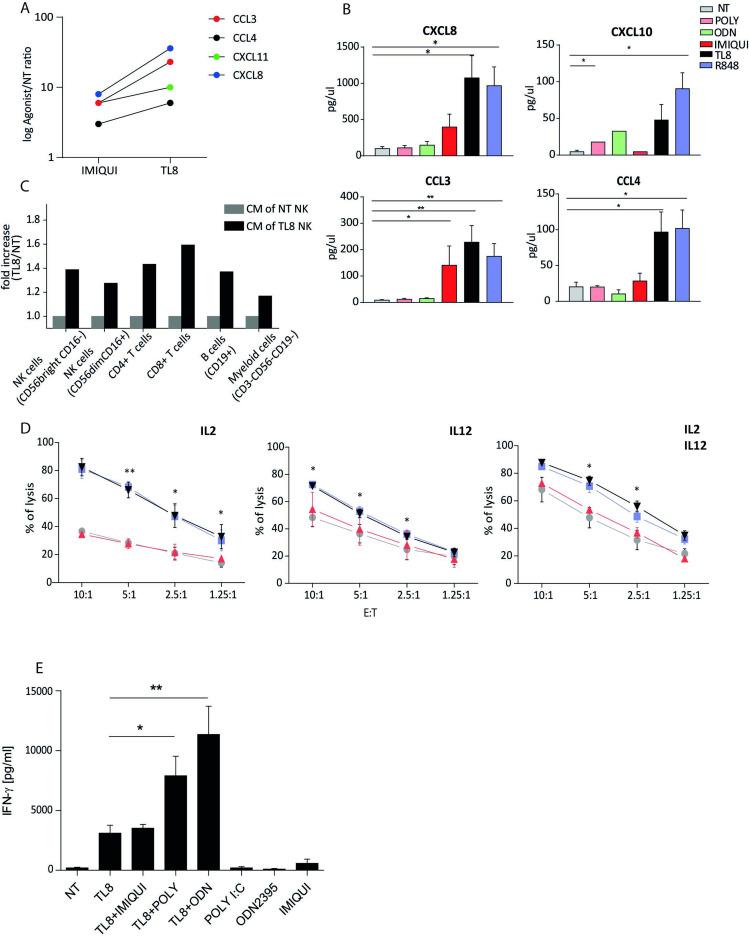
Although the four endosomal TLRs (TLR3, TLR7/8, and TLR9) were uniformly expressed on CD56CD16 and CD56CD16 cell subsets, the TLR7/8 (R848), TLR3 (polyinosinic-polycytidylic acid, Poly I:C) and TLR9 (ODN2395) ligands promoted NK-cell function only in the presence of suboptimal doses of cytokines, including interleukin (IL)-2, IL-12, IL-15, and IL-18, produced by other environmental cells. We showed that R848 rather than TLR3 and TLR9 agonists primarily activated CD56CD16 NK cells by increasing their proliferation, cytokine production and cytotoxic activity. Moreover, we demonstrated that R848, which usually triggers TLR7 and TLR8 on dendritic cells, macrophages and neutrophils cells, activated CD56CD16 NK-cell subset only via TLR8. Indeed, specific TLR8 but not TLR7 agonists increased cytokine production and cytotoxic activity of CD56CD16 NK cells. Importantly, these activities were also observed in peritoneal NK cells from patients with metastatic ovarian carcinoma, prevalently belonging to the CD56CD16 subset.
CONCLUSION
These data highlight the potential value of TLR8 in NK cells as a new target for immunotherapy in patients with cancer.
背景
Toll 样受体(TLR)是主要表达于固有免疫细胞的模式识别传感器,可直接识别病原体结构(病原体相关分子模式-PAMPs)。已描述自然杀伤(NK)细胞表达不同的内体 TLR,这些 TLR 可被源自病毒和细菌的 RNA 和 DNA 序列触发。本研究旨在确定哪种内体 TLR 可以在适当刺激后直接介导 NK 细胞的激活和功能。确定最适合用作肿瘤疫苗佐剂或联合癌症免疫疗法的 TLR 激动剂也很重要。
方法
我们通过 RT-qPCR 和 Western blot 技术评估总 NK 细胞中的内体 TLR 表达。在一些实验中,我们使用 NK 细胞分离试剂盒激活标志物纯化 CD56CD16 和 CD56CD16 细胞亚群,通过流式细胞术评估细胞因子产生、CD107a 表达和细胞毒性试验。通过 ELISA 定量细胞因子释放。对来自卵巢腹水的 NK 细胞进行了相同的分析。
结果
尽管四种内体 TLR(TLR3、TLR7/8 和 TLR9)均匀表达于 CD56CD16 和 CD56CD16 细胞亚群,但 TLR7/8(R848)、TLR3(多聚肌苷酸-多聚胞苷酸,Poly I:C)和 TLR9(ODN2395)配体仅在存在亚最佳剂量细胞因子(包括白细胞介素(IL)-2、IL-12、IL-15 和 IL-18)的情况下才能促进 NK 细胞功能,这些细胞因子由其他环境细胞产生。我们表明,R848 而不是 TLR3 和 TLR9 激动剂主要通过增加其增殖、细胞因子产生和细胞毒性活性来激活 CD56CD16 NK 细胞。此外,我们证明 R848 通常在树突状细胞、巨噬细胞和中性粒细胞上触发 TLR7 和 TLR8,仅通过 TLR8 激活 CD56CD16 NK 细胞亚群。事实上,特异性 TLR8 而不是 TLR7 激动剂增加了 CD56CD16 NK 细胞的细胞因子产生和细胞毒性活性。重要的是,这些活性也在患有转移性卵巢癌的患者的腹腔 NK 细胞中观察到,这些细胞主要属于 CD56CD16 亚群。
结论
这些数据突出了 TLR8 在 NK 细胞作为癌症患者免疫治疗新靶标的潜在价值。


 Zotero 插件