
先前接受过低甲基化剂治疗的继发性 AML 患者的一线治疗方法对其结局的影响。
Impact of frontline treatment approach on outcomes in patients with secondary AML with prior hypomethylating agent exposure.
机构信息
Department of Leukemia, Unit 428, The University of Texas MD Anderson Cancer Center, 1515 Holcombe Boulevard, Houston, TX, 77030, USA.
Department of Biostatistics, The University of Texas MD Anderson Cancer Center, Houston, TX, USA.
出版信息
J Hematol Oncol. 2022 Jan 29;15(1):12. doi: 10.1186/s13045-022-01229-z.
BACKGROUND
Treated secondary acute myeloid leukemia (ts-AML)-i.e., AML arising from a previously treated antecedent hematologic disorder-is associated with very poor outcomes. The optimal frontline treatment regimen for these patients is uncertain.
METHODS
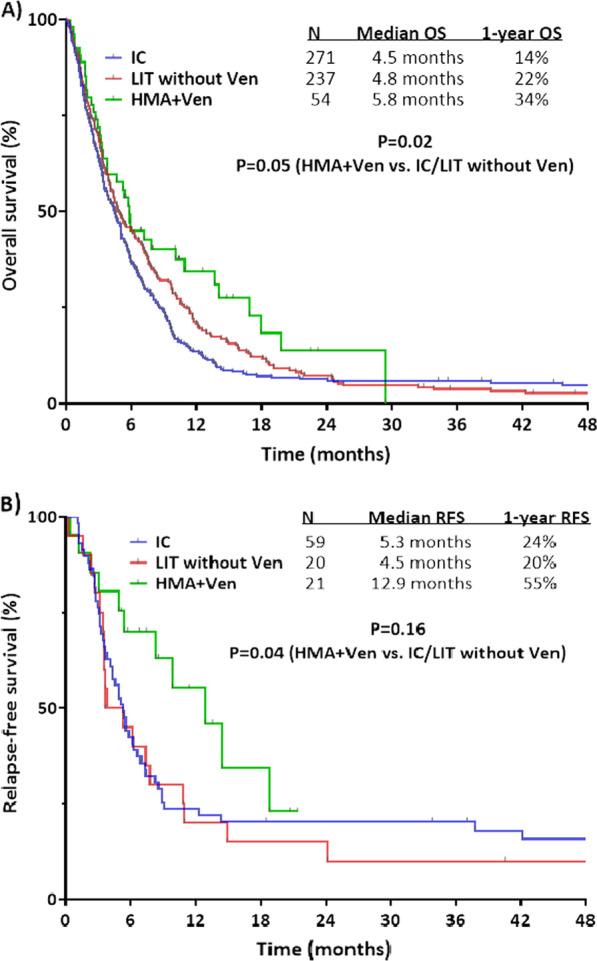
We retrospectively analyzed 562 patients who developed AML from preceding myelodysplastic syndrome or chronic myelomonocytic leukemia for which they had received a hypomethylating agent (HMA). Patients with ts-AML were stratified by frontline AML treatment with intensive chemotherapy (IC, n = 271), low-intensity therapy (LIT) without venetoclax (n = 237), or HMA plus venetoclax (n = 54).
RESULTS
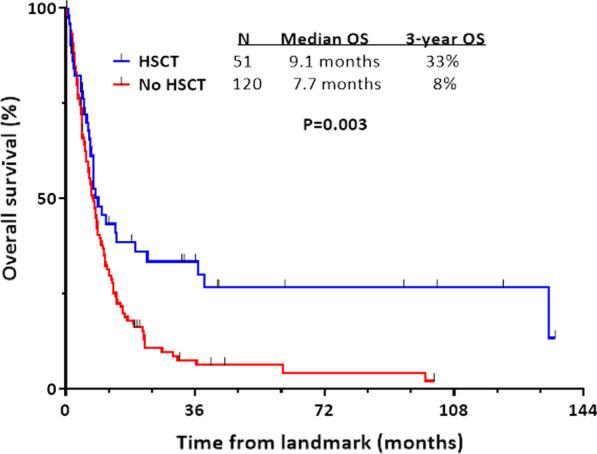
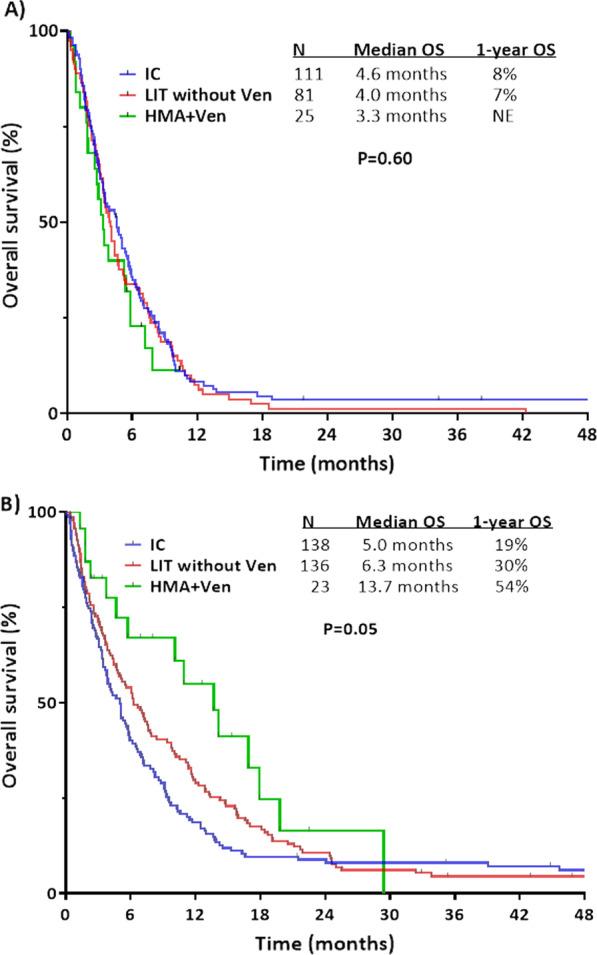
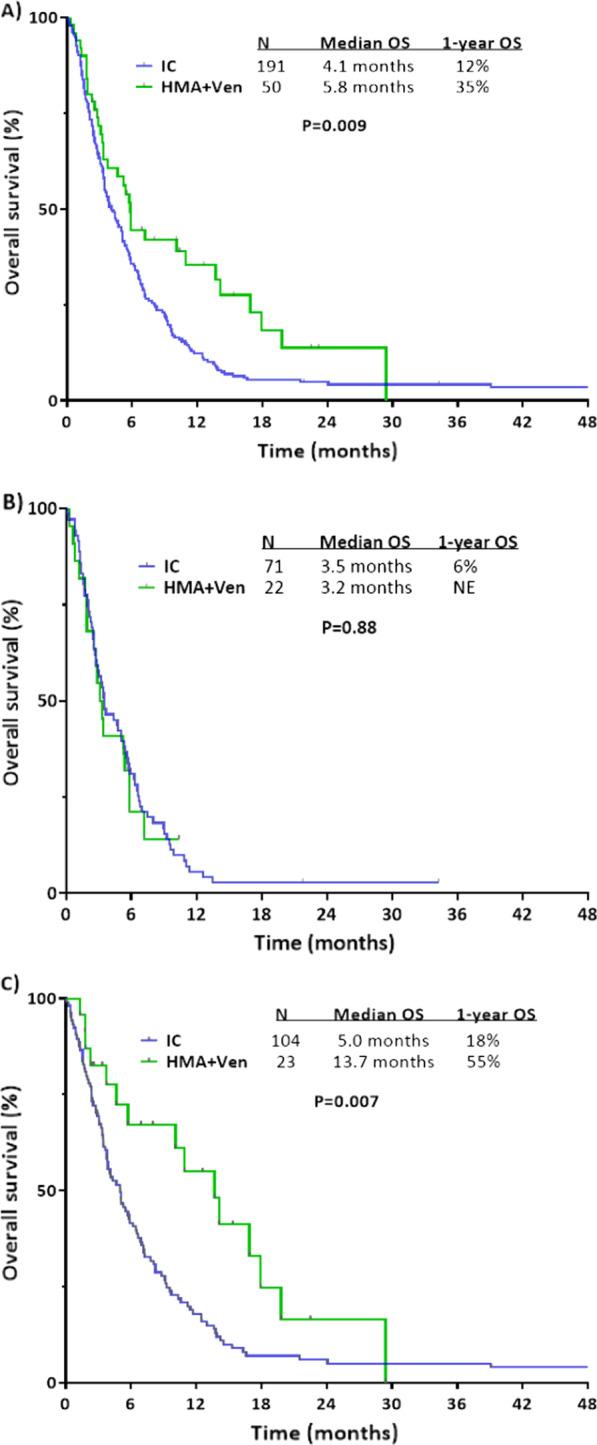
Compared with IC or LIT without venetoclax, HMA plus venetoclax resulted in higher CR/CRi rates (39% and 25%, respectively; P = 0.02) and superior OS (1-year OS 34% and 17%, respectively; P = 0.05). The benefit of HMA plus venetoclax was restricted to patients with non-adverse risk karyotype, where HMA plus venetoclax resulted in a median OS of 13.7 months and 1-year OS rate of 54%; in contrast, for patients with adverse risk karyotype, OS was similarly dismal regardless of treatment approach (median OS 3-5 months). A propensity score analysis accounting for relevant clinical variables confirmed the significant OS benefit of HMA plus venetoclax, as compared with other frontline treatment approaches. In a landmark analysis, patients with ts-AML who underwent subsequent hematopoietic stem cell transplantation (HSCT) had superior 3-year OS compared to non-transplanted patients (33% vs. 8%, respectively; P = 0.003).
CONCLUSIONS
The outcomes of ts-AML are poor but may be improved with use of an HMA plus venetoclax-based regimen, followed by HSCT, particularly in those with a non-adverse risk karyotype.
背景
治疗后急性髓系白血病(ts-AML),即由先前治疗的前驱血液系统疾病引起的 AML,其预后非常差。这些患者的最佳一线治疗方案仍不确定。
方法
我们回顾性分析了 562 例先前接受低甲基化药物(HMA)治疗的骨髓增生异常综合征或慢性粒单核细胞白血病进展为 AML 的患者。根据一线 AML 治疗方案,将 ts-AML 患者分为强化化疗(IC,n=271)、无维奈克拉的低强度治疗(LIT,n=237)或 HMA 联合维奈克拉(n=54)三组。
结果
与 IC 或无维奈克拉的 LIT 相比,HMA 联合维奈克拉治疗后患者的 CR/CRi 率更高(分别为 39%和 25%,P=0.02),OS 也更好(1 年 OS 率分别为 34%和 17%,P=0.05)。HMA 联合维奈克拉的获益仅限于非不良风险核型的患者,在这些患者中,HMA 联合维奈克拉治疗的中位 OS 为 13.7 个月,1 年 OS 率为 54%;相比之下,对于具有不良风险核型的患者,无论采用何种治疗方法,OS 均较差(中位 OS 3-5 个月)。一项考虑了相关临床变量的倾向评分分析证实,与其他一线治疗方法相比,HMA 联合维奈克拉治疗可显著改善 OS。在一个里程碑式分析中,接受造血干细胞移植(HSCT)的 ts-AML 患者的 3 年 OS 明显优于未移植患者(分别为 33%和 8%,P=0.003)。
结论
ts-AML 的预后较差,但使用 HMA 联合维奈克拉方案治疗后,再进行 HSCT,可改善预后,尤其是在非不良风险核型的患者中。
 Zotero 插件