
SARS-CoV-2、流感病毒和呼吸道合胞病毒引起的社区获得性肺炎中的细菌合并感染。
Bacterial co-infections in community-acquired pneumonia caused by SARS-CoV-2, influenza virus and respiratory syncytial virus.
机构信息
Department of Medicine Solna, Karolinska Institutet, 171 77, Stockholm, Sweden.
Department of Infectious Diseases, Karolinska University Hospital, Stockholm, Sweden.
出版信息
BMC Infect Dis. 2022 Jan 31;22(1):108. doi: 10.1186/s12879-022-07089-9.
BACKGROUND
A mismatch between a widespread use of broad-spectrum antibiotic agents and a low prevalence of reported bacterial co-infections in patients with SARS-CoV-2 infections has been observed. Herein, we sought to characterize and compare bacterial co-infections at admission in hospitalized patients with SARS-CoV-2, influenza or respiratory syncytial virus (RSV) positive community-acquired pneumonia (CAP).
METHODS
A retrospective cohort study of bacterial co-infections at admission in SARS-CoV-2, influenza or RSV-positive adult patients with CAP admitted to Karolinska University Hospital in Stockholm, Sweden, from year 2011 to 2020. The prevalence of bacterial co-infections was investigated and compared between the three virus groups. In each virus group, length of stay, ICU-admission and 30-day mortality was compared in patients with and without bacterial co-infection, adjusting for age, sex and co-morbidities. In the SARS-CoV-2 group, risk factors for bacterial co-infection, were assessed using logistic regression models and creation of two scoring systems based on disease severity, age, co-morbidities and inflammatory markers with assessment of concordance statistics.
RESULTS
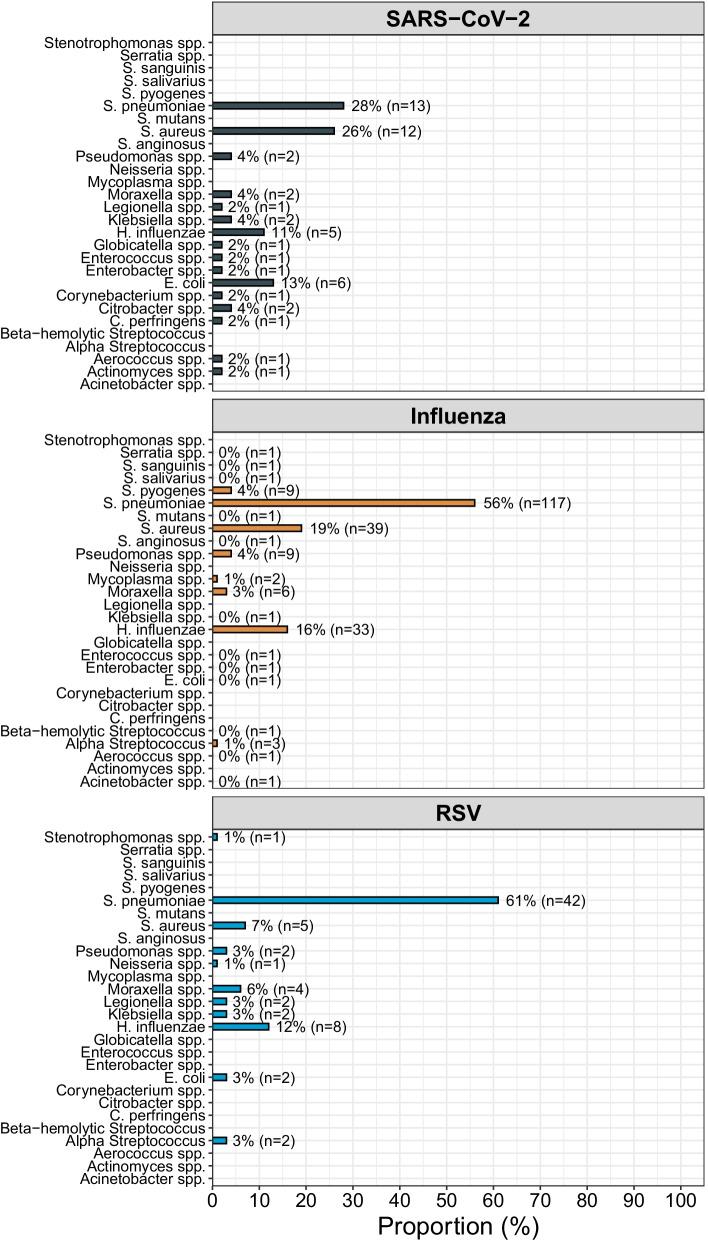
Compared to influenza and RSV, the bacterial co-infection testing frequency in SARS-CoV-2 was lower for all included test modalities. Four percent [46/1243 (95% CI 3-5)] of all SARS-CoV-2 patients had a bacterial co-infection at admission, whereas the proportion was 27% [209/775 (95% CI 24-30)] and 29% [69/242 (95% CI 23-35)] in influenza and RSV, respectively. S. pneumoniae and S. aureus constituted the most common bacterial findings for all three virus groups. Comparing SARS-CoV-2 positive patients with and without bacterial co-infection at admission, a relevant association could not be demonstrated nor excluded with regards to risk of ICU-admission (aHR 1.53, 95% CI 0.87-2.69) or 30-day mortality (aHR 1.28, 95% CI 0.66-2.46) in adjusted analyses. Bacterial co-infection was associated with increased inflammatory markers, but the diagnostic accuracy was not substantially different in a scoring system based on disease severity, age, co-morbidities and inflammatory parameters [C statistic 0.66 (95% CI 0.59-0.74)], compared to using disease severity, age and co-morbidities only [C statistic 0.63 (95% CI 0.56-0.70)].
CONCLUSIONS
The prevalence of bacterial co-infections was significantly lower in patients with community-acquired SARS-CoV-2 positive pneumonia as compared to influenza and RSV positive pneumonia.
背景
在 SARS-CoV-2 感染患者中,广谱抗生素的广泛使用与报告的细菌合并感染的低流行率之间存在不匹配。在此,我们旨在描述和比较住院的 SARS-CoV-2、流感或呼吸道合胞病毒(RSV)阳性社区获得性肺炎(CAP)患者入院时的细菌合并感染。
方法
这是一项回顾性队列研究,研究了来自瑞典斯德哥尔摩卡罗林斯卡大学医院的 2011 年至 2020 年期间患有 CAP 的 SARS-CoV-2、流感或 RSV 阳性成年患者入院时的细菌合并感染。研究比较了三组病毒之间的细菌合并感染发生率。在每组病毒中,比较了有和无细菌合并感染的患者的住院时间、入住 ICU 和 30 天死亡率,并根据年龄、性别和合并症进行了调整。在 SARS-CoV-2 组中,使用逻辑回归模型评估了细菌合并感染的危险因素,并基于疾病严重程度、年龄、合并症和炎症标志物创建了两个评分系统,评估了一致性统计数据。
结果
与流感和 RSV 相比,SARS-CoV-2 的所有纳入检测方法的细菌合并感染检测频率均较低。4%[46/1243(95%CI 3-5)]的 SARS-CoV-2 患者入院时存在细菌合并感染,而流感和 RSV 组的比例分别为 27%[209/775(95%CI 24-30)]和 29%[69/242(95%CI 23-35)]。肺炎链球菌和金黄色葡萄球菌是所有三组病毒的最常见细菌发现。比较 SARS-CoV-2 阳性患者入院时有无细菌合并感染,在调整分析中,入住 ICU 的风险(aHR 1.53,95%CI 0.87-2.69)或 30 天死亡率(aHR 1.28,95%CI 0.66-2.46)均无明显相关性。细菌合并感染与炎症标志物升高相关,但基于疾病严重程度、年龄、合并症和炎症参数的评分系统的诊断准确性与仅基于疾病严重程度、年龄和合并症的评分系统无明显差异[C 统计量 0.66(95%CI 0.59-0.74)]。
结论
与流感和 RSV 阳性肺炎患者相比,社区获得性 SARS-CoV-2 阳性肺炎患者的细菌合并感染发生率显著降低。

 Zotero 插件