
通过单核苷酸引物延伸和Illumina公司的Infinium甲基化EPIC芯片测定的七CpG DNA甲基化年龄提供了高度可比的结果。
Seven-CpG DNA Methylation Age Determined by Single Nucleotide Primer Extension and Illumina's Infinium MethylationEPIC Array Provide Highly Comparable Results.
作者信息
Vetter Valentin Max, Kalies Christian Humberto, Sommerer Yasmine, Bertram Lars, Demuth Ilja
机构信息
Department of Endocrinology and Metabolic Diseases (Including Division of Lipid Metabolism), Biology of Aging Working Group, Charité-Universitätsmedizin Berlin, Corporate Member of Freie Universität Berlin and Humboldt-Universität zu Berlin, Berlin, Germany.
Department of Psychology, Humboldt University Berlin, Berlin, Germany.
出版信息
Front Genet. 2022 Jan 17;12:759357. doi: 10.3389/fgene.2021.759357. eCollection 2021.
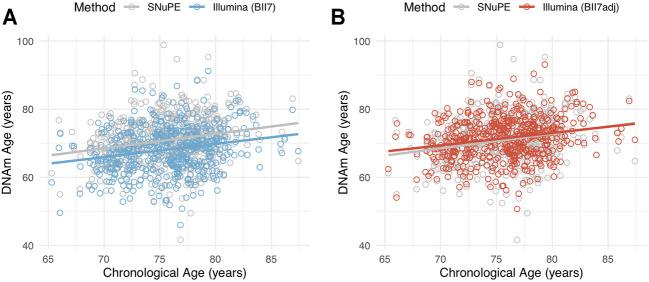
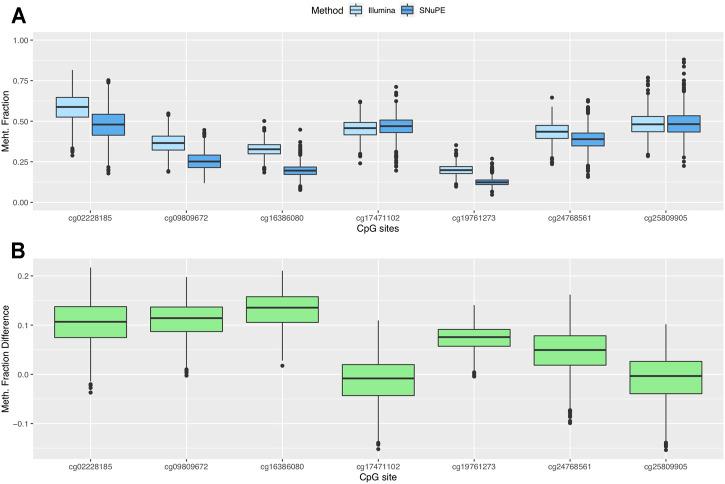
DNA methylation age (DNAm age, epigenetic clock) is a novel and promising biomarker of aging. It is calculated from the methylation fraction of specific cytosine phosphate guanine sites (CpG sites) of genomic DNA. Several groups have proposed epigenetic clock algorithms and these differ mostly regarding the number and location of the CpG sites considered and the method used to assess the methylation status. Most epigenetic clocks are based on a large number of CpGs, e.g. as measured by DNAm microarrays. We have recently evaluated an epigenetic clock based on the methylation fraction of seven CpGs that were determined by methylation-sensitive single nucleotide primer extension (MS-SNuPE). This method is more cost-effective when compared to array-based technologies as only a few CpGs need to be examined. However, there is only little data on the correspondence in epigenetic age estimation using the 7-CpG clock and other algorithms. To bridge this gap, in this study we measured the 7-CpG DNAm age using two methods, via MS-SNuPE and via the MethylationEPIC array, in a sample of 1,058 participants of the Berlin Aging Study II (BASE-II), assessed as part of the GendAge study. On average, participants were 75.6 years old (SD: 3.7, age range: 64.9-90.0, 52.6% female). Agreement between methods was assessed by Bland-Altman plots. DNAm age was highly correlated between methods (Pearson's r = 0.9) and Bland-Altman plots showed a difference of 3.1 years. DNAm age by the 7-CpG formula was 71.2 years (SD: 6.9 years, SNuPE) and 68.1 years (SD: 6.4 years, EPIC array). The mean of difference in methylation fraction between methods for the seven individual CpG sites was between 0.7 and 13 percent. To allow direct conversion of DNAm age obtained from both methods we developed an adjustment formula with a randomly selected training set of 529 participants using linear regression. After conversion of the Illumina data in a second and independent validation set, the adjusted DNAm age was 71.44 years (SD: 6.1 years, n = 529). In summary, we found the results of DNAm clocks to be highly comparable. Furthermore, we developed an adjustment formula that allows for direct conversion of DNAm age estimates between methods and enables one singular clock to be used in studies that employ either the Illumina or the SNuPE method.
DNA甲基化年龄(DNAm年龄,表观遗传时钟)是一种新型且有前景的衰老生物标志物。它是根据基因组DNA中特定胞嘧啶磷酸鸟嘌呤位点(CpG位点)的甲基化分数计算得出的。多个研究团队提出了表观遗传时钟算法,这些算法在考虑的CpG位点数量和位置以及用于评估甲基化状态的方法上大多有所不同。大多数表观遗传时钟基于大量的CpG,例如通过DNAm微阵列测量。我们最近评估了一种基于七个CpG甲基化分数的表观遗传时钟,这些CpG是通过甲基化敏感单核苷酸引物延伸(MS-SNuPE)测定的。与基于阵列的技术相比,这种方法更具成本效益,因为只需要检测少数几个CpG。然而,关于使用7-CpG时钟和其他算法进行表观遗传年龄估计的一致性数据很少。为了填补这一空白,在本研究中,我们在柏林衰老研究II(BASE-II)的1058名参与者样本中,通过MS-SNuPE和MethylationEPIC阵列这两种方法测量了7-CpG DNAm年龄,该样本是作为GendAge研究的一部分进行评估的。参与者的平均年龄为75.6岁(标准差:3.7,年龄范围:64.9 - 90.0,女性占52.6%)。通过Bland-Altman图评估了两种方法之间的一致性。两种方法之间的DNAm年龄高度相关(Pearson相关系数r = 0.9),Bland-Altman图显示差异为3.1岁。7-CpG公式计算的DNAm年龄,通过SNuPE法为71.2岁(标准差:6.9岁),通过EPIC阵列法为68.1岁(标准差:6.4岁)。七种单个CpG位点方法之间甲基化分数差异的平均值在0.7%至13%之间。为了实现从两种方法获得的DNAm年龄的直接转换,我们使用线性回归,在一个由529名参与者组成的随机选择的训练集中开发了一个调整公式。在第二个独立验证集中对Illumina数据进行转换后,调整后的DNAm年龄为71.44岁(标准差:6.1岁,n = 529)。总之,我们发现DNAm时钟的结果具有高度可比性。此外,我们开发了一个调整公式,允许在不同方法之间直接转换DNAm年龄估计值,并使在使用Illumina或SNuPE方法的研究中能够使用单一的时钟。

 Zotero 插件