
通过STAT5失活抑制BCL2A1可克服FLT3-ITD/D835突变型急性髓系白血病对靶向治疗的耐药性。
Inhibition of BCL2A1 by STAT5 inactivation overcomes resistance to targeted therapies of FLT3-ITD/D835 mutant AML.
作者信息
Yamatani Kotoko, Ai Tomohiko, Saito Kaori, Suzuki Koya, Hori Atsushi, Kinjo Sonoko, Ikeo Kazuho, Ruvolo Vivian, Zhang Weiguo, Mak Po Yee, Kaczkowski Bogumil, Harada Hironori, Katayama Kazuhiro, Sugimoto Yoshikazu, Myslinski Jered, Hato Takashi, Miida Takashi, Konopleva Marina, Hayashizaki Yoshihide, Carter Bing Z, Tabe Yoko, Andreeff Michael
机构信息
Department of Clinical Laboratory Medicine, Juntendo University Graduate School of Medicine, 2-1-1 Hongo, Bunkyo-ku, Tokyo 113-8421, Japan.
Department of Clinical Laboratory Medicine, Juntendo University Graduate School of Medicine, 2-1-1 Hongo, Bunkyo-ku, Tokyo 113-8421, Japan; Center for Genomic and Regenerative Medicine, Juntendo University Graduate School of Medicine, Tokyo, Japan.
出版信息
Transl Oncol. 2022 Apr;18:101354. doi: 10.1016/j.tranon.2022.101354. Epub 2022 Feb 1.
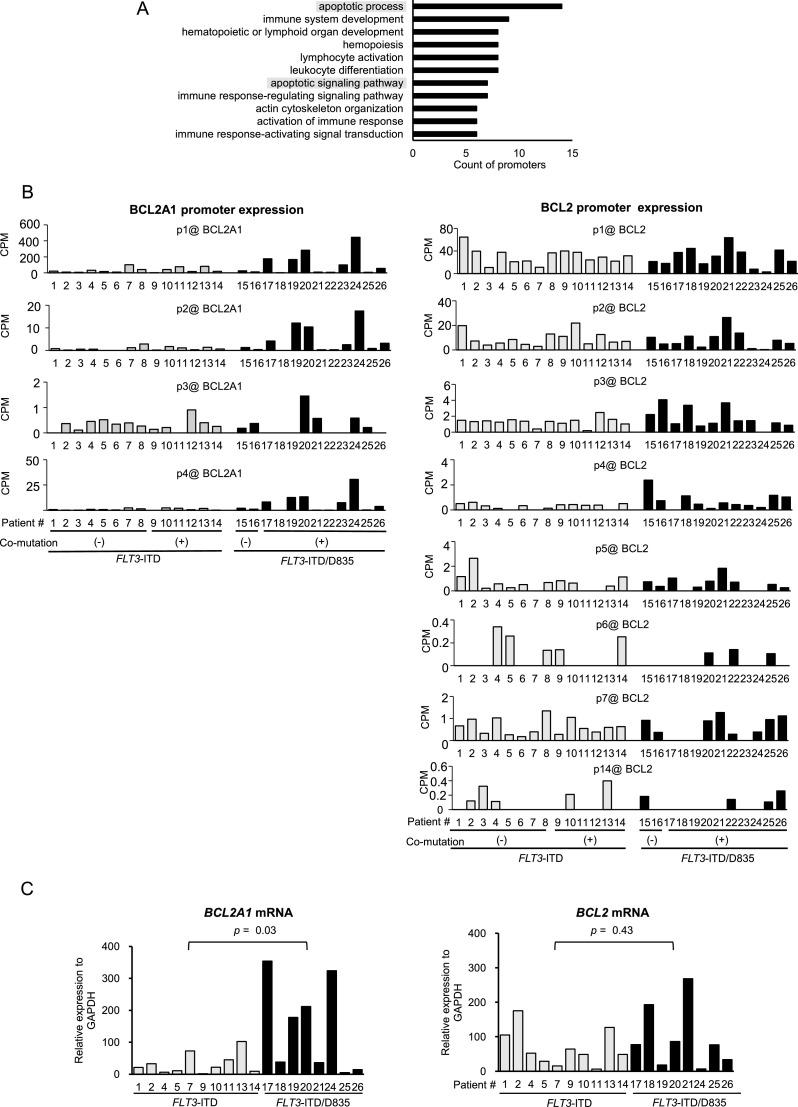
Tyrosine kinase inhibitors (TKIs) are established drugs in the therapy of FLT3-ITD mutated acute myeloid leukemia (AML). However, acquired mutations, such as D835 in the tyrosine kinase domain (FLT3-ITD/D835), can induce resistance to TKIs. A cap analysis gene expression (CAGE) technology revealed that the gene expression of BCL2A1 transcription start sites was increased in primary AML cells bearing FLT3-ITD/D835 compared to FLT3-ITD. Overexpression of BCL2A1 attenuated the sensitivity to quizartinib, a type II TKI, and venetoclax, a selective BCL2 inhibitor, in AML cell lines. However, a type I TKI, gilteritinib, inhibited the expression of BCL2A1 through inactivation of STAT5 and alleviated TKI resistance of FLT3-ITD/D835. The combination of gilteritinib and venetoclax showed synergistic effects in the FLT3-ITD/D835 positive AML cells. The promoter region of BCL2A1 contains a BRD4 binding site. Thus, the blockade of BRD4 with a BET inhibitor (CPI-0610) downregulated BCL2A1 in FLT3-mutated AML cells and extended profound suppression of FLT3-ITD/D835 mutant cells. Therefore, we propose that BCL2A1 has the potential to be a novel therapeutic target in treating FLT3-ITD/D835 mutated AML.
酪氨酸激酶抑制剂(TKIs)是治疗FLT3-ITD突变急性髓系白血病(AML)的常用药物。然而,获得性突变,如酪氨酸激酶结构域中的D835(FLT3-ITD/D835),可诱导对TKIs产生耐药性。帽分析基因表达(CAGE)技术显示,与FLT3-ITD相比,携带FLT3-ITD/D835的原发性AML细胞中BCL2A1转录起始位点的基因表达增加。BCL2A1的过表达减弱了AML细胞系对第二代TKI喹扎替尼和选择性BCL2抑制剂维奈克拉的敏感性。然而,第一代TKI吉列替尼通过使STAT5失活来抑制BCL2A1的表达,并减轻FLT3-ITD/D835的TKI耐药性。吉列替尼和维奈克拉的联合使用在FLT3-ITD/D835阳性AML细胞中显示出协同作用。BCL2A1的启动子区域包含一个BRD4结合位点。因此,用溴结构域和额外末端结构域(BET)抑制剂(CPI-0610)阻断BRD4可下调FLT3突变AML细胞中BCL2A1的表达,并增强对FLT3-ITD/D835突变细胞的深度抑制。因此,我们认为BCL2A1有潜力成为治疗FLT3-ITD/D835突变AML的新型治疗靶点。



 Zotero 插件