
术前淋巴细胞与单核细胞比值、中性粒细胞与淋巴细胞比值及中性粒细胞与单核细胞比值对食管鳞状细胞癌患者的临床及预后意义
Clinical and prognostic significance of preoperative lymphocyte-monocyte ratio, neutrophil-lymphocyte ratio and neutrophil-monocyte ratio on esophageal squamous cell carcinoma patients.
作者信息
Shang Qi-Xin, Yang Yu-Shang, Hu Wei-Peng, Yuan Yong, He Yan, Zhao Jing-Ying, Ji Ai-Fang, Chen Long-Qi
机构信息
Department of Thoracic Surgery, West China Hospital of Sichuan University, Chengdu, China.
Central Laboratory, Heping Hospital Affiliated to Changzhi Medical University, Changzhi City, China.
出版信息
Transl Cancer Res. 2020 Jun;9(6):3903-3914. doi: 10.21037/tcr-19-2777.
BACKGROUND
The interaction between tumor cells and inflammatory cells has not been systematically investigated in esophageal squamous cell carcinoma (ESCC). The aim of the present study was to evaluate whether preoperative lymphocyte-monocyte ratio (LMR), neutrophil-lymphocyte ratio (NLR), and neutrophil-monocyte ratio (NMR) could predict the prognosis of ESCC patients undergoing esophagectomy.
METHODS
A total of 1,883 patients with histologically diagnosed ESCC who underwent radical esophagectomy from May 2005 to May 2015 were retrospectively reviewed. Besides clinicopathological factors, "Survminer" package in R was applied to determine the optimal cut-off point for LMR, NLR and NMR. Meanwhile, we evaluated the prognostic value of LMR, NLR, and PLR using Kaplan-Meier curves and Cox regression models.
RESULTS
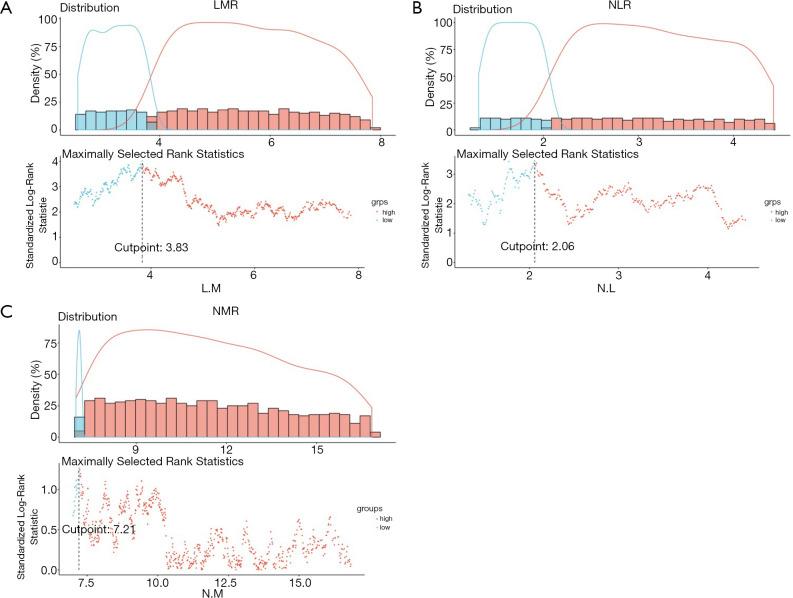
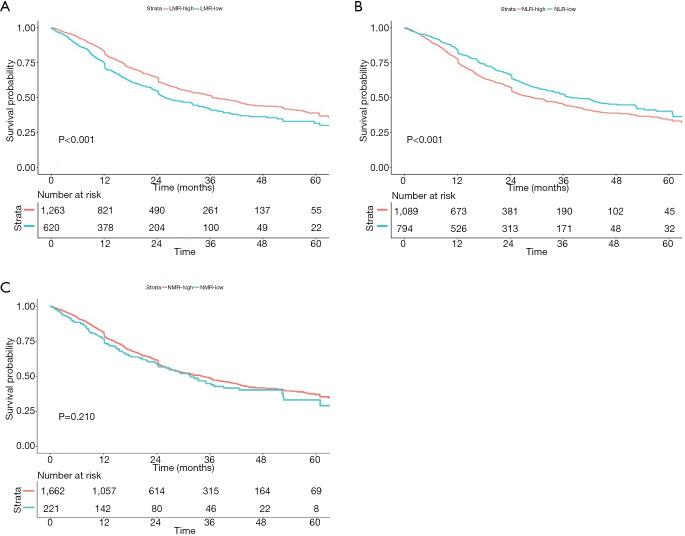
The median follow-up was 28.77 months (range, 1.60-247.90 months). The optimal cut-off point of LMR, NLR and NMR is 3.83, 2.06 and 7.21, respectively. Kaplan-Meier survival analysis of patients with low preoperative LMR demonstrated a significant worse prognosis for 5-year OS (P<0.001) than those with high preoperative LMR. The high NLR cohort had lower 5-year OS (P<0.001). No significant difference with 5-year OS was found in NMR (P=0.405). On multivariate analysis, preoperative LMR (P=0.018; HR =0.786, 95% CI: 0.645, 0.959) and NLR (P=0.028; HR =1.247, 95% CI: 1.024, 1.519) were the independent prognostic factors in ESCC patients. Integrating LMR and NLR, we divided the ESCC patients in four groups according to their cut-off points and we found the patients in LMR ≥3.83 and NLR <2.06 group received the best prognosis while the prognosis of patients in LMR<3.83 and NLR ≥2.06 group was the worst. The difference was statistically significant.
CONCLUSIONS
Preoperative LMR and NLR better predicts cancer survival in patients with ESCC undergoing esophagectomy, especially under the circumstances of LMR ≥3.83 and NLR <2.06.
背景
肿瘤细胞与炎症细胞之间的相互作用在食管鳞状细胞癌(ESCC)中尚未得到系统研究。本研究的目的是评估术前淋巴细胞与单核细胞比值(LMR)、中性粒细胞与淋巴细胞比值(NLR)以及中性粒细胞与单核细胞比值(NMR)是否能够预测接受食管切除术的ESCC患者的预后。
方法
回顾性分析了2005年5月至2015年5月期间1883例经组织学诊断为ESCC并接受根治性食管切除术的患者。除临床病理因素外,使用R语言中的“Survminer”软件包确定LMR、NLR和NMR的最佳截断点。同时,我们使用Kaplan-Meier曲线和Cox回归模型评估LMR、NLR和PLR的预后价值。
结果
中位随访时间为28.77个月(范围1.60 - 247.90个月)。LMR、NLR和NMR的最佳截断点分别为3.83、2.06和7.21。术前LMR低的患者的Kaplan-Meier生存分析显示,其5年总生存期(OS)的预后明显差于术前LMR高的患者(P<0.001)。高NLR组的5年OS较低(P<0.001)。NMR与5年OS无显著差异(P = 0.405)。多因素分析显示,术前LMR(P = 0.018;HR = 0.786,95% CI:0.645,0.959)和NLR(P = 0.028;HR = 1.247,95% CI:1.024,1.519)是ESCC患者的独立预后因素。综合LMR和NLR,我们根据截断点将ESCC患者分为四组,发现LMR≥3.83且NLR<2.06组的患者预后最佳,而LMR<3.83且NLR≥2.06组的患者预后最差。差异具有统计学意义。
结论
术前LMR和NLR能更好地预测接受食管切除术的ESCC患者的癌症生存情况,尤其是在LMR≥3.83且NLR<2.06的情况下。

 Zotero 插件