
慢性不可预测轻度应激对大鼠海马转录组的动态影响。
Dynamic effects of chronic unpredictable mild stress on the hippocampal transcriptome in rats.
机构信息
Department of Military cognitive and Stress Medicine, Beijing Institute of Basic Medical Sciences, Academy of Military Medical Sciences, Beijing 100039, P.R. China.
出版信息
Mol Med Rep. 2022 Apr;25(4). doi: 10.3892/mmr.2022.12626. Epub 2022 Feb 4.
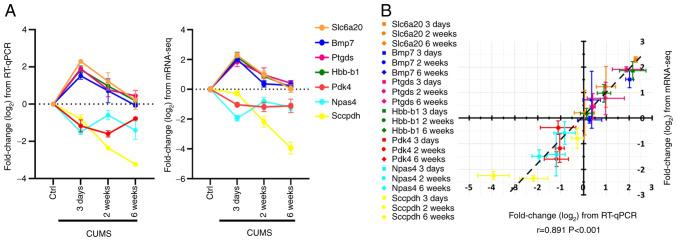
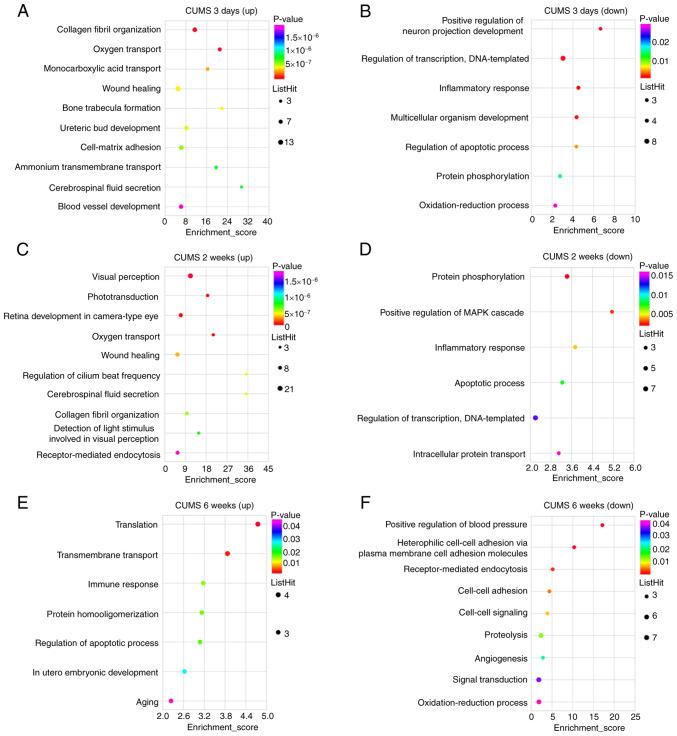
Stress causes extensive changes in hippocampal genomic expression, leading to changes in hippocampal structure and function. The dynamic changes in hippocampal gene expression caused by stress of different durations are still unknown. mRNA sequencing was used to analyze the hippocampal transcriptome of rats subjected to chronic unpredictable mild stress (CUMS) of different durations. Compared with the control, 501, 442 and 235 differentially expressed genes (DEGs) were detected in the hippocampus of rats subjected to CUMS for 3 days and 2 and 6 weeks, respectively. Gene Ontology (GO) analysis was used to determine the potential mechanism underlying the dynamic harmful effects of stress on the hippocampus; Certain GO terms of the down‑regulated DEGs in CUMS (3 days) rats were also found in the up‑regulated DEGs in CUMS (6 weeks) rats. These results showed opposing regulation patterns of DEGs between CUMS at 3 days and 6 weeks, which suggested a functional change from adaptation to damage in during the early and late stages of chronic stress. GO analysis for upregulated genes in rats subjected to CUMS for 3 days and 2 weeks suggested significant changes in 'extracellular matrix' and 'wound healing'. Upregulated genes in rats subjected to CUMS for 2 weeks were involved in changes associated with visual function. GO analysis of DEGs in rats subjected to CUMS for 6 weeks revealed increased expression of genes associated with 'apoptotic process' and 'aging' and decreased expression of those associated with inhibition of cell proliferation and cell structure. These results suggest that the early and middle stages of chronic stress primarily promote adaptive regulation and damage repair in the organism, while the late stage of chronic stress leads to damage in the hippocampus.
压力会引起海马基因组表达的广泛变化,导致海马结构和功能的改变。不同持续时间的应激引起的海马基因表达的动态变化尚不清楚。采用 mRNA 测序分析了不同持续时间慢性不可预测轻度应激(CUMS)大鼠海马转录组。与对照组相比,CUMS 3 天、2 周和 6 周大鼠海马中分别检测到 501、442 和 235 个差异表达基因(DEGs)。GO 分析用于确定应激对海马产生动态有害影响的潜在机制;在 CUMS(3 天)大鼠下调的 DEGs 的某些 GO 术语也在 CUMS(6 周)大鼠上调的 DEGs 中发现。这些结果表明,CUMS 3 天和 6 周之间 DEGs 的表达模式相反,这表明在慢性应激的早期和晚期,从适应到损伤的功能发生了变化。对 CUMS 3 天和 2 周大鼠上调基因的 GO 分析表明,“细胞外基质”和“伤口愈合”发生了显著变化。CUMS 2 周大鼠上调的基因与与视觉功能变化相关。对 CUMS 6 周大鼠 DEGs 的 GO 分析表明,与“凋亡过程”和“衰老”相关的基因表达增加,与细胞增殖和细胞结构抑制相关的基因表达减少。这些结果表明,慢性应激的早期和中期主要促进机体的适应性调节和损伤修复,而慢性应激的晚期则导致海马损伤。


 Zotero 插件