
严重急性呼吸综合征冠状病毒 2 的传染性和致病性:二次攻击率和无症状感染的系统评价和荟萃分析。
Transmissibility and pathogenicity of the severe acute respiratory syndrome coronavirus 2: A systematic review and meta-analysis of secondary attack rate and asymptomatic infection.
机构信息
Department of Epidemiology and Health Statistics, School of Public Health, Southeast University, Nanjing 210009, China; Key Laboratory of Environmental Medicine Engineering, Ministry of Education, School of Public Health, Southeast University, Nanjing 210009, China.
Jiangsu Center of Disease Control and Prevention, Nanjing 210009, China.
出版信息
J Infect Public Health. 2022 Mar;15(3):297-306. doi: 10.1016/j.jiph.2022.01.015. Epub 2022 Jan 31.
BACKGROUND
Understanding the transmissibility and pathogenicity of the severe acute respiratory syndrome coronavirus 2 (SARS-CoV-2) is crucial for control policies, but evidence remains limited.
METHODS
We presented a systematic and meta-analytic summary concerning the transmissibility and pathogenicity of COVID-19.
RESULTS
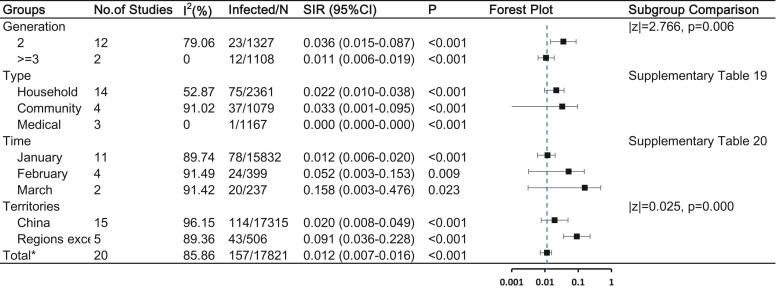
A total of 105 studies were identified, with 35042 infected cases and 897912 close contacts. 48.6% (51/105) of studies on secondary transmissions were from China. We estimated a total SIR of 7.8% (95% confidence interval [CI], 6.8%-8.8%), SAR of 6.6% (95% CI, 5.7%-7.5%), and symptomatic infection ratio of 86.9% (95%CI, 83.9%-89.9%) with a disease series interval of 5.84 (95%CI, 4.92-6.94) days. Household contacts had a higher risk of both symptomatic and asymptomatic infection, and transmission was driven between index cases and second-generation cases, with little transmission occurring in second-to-later-generation cases (SIR, 12.4% vs. 3.6%). The symptomatic infection ratio was not significantly different in terms of infection time, generation, type of contact, and index cases.
CONCLUSIONS
Our results suggest a higher risk of infection among household contacts. Transmissibility decreased with generations during the intervention. Pathogenicity of SARS-CoV-2 varied among territories, but didn't change over time. Strict isolation and medical observation measures should be implemented.
背景
了解严重急性呼吸综合征冠状病毒 2(SARS-CoV-2)的传染性和致病性对于控制政策至关重要,但证据仍然有限。
方法
我们提出了一个关于 COVID-19 传染性和致病性的系统和荟萃分析总结。
结果
共确定了 105 项研究,涉及 35042 例感染病例和 897912 名密切接触者。48.6%(51/105)的二次传播研究来自中国。我们估计总 SIR 为 7.8%(95%置信区间[CI],6.8%-8.8%),SAR 为 6.6%(95%CI,5.7%-7.5%),症状感染比例为 86.9%(95%CI,83.9%-89.9%),疾病系列间隔为 5.84(95%CI,4.92-6.94)天。家庭接触者有较高的症状和无症状感染风险,传播发生在指数病例和第二代病例之间,第二代以后的病例传播很少(SIR,12.4%对 3.6%)。症状感染比例在感染时间、代际、接触类型和指数病例方面没有显著差异。
结论
我们的结果表明家庭接触者感染的风险较高。在干预过程中,传染性随代际而降低。SARS-CoV-2 的致病性在不同地区有所不同,但随着时间的推移没有变化。应实施严格的隔离和医学观察措施。


 Zotero 插件